






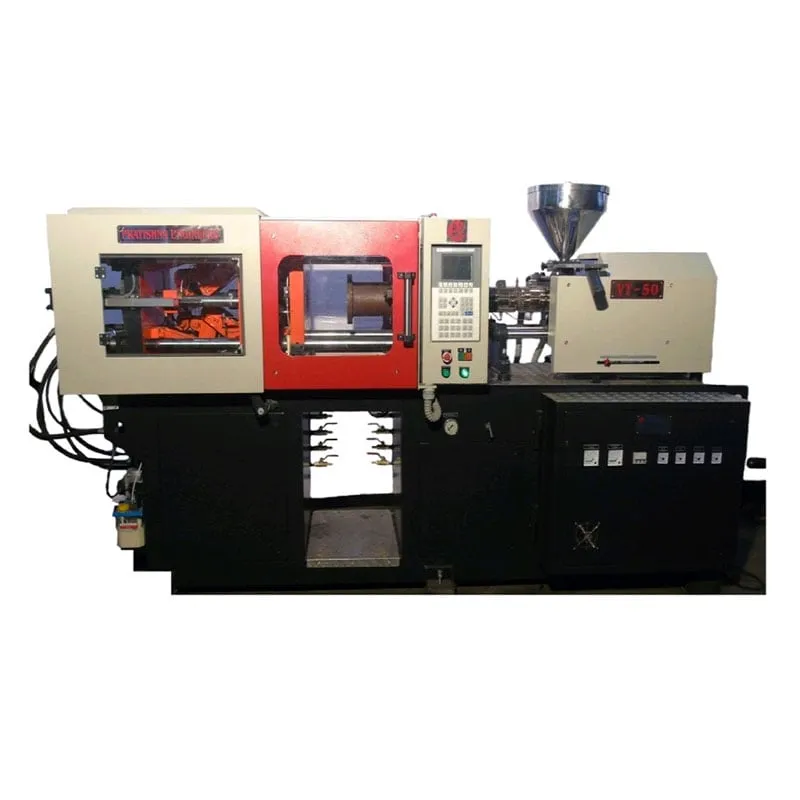

Industrial injection moulding machines in Mumbai that run round the clock need four things a single-shift machine can get away without: a stiff frame and platens sized for the mould, hydraulics that hold oil temperature and cleanliness, cooling water sized for the hottest month, and a maintenance schedule that is actually followed. Buy for continuous duty, not for the trial run.
On a three-shift line, a stoppage costs output from every shift it spans, so weaknesses that a day-shift plant might never notice can surface within weeks. This guide covers what to check under each of the four headings, what to ask a supplier, and how to size the clamp and mould before you sign.
Key Takeaways
- Size the clamp to the mould with a modest reserve; running far above or below what the mould needs stresses the frame, platens and tie bars.
- On continuous duty, oil temperature and cleanliness decide valve life and repeatability, so check the cooler, filtration and tank before the clamp rating.
- Cooling water capacity must match the hottest month, because every machine and mould on the line draws from the same tower or chiller.
- A written maintenance schedule with logged energy and cycle data catches screw wear and leaks before they stop a three-shift line.
What should industrial injection moulding machines in Mumbai have for 24-hour duty?
They need a frame and platens that stay parallel under repeated full clamping, hydraulics that hold oil temperature through a hot afternoon, enough cooling water for every mould on the line, and a supplier who stocks wear parts locally. Rated tonnage alone tells you little about continuous duty.
Start with the questions a catalogue does not answer. How thick are the platens relative to the tie-bar spacing? Is toggle lubrication centralised and automatic, with a low-level alarm? What filtration does the hydraulic circuit carry, and how is filter condition shown to the operator?
Then ask about the injection side. Screw and barrel metallurgy should suit your material and any glass fill or regrind. Heater bands and thermocouples should be easy to reach, because on a 24-hour line they will be replaced during short stops, often at night.
Finally, look at the electrics. Panel cooling, contactor ratings and cable sizing that are fine on one shift can run hot on three. Ask what ambient temperature the panel is designed for, and whether it has forced ventilation or an air conditioner.
Single-shift vs round-the-clock: what to check on the machine
| Area | What to ask | Why it matters on three shifts |
|---|---|---|
| Frame and platens | Platen thickness, tie-bar size, parallelism at installation | Repeated full clamping shows up as flash and parting-line wear |
| Hydraulics | Oil cooler size, tank volume, filtration, oil test interval | Hot or dirty oil drifts the process and wears valves |
| Cooling water | Flow per machine, separate oil and mould circuits | One starved circuit stretches the cycle on that machine |
| Electrics | Panel design ambient, ventilation, contactor ratings | Panels that run hot trip in the afternoon |
| Spares | Local stock of wear parts and seal kits | A small missing part can stop all three shifts |
How do you size the frame and clamp so the machine lasts?
Size clamp force from the mould's projected area and the material, then add a modest reserve. Too little clamp flashes parts; far too much, applied every cycle, can crack cylinder mounting plates, deform platens and in severe cases fracture the frame. The mould must also cover the platen properly.
The working method is the one set out in a Plastics Technology article on clamp tonnage: projected area of the part, times cavities, plus the cold runner area, times a tonnage factor for the material and flow length. A 10% reserve on top is a starting margin, not a rule. The worked example below runs the numbers.
Mould size matters as much as tonnage. A Plastics Technology guide on mounting moulds gives a rule of thumb that the mould should cover at least 70% of the distance between the tie bars. Smaller moulds let the platens bow under clamp, which flashes the centre of the mould and, with very small moulds, can damage the platens.
On a toggle machine, also check how die height is set. If the mould is closed and adjusted cold, it can over-clamp as the steel warms and expands through the first hour of running. Set and check tonnage at working temperature, and log the figure.
How do hydraulics and cooling hold up on three shifts?
They hold up when the oil stays clean and within its design temperature, and when cooling water reaches every machine at the flow it needs. Many continuous-duty problems, from drifting cycle times to sticking valves, can be traced back to hot or dirty oil and starved cooling circuits.
Ask how the filtration is arranged: suction strainer, return-line filter, and whether there is an offline or kidney-loop filter for the tank. Ask for the oil cleanliness the valve maker specifies and how often the oil should be tested. Then put the test date in the maintenance calendar, not in someone's memory.
Cooling is a plant decision as much as a machine one. The ExxonMobil energy guide estimates that raising chilled water temperature by 1 °C cuts chiller running cost by about 3%, so do not run every mould colder than its part needs. Separate the oil cooler circuit from mould cooling where you can, so one does not starve the other.
Plan the tower or chiller for the hottest month, with every machine on the line running. Scale in cooling lines cuts flow slowly, so fit flow indicators or at least measure return temperature on each machine every week. A rising return temperature on one machine is the early warning.
What maintenance schedule keeps an industrial machine running?
A schedule built from daily, weekly, monthly and annual checks, written against each machine and signed off. Daily checks cover oil level, temperature, leaks and lubrication. Weekly and monthly checks cover filters, heater bands, cooling flow and safety interlocks. Annual work covers platen parallelism, screw wear and oil analysis.
Parallelism is worth measuring, not assuming. A MoldMaking Technology guide on machine sizing gives 0.025 to 0.05 mm as generally acceptable platen level and parallelism for machines under 500 t. Measure at installation, record the figure, and recheck it at each annual shutdown so you see the trend.
Energy logging doubles as condition monitoring. Ray Kent's PlasticsToday article notes that rising energy on the same job can point to screw or barrel wear. Log kWh per kg on your main jobs every month; a steady climb tells you to pull the screw before parts start to fail.
Read the bill at the same time. MERC issued a fresh order on MSEDCL's tariff petition on 25 March 2026, after court challenges to an earlier review order, so use the rates on your latest bill when you work out what a third shift adds.
Our flat view: on a 24-hour line, keep a spare screw tip and check ring, heater bands, thermocouples and the main hydraulic seal kits on the shelf. Waiting for a courier on a small wear part loses three shifts of output.
What Pratishna Engineers builds for continuous production
Pratishna Engineers was founded in Mumbai in 1991 and has supplied 9,000+ machines to 1,000+ customers in India and international markets. Its manufacturing facilities in Mumbai cover about 25,000 sq ft, with CNC turning centres, vertical and horizontal machining centres, jig boring machines, and assembly and testing facilities.
An independent QA department works to written SOPs, using accredited external labs when required. For heavier work, the horizontal C and H series and the two-platen PHM series cover the tonnages below, quoted as listed in the series data.
- C series from C-140 at 125 t to C-320 at 320 t mould clamping force; H series from VT-120 at 120 t to VT-350 at 320 t.
- PHM two-platen series from PHM-160 at 160 t to PHM-350 at 350 t mould clamping force.
What should you send before you order a machine for continuous duty?
Send the part drawing, material, mould dimensions and weight, cavities, target output per day and the shifts you plan to run. Add your cooling water arrangement and available power. With that, the machine can be sized for duty rather than for a trial. See the injection moulding machine range.
Frequently Asked Questions About Industrial Injection Moulding Machines
Can a standard machine run three shifts?
Many can, if the mould suits the machine and the hydraulics, cooling and electrics were sized for continuous running. The weak points show up as hot oil, drifting cycles, panel trips and faster wear of heater bands and seals. Ask the supplier what duty the machine was designed and tested for.
What spares should a three-shift plant keep on the shelf?
At a minimum: screw tip and check ring, heater bands, thermocouples, the main hydraulic seal kits, filter elements, proximity switches and a spare solenoid coil for the most-used valves. Agree the list with the supplier at order stage, and check what they stock locally against what must come from elsewhere.
Is a bigger machine safer for continuous duty?
No. A machine far larger than the mould needs can leave the mould below the minimum size for its platens, which bows them and flashes parts. It also carries a higher base load. Size the clamp to the mould with a modest reserve and choose a stiff machine of the right size.
How often should hydraulic oil be tested?
Follow the oil and valve makers' guidance and the condition you find. A practical approach is to test on a fixed calendar and also after any major leak, pump repair or overheating event. Track cleanliness, water content and viscosity on the same machine over time; the trend tells you more than one result.
Does a two-platen machine suit round-the-clock production?
It can, especially for large moulds, where a two-platen design keeps overall machine length down. The same continuous-duty checks apply: oil temperature, filtration, lubrication of locking parts and cooling. Judge it on your mould dimensions, weight and opening stroke, not on clamp tonnage alone.
What can Pratishna supply for continuous production?
Pratishna Engineers builds horizontal C and H series machines from 120 t to 320 t and PHM two-platen machines from 160 t to 350 t, with design, manufacturing, testing and service in-house. Send your part, mould and shift plan and the team will size the machine for duty.
Related Articles
- Servo-Driven Injection Moulding Machine in Mumbai
- The Role of Vertical Injection Moulding Machines in Footwear Manufacturing
- Horizontal Injection Moulding Machines: Maximizing Production Efficiency
- PHM series Two Platen Injection Molding Machine: An Overview
Sources & References
- Plastics Technology, J. Williams (RJG): Clamp Tonnage: More Is Better...Right? (May 2017)
- Plastics Technology, P. Witaszek, J. Klees, J. Fattori, E. Di Siro, J. Bozzelli: How to Mount an Injection Mold (June 2017)
- MoldMaking Technology, B. Catoen: Machine Sizing and Specification for Optimal Mold Performance, Part 1 (Aug 2025)
- Deccan Chamber of Commerce, Industries and Agriculture, Pune: Circular No. 085: MERC Order dated 25 March 2026 (27 Mar 2026)
Technical Disclaimer
Disclaimer: The information provided in this document is for general informational and educational purposes only. It is based on technical references and industry information available at the time of preparation and may be subject to change. It does not constitute engineering, technical, commercial or professional advice, nor does it constitute a quotation, specification, warranty or contractual commitment by Pratishna Engineers.
Actual injection moulding machine and process requirements vary according to the component design, material, mould, production volume, machine configuration and operating conditions. The information, examples, calculations and recommendations provided should be independently evaluated and verified for the specific application before making any equipment, process or production decision. Information obtained from third-party sources remains subject to the accuracy and limitations of those sources.
Limitation of Liability: Pratishna Engineers makes no representation or warranty, express or implied, regarding the completeness, accuracy or suitability of the information for any particular application. To the extent permitted by applicable law, Pratishna Engineers shall not be liable for any loss, damage, cost or consequence arising from reliance on or use of the information contained in this document. Final machine selection, configuration and application suitability should be confirmed with Pratishna Engineers based on complete and accurate project requirements.

