






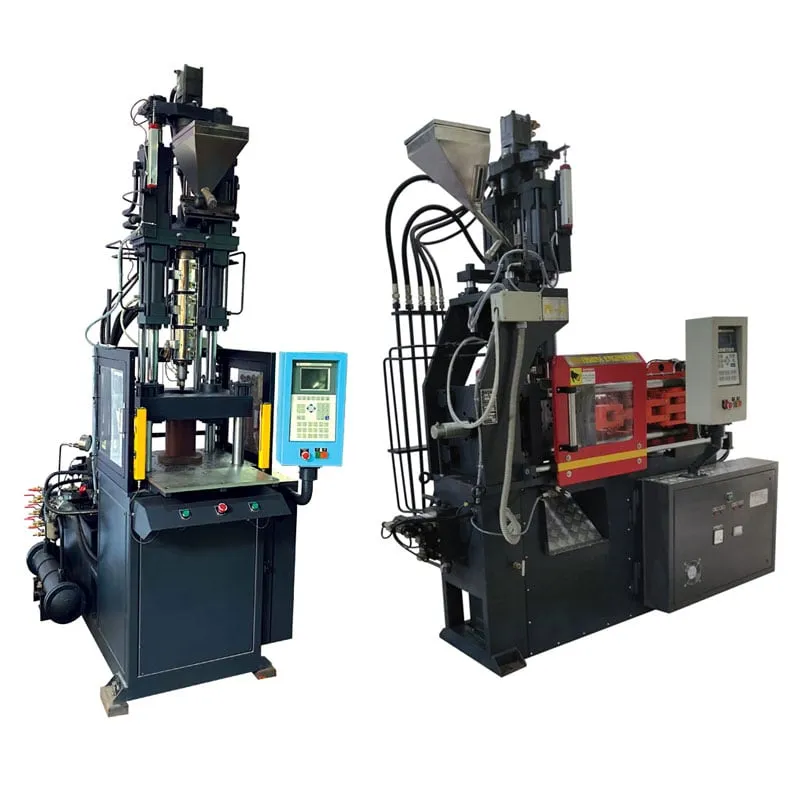

Vertical injection moulding machine for footwear: which parts fit
| Footwear part | Why a vertical machine | Table or loading need |
|---|---|---|
| Straps with moulded-on details | Strap laid flat stays put by gravity | Shuttle or rotary table so loading overlaps moulding |
| Buckles, eyelets and trims with metal inserts | Inserts sit on core pins without falling out | Insert check before the mould closes |
| Heel tips and small sole components | Short shot, compact mould, modest clamp | Fixed table often enough at low volume |
| Logos and badges moulded onto finished parts | Part held face-up in a nest | One nest per style, quick change |
A vertical injection moulding machine for footwear earns its place where something must be placed in the mould by hand or robot: a strap, a fabric piece, a buckle or a metal eyelet. Gravity holds the insert, and a shuttle or rotary table lets the operator load one station while the other moulds.
Complete unit soles moulded onto uppers are normally made on dedicated sole moulding machines, which are a separate class of equipment.
Key Takeaways
- Vertical machines suit footwear parts that carry an insert or a fabric piece, because gravity keeps the insert in place while the mould closes.
- A shuttle or rotary table pays when loading is a large share of the cycle; with fast loading, a fixed table is simpler and needs less tooling.
- PVC strap and sole compounds are heat sensitive, so screw design, purging and shutdown practice matter as much as clamp force.
- Many footwear products sold in India fall under BIS quality control orders, and PVC sandals and slippers now follow IS 6721:2023.
Which parts suit a vertical injection moulding machine for footwear?
Parts that carry something placed by hand: straps with moulded-on buckles, uppers with moulded logos or trims, eyelets, and heel tips with metal reinforcement. The vertical clamp keeps the insert sitting where it was put, and the open top gives the operator a clear view of every nest.
Horizontal machines can do some of this work, but an insert placed in a horizontal mould has to be held against gravity by magnets, pins or vacuum. Fabric and strap material is the hardest case: it sags, shifts as the mould closes and ends up under the parting line, which crushes it or flashes the part.
Full unit soles are another matter. ISO 20430, the international safety standard for injection moulding machines, excludes footwear sole and boot moulding machines from its scope, which tells you they are treated as a separate class. If your product is a complete sole moulded onto an upper, look at dedicated sole machines rather than a general vertical press.
Where vertical presses do fit, clamp force is usually modest because the parts are small. The constraint is rarely tonnage. It is how fast an operator can load inserts accurately, and whether the table lets that loading overlap the moulding time.
How do insert loading and rotary or shuttle tables change output?
On a fixed table, the mould sits open while the operator unloads and reloads it, so loading time adds onto the cycle. A shuttle or rotary table adds a second lower half, so loading overlaps moulding and the cycle approaches the longer of the two.
The usual shuttle arrangement, as a PlasticsToday report describes it, is one top half and two bottom halves, with the operator loading one bottom half while the press moulds the other. Its drawback is that the machine still waits for each part to cool in the clamp. A rotary table holds two or more lower halves and indexes them round.
The extra lower half is real tooling, and every style or size in a footwear range may need its own pair. That is why the table choice should follow the worked example below: loading time against moulding time, and how many styles you run.
Insert quality decides how far the table can help. Buckles with burrs, or straps cut to inconsistent width, slow every load and cause flash. Inspect inserts before they reach the machine, and give the operator a nest that only accepts the insert the right way round.
Our flat view: if loading takes more than half the moulding time, fit the shuttle table, because a fixed table at that point leaves the clamp waiting for much of the shift.
What do PVC and other footwear compounds need from the machine?
PVC compounds need a streamlined melt path with no dead spots, a low-compression screw in corrosion-resistant steel, and disciplined purging and shutdown. Softer compounds such as thermoplastic rubber are more forgiving, but every footwear material needs stable barrel temperatures and a shot that sits inside the barrel's working range.
The GEON injection moulding guide for rigid PVC formulations is a useful hardware reference. It recommends a screw compression ratio of about 2.2:1, stainless screws or triple-chromed 4140 steel, a sliding check ring rather than a ball check, and no segmented or vented barrels. Overheated PVC yellows and gives off HCl.
Shutdown practice matters on a footwear line, where styles and colours change often. The same guide says never to shut down with PVC in the barrel, to purge with natural general-purpose ABS, PS or acrylic regrind but never PE or PP, and never to let PVC and acetal meet at processing temperature.
Check shot size too. The guide suggests a PVC shot of 50% to 80% of barrel capacity, and warns that a low shot percentage on long cycles degrades the material. A small strap shot on a large barrel sits in the heat for many cycles, so do not buy the biggest screw on offer.
What should you prepare before choosing a vertical machine for footwear parts?
Write down each part, its insert or fabric piece, the material grade, the shot weight, the cavities per mould and the loading time measured on a mock-up. Add the number of styles and sizes you run. Those figures settle table type and clamp size. See the vertical injection moulding machine page.
Frequently Asked Questions About Vertical Machines for Footwear
Which BIS standards apply to PVC sandals and slippers?
According to BIS, PVC sandals earlier covered by IS 6721:1972 and rubber slippers earlier under IS 11544 now come under IS 6721:2023, Sandal and Slipper. Hawai chappals moved to IS 10702:2023. Certification is granted per manufacturing premises, so check the current order and licence scope with BIS before production.
Can a vertical machine mould a complete sole onto an upper?
Some small components can be moulded onto an upper on a vertical press, but complete unit soles usually need dedicated sole moulding machines with lasts and several stations. Those machines sit outside the scope of ISO 20430, so ask the builder which safety standard and guarding they apply.
Is a rotary table better than a shuttle table for footwear trims?
A rotary table suits cells where unloading, inspection and loading happen at separate positions, or where three or more lower halves are needed. A shuttle table is simpler with two halves. Choose by measured loading time, number of styles, floor space and the tooling needed for extra lower halves.
How do I stop fabric straps shifting when the mould closes?
Cut straps to a consistent width and length, locate them on pins or in a pocket in the lower half, and keep the fabric clear of the parting line. A light hold-down or vacuum in the nest helps with thin fabric. Trial the nest design before cutting the production mould.
How often should the barrel be purged on a footwear line?
Purge at every colour or material change and before any stop long enough for PVC to degrade in the barrel. Use a purge material the compound supplier approves, keep PE and PP out of it, and never let PVC meet acetal at processing temperature. Record each purge in the shift log.
Related Articles
- Servo-Driven Injection Moulding Machine in Mumbai
- Industrial Injection Moulding Machines in Mumbai
- Vertical Injection Moulding Machines: Innovating Manufacturing
- Vertical Locking Vertical Injection Sliding Double Station Machines
Sources & References
- Bureau of Indian Standards (BIS Blog): Footwear QCOs: All you need to know (July 2023)
- ISO: ISO 20430:2020 Plastics and rubber machines: Injection moulding machines: Safety requirements
- PlasticsToday: Shuttle table increases production (Aug 2008)
- GEON Performance Solutions: Injection Molding Guide: GEON PVC Molding Formulations (PG0019BC, 2021)
Technical Disclaimer
Disclaimer: The information provided in this document is for general informational and educational purposes only. It is based on technical references and industry information available at the time of preparation and may be subject to change. It does not constitute engineering, technical, commercial or professional advice, nor does it constitute a quotation, specification, warranty or contractual commitment by Pratishna Engineers.
Actual injection moulding machine and process requirements vary according to the component design, material, mould, production volume, machine configuration and operating conditions. The information, examples, calculations and recommendations provided should be independently evaluated and verified for the specific application before making any equipment, process or production decision. Information obtained from third-party sources remains subject to the accuracy and limitations of those sources.
Limitation of Liability: Pratishna Engineers makes no representation or warranty, express or implied, regarding the completeness, accuracy or suitability of the information for any particular application. To the extent permitted by applicable law, Pratishna Engineers shall not be liable for any loss, damage, cost or consequence arising from reliance on or use of the information contained in this document. Final machine selection, configuration and application suitability should be confirmed with Pratishna Engineers based on complete and accurate project requirements.

