






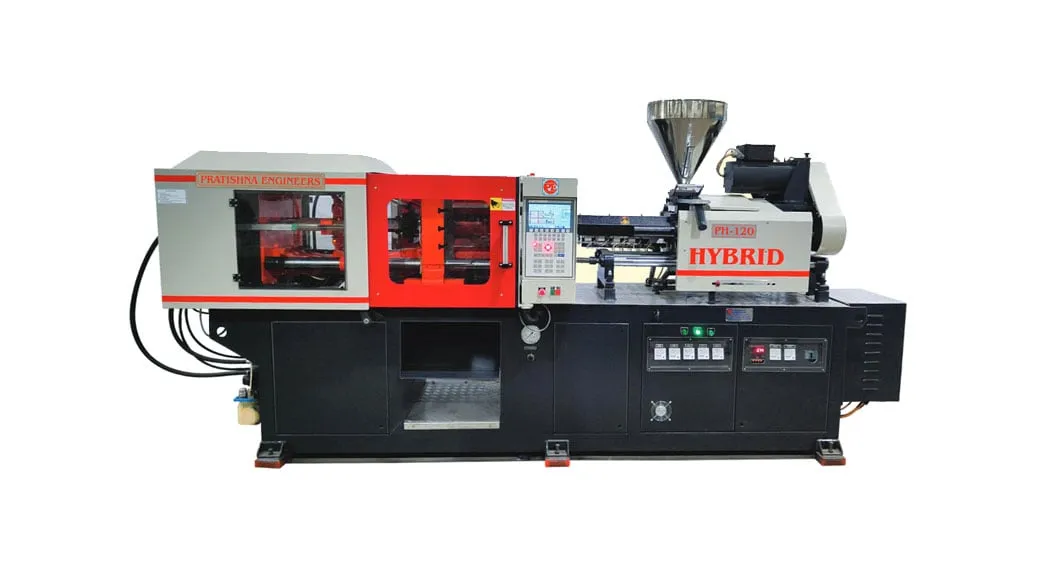

The quick answer: an injection moulding machine for plastic pallets is sized by three numbers. The projected area of the deck sets clamp tonnage, the weight of the whole pallet sets the barrel and injection unit, and pallet height plus mould height sets the opening. A 1,200 × 1,000 mm deck with half its area open works out to about 1,855 to 2,785 t at PP tonnage factors 2 to 3, which is where two-platen clamps become worth comparing. If you mould in recycled PP, the runner system and residence time need as much attention as tonnage.
Key Takeaways
- Deck projected area after subtracting openings sets the clamp, and the pallet weight has almost no bearing on the tonnage you need.
- Barrels are rated in grams of polystyrene, and the same melt volume of PP weighs about 22% less, so convert before you compare.
- Opening stroke should be at least 2.5 times the part height, and on a two-platen clamp the available stroke falls as mould height rises.
- Recycled PP needs cold runners or larger gates, good venting, lower melt temperatures and residence kept within about 5 minutes.
How much clamp does an injection moulding machine for plastic pallets need?
Clamp follows the deck's projected area. Take the pallet outline seen along the injection axis, subtract the openings that pass right through, add any cold runner, and multiply by a PP tonnage factor of about 2 to 3 US tons per square inch, plus a reserve.
Clamp for single-cavity PP pallet decks, 10% reserve added (calculated)
| Deck and open share | Projected area | Factor 2 (0.281 t/cm²) | Factor 3 (0.422 t/cm²) |
|---|---|---|---|
| 800 × 600 mm, 40% open | 2,880 cm² | 890 t | 1,337 t |
| 1,200 × 800 mm, 50% open | 4,800 cm² | 1,484 t | 2,228 t |
| 1,200 × 1,000 mm, 50% open | 6,000 cm² | 1,855 t | 2,785 t |
| 1,100 × 1,100 mm, 50% open | 6,050 cm² | 1,870 t | 2,808 t |
Feet, stringers and edge walls hang below the deck, inside its outline, so they add depth and weight but no projected area. The 10% reserve is a starting margin, not a rule. If the upper figure exceeds a machine and the lower one fits, a flow analysis and a trial should decide.
Over-clamping a tool this size is costly. Plastics Technology lists crushed vents and a rolled parting line among its effects, and SPE Plastics Engineering notes that excess clamp can deform platens and crack the machine frame.
How do you size the shot and injection unit for a pallet?
Convert the full shot weight to melt volume using a PP melt density of about 0.74 g/cm³, add 10% for check valve leakage, then pick a barrel where that volume uses no more than about 65% of its capacity. Machine shot ratings in grams of PS must be converted first.
Plastics Technology gives PS melt density as 0.945 g/cm³, so a barrel rated in PS grams holds about 22% less PP by weight. A pallet shot of many kilograms needs a barrel rated well above the pallet weight. Our flat opinion: never size a pallet machine on its PS rating without this conversion.
Fill matters as much as volume. A wide deck has long flow paths, and the screw size trades pressure against volume: on the same injection unit, volume rises and pressure falls with the square of the screw diameter. Check both the shot volume and the pressure your flow length needs.
Recovery must also fit inside cooling. Thick feet and stringers cool slowly, because cooling time rises with the square of wall thickness, so a heavy pallet often gives the screw time to recover. Check it on the trial rather than assume it, since a large screw at high back pressure can still run late.
When does a two-platen machine suit pallet moulding?
A two-platen clamp suits pallets when the machine must carry a large, heavy mould and a long opening without the length of a toggle machine. Two-platen designs lock the moving platen and apply tonnage through short-stroke cylinders, and most reduce overall machine length.
Opening is the next check. MoldMaking Technology advises an opening stroke of at least 2.5 times the part height. On a two-platen or piston clamp, the available stroke falls as mould height rises and peaks only at minimum mould height, so a tall pallet mould eats into the opening you have.
Mould weight must sit within the rating for both platens, and the platens must stay level and parallel under that load. Ask for the maximum mould weight per platen and the daylight in writing, then check them against your mould maker's drawing.
Ejection is the other check. A deep deck with many ribs needs ejector area spread across the part, and the ejector stroke must push the deepest feature clear of the core before a robot or operator can lift the pallet out.
What changes when you mould pallets in recycled PP?
Recycled PP is less consistent than virgin resin in pellet shape, properties and processability, and it can carry small metal pieces and volatiles. The machine and mould need cold runners or larger gates, good venting, lower melt temperatures and tight control of residence time.
Entec Polymers' guidance for post-industrial recycled PP compounds advises against hot runners, since small metal fragments can plug hot tips. It puts typical melt at about 199 to 227 °C, with a maximum near 238 °C, against up to 260 °C for virgin PP, and limits residence to 5 minutes.
Rough residence equals barrel swept volume divided by shot volume, times the cycle. A barrel holding three shots on a 90 second cycle gives about 4.5 minutes. For virgin or blended runs, Reliance lists its Repol C080MA and C120MN impact copolymers for industrial components.
What should you send before sizing a pallet machine?
Send the pallet drawing with deck size, open area, height and target weight, plus the resin, including any recycled share, and your output per day. Those numbers fix the clamp, barrel and opening before anyone discusses a machine model. See material handling moulding solutions.
Frequently Asked Questions About Moulding Plastic Pallets
How is pallet projected area different from its footprint?
The footprint is the full outline, such as 1,200 × 1,000 mm. Projected area is that outline minus every opening that passes right through the deck, as seen along the injection axis. A deck that is half open has half the projected area of its footprint, and the clamp is sized on that smaller figure.
Does a heavier pallet always need a bigger clamp?
No. Clamp follows projected area, not weight. A pallet with deeper feet or thicker stringers gets heavier without adding projected area, so it needs a bigger barrel and a longer cycle but not more tonnage. Weight drives the injection unit; deck area and openings drive the clamp.
Can a toggle machine mould pallets?
It can if the tonnage, platen size, tie bar gap and opening stroke all cover the mould. On a toggle, full stroke is available at every mould height, which helps tall tools. The trade-off at large tonnage is machine length and floor space, which is where two-platen designs are usually compared.
How long can recycled PP stay in the barrel?
Entec Polymers' guidance for post-industrial recycled PP compounds limits residence to 5 minutes and advises reducing melt temperature if it runs longer. Estimate residence as barrel swept volume divided by shot volume, times the cycle. If degradation appears, the same guidance suggests adding antioxidant through a masterbatch.
How many pallets can one machine make per hour?
Output equals 3,600 divided by cycle time in seconds, times cavities, times the good-shot share. As an assumption only, a single-cavity mould on a 90 second cycle at 98% good shots gives about 39 pallets per hour. Your actual cycle depends on the thickest section and the mould cooling.
Related Articles
- Injection Moulding Machine for Construction Tiles
- Applications of Two-Platen Injection Moulding Machines in Large-Scale Projects
- Types of Injection Moulding Machines
Sources & References
- Plastics Technology, J. Williams (RJG): Clamp Tonnage: More Is Better...Right?
- Plastics Technology, J. Bozzelli: A Simpler Way to Calculate Shot Size vs. Barrel Capacity
- MoldMaking Technology, B. Catoen: Machine Sizing and Specification for Optimal Mold Performance, Part 1
- Entec Polymers: Processing ECHO Post-Industrial Recycled Polypropylene Compounds
Technical Disclaimer
Disclaimer: The information provided in this document is for general informational and educational purposes only. It is based on technical references and industry information available at the time of preparation and may be subject to change. It does not constitute engineering, technical, commercial or professional advice, nor does it constitute a quotation, specification, warranty or contractual commitment by Pratishna Engineers.
Actual injection moulding machine and process requirements vary according to the component design, material, mould, production volume, machine configuration and operating conditions. The information, examples, calculations and recommendations provided should be independently evaluated and verified for the specific application before making any equipment, process or production decision. Information obtained from third-party sources remains subject to the accuracy and limitations of those sources.
Limitation of Liability: Pratishna Engineers makes no representation or warranty, express or implied, regarding the completeness, accuracy or suitability of the information for any particular application. To the extent permitted by applicable law, Pratishna Engineers shall not be liable for any loss, damage, cost or consequence arising from reliance on or use of the information contained in this document. Final machine selection, configuration and application suitability should be confirmed with Pratishna Engineers based on complete and accurate project requirements.

