






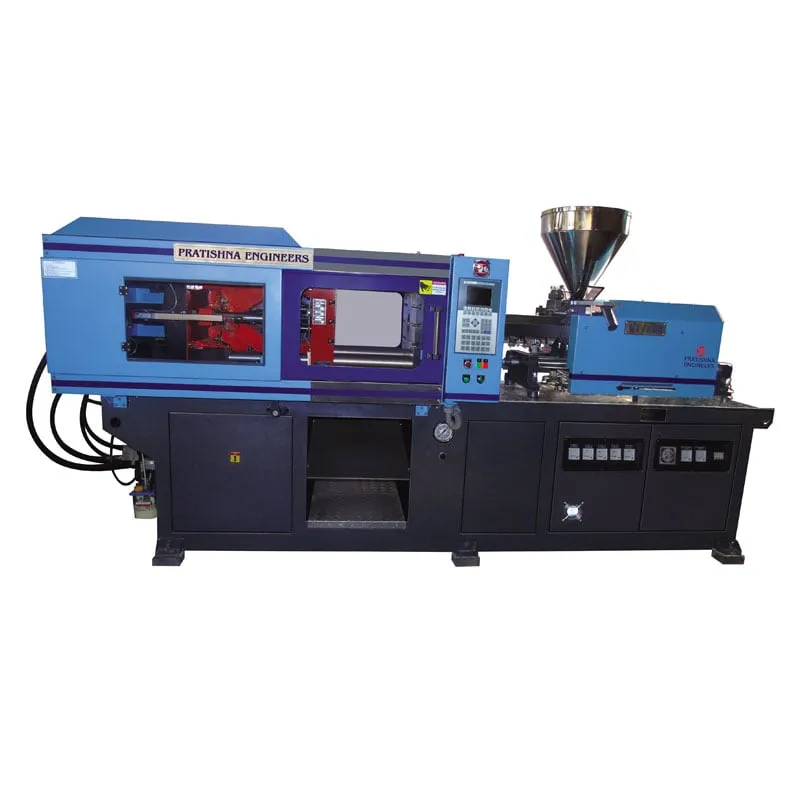

Two platen moulding machine applications are the large, heavy or deep parts: crates, bins and dustbins, table tops, chair shells and pallets. These parts need a big clamp, wide space between the tie bars and a long mould opening, all in one machine. A two-platen clamp locks the moving platen with nuts on the tie bars and builds tonnage with short-stroke cylinders, so the machine is usually shorter than a toggle of similar force. Its usable opening is the daylight minus the mould height. Choose it when the part demands that combination.
Key Takeaways
- Two-platen machines suit parts that need high clamp force, wide tie-bar spacing and a long opening together, such as crates, bins, table tops and pallets.
- Size clamp from the projected area after deducting through openings, times a tonnage factor; PP commonly sits at 2 to 3 US tons per square inch.
- On a two-platen clamp the usable opening shrinks as the mould gets taller, so tall bins are often limited by daylight before tonnage.
- Large PP parts often run recycled material, which favours cold runners, larger gates and good venting over hot runner systems with small tips.
Which large parts suit two platen moulding machine applications?
Parts with a large projected area, a deep draw or a heavy mould suit two-platen machines. Crates, dustbins, laundry baskets, table tops and pallets are typical, because each needs high clamp force, a wide mould space and a long opening stroke in one machine.
Clamp needed for typical large PP parts (factor 2 to 3 US t/in², 10% reserve)
| Part (assumed size) | Projected area | Clamp range |
|---|---|---|
| Crate 450 × 300 mm, base 40% open | 810 cm² | 250 to 376 t |
| Crate 600 × 400 mm, base 50% open | 1,200 cm² | 371 to 557 t |
| Round dustbin, 350 mm rim | 962 cm² | 297 to 447 t |
| Table top | 1,600 cm² | 495 to 743 t |
| Table top | 2,025 cm² | 626 to 940 t |
| Solid pallet deck | 2,400 cm² | 742 to 1,114 t |
The figures come from one method. Take the projected area of the part, deduct openings that pass through it in the clamp direction, multiply by a tonnage factor and add a reserve. The 10% reserve used here is a starting margin, not a rule.
Pallets show why the machine must match the part. A solid deck of 2,400 cm² needs roughly 742 to 1,114 t, and the shot is heavy too. PP melt weighs about 22% less than PS for the same volume, so a 1.5 kg PP part needs a barrel rated about 3,240 g of PS.
Resin choice follows the part. Reliance's Repol listing on UL Prospector names impact copolymer grades such as B030MG and MI3530 for crates and furniture, and C080MA and C120MN for paint pails and luggage. Take melt and mould temperatures from the supplier's current data sheet before the first trial.
How do you size clamp force for crates, bins and table tops?
Multiply the projected area of every cavity, plus any cold runner, by a tonnage factor for the resin, then add a reserve. For PP the factor is commonly 2 to 3 US tons per square inch, about 0.281 to 0.422 t/cm², higher for thin walls or long flows.
A Plastics Technology article on clamp tonnage recommends 3 tons per square inch as a starting point and lists what moves the factor: melt flow, flow length, wall thickness, gate size, gate location and number of gates. A table top filled from a single central gate has a long flow and sits toward the top of the range.
Crates need care with the deduction. Only openings in the base reduce projected area, because they pass through the part in the clamp direction. Windows in the side walls run parallel to the clamp and never counted in the first place. Measure the base outline, subtract the base openings, and the estimate stays honest.
Do not oversize to be safe. Excess clamp crushes vents, can damage the mould and, in one case reported in Plastics Technology, split a cavity block. Too small a mould on a big platen also lets the platens bow, and a common rule of thumb is that the mould should cover at least 70% of the tie-bar gap.
Why does mould opening decide the machine for tall bins and dustbins?
A tall part needs the mould to open at least about 2.5 times the part height to eject cleanly. On a two-platen machine the opening equals maximum daylight minus mould height, so a taller mould leaves less stroke, and tall bins often hit the opening limit first.
The two clamp types behave differently. On a toggle, the full stroke is available at every shut height. On a two-platen or other piston clamp, the maximum stroke is reached only at minimum shut height and falls as the mould gets taller, according to a MoldMaking Technology sizing guide.
Work it through with numbers. If the mould is the part height plus a 260 mm allowance and the opening must be 2.5 times the part height, the daylight needed is 3.5 times the part height plus 260 mm. With 1,500 mm of daylight, the tallest part is about 354 mm; a toggle with a 600 mm stroke reaches about 240 mm.
A flat view from the shop floor: for a tall bin, check the opening before the tonnage. A machine with enough clamp but too little opening forces a shorter part, a split mould design or a different machine. Check the maximum mould weight the platens can carry at the same time, because large-part moulds are heavy.
What should you send before choosing a machine for a large part?
Send the part drawing with its projected area and height, the resin grade, the mould dimensions and weight, and the target output. With those, clamp, opening, tie-bar space and shot can each be checked against a machine before any order. See the two-platen injection moulding machine page.
Frequently Asked Questions About Two-Platen Machine Applications
Can a toggle machine mould crates?
Yes, if its clamp, tie-bar space and opening all suit the crate. A toggle gives full stroke at every mould height. The limit for large crates is the combination: a high-tonnage toggle is long, and its mould space may not take the crate mould without moving to a bigger frame.
Do recycled PP pallets need a hot runner?
Not necessarily, and one compounder advises against it. Entec Polymers notes that small metal pieces can remain in recycled PP pellets and plug hot runner tips, and recommends cold runners, larger gates and good venting. It gives a typical melt of about 199 to 227 °C and a maximum residence of 5 minutes.
How much shot capacity does a large PP part need?
Work in volume, not weight. Machine shot ratings are usually in grams of PS, and PP melt is lighter, so convert first. Keep the shot within roughly 20% to 65% of barrel capacity, then add about 10% for check valve leakage and melt uniformity before choosing the barrel.
Why must the mould cover most of the platen?
A small mould on a large platen lets the platens bow under clamp, which can cause flash in the middle of the mould and, in extreme cases, platen damage. A rule of thumb from Plastics Technology is that the mould should cover at least 70% of the distance between the tie bars.
Which PP grades are used for moulded crates in India?
Reliance lists Repol impact copolymers such as B030MG and MI3530 for crates and furniture, and C080MA and C120MN for paint pails and luggage. Impact copolymers are chosen where parts must take knocks and drops. Confirm melt and mould temperatures from the current data sheet before the trial.
Related Articles
- How Horizontal Injection Moulding Machines Boost Efficiency in Manufacturing
- Applications of PV Series Plastic Injection Moulding Machines in Consumer Electronics
- Two-Platen Injection Moulding Machine Manufacturer in India
- PHM series Two Platen Injection Molding Machine: An Overview
Sources & References
- Plastics Technology, J. Williams (RJG): Clamp Tonnage: More Is Better...Right? (May 2017)
- MoldMaking Technology, B. Catoen: Machine Sizing and Specification for Optimal Mold Performance, Part 1 (Aug 2025)
- UL Prospector: Polypropylene (PP): REPOL grade listing
- Entec Polymers: Processing ECHO Post-Industrial Recycled Polypropylene Compounds
Technical Disclaimer
Disclaimer: The information provided in this document is for general informational and educational purposes only. It is based on technical references and industry information available at the time of preparation and may be subject to change. It does not constitute engineering, technical, commercial or professional advice, nor does it constitute a quotation, specification, warranty or contractual commitment by Pratishna Engineers.
Actual injection moulding machine and process requirements vary according to the component design, material, mould, production volume, machine configuration and operating conditions. The information, examples, calculations and recommendations provided should be independently evaluated and verified for the specific application before making any equipment, process or production decision. Information obtained from third-party sources remains subject to the accuracy and limitations of those sources.
Limitation of Liability: Pratishna Engineers makes no representation or warranty, express or implied, regarding the completeness, accuracy or suitability of the information for any particular application. To the extent permitted by applicable law, Pratishna Engineers shall not be liable for any loss, damage, cost or consequence arising from reliance on or use of the information contained in this document. Final machine selection, configuration and application suitability should be confirmed with Pratishna Engineers based on complete and accurate project requirements.

