






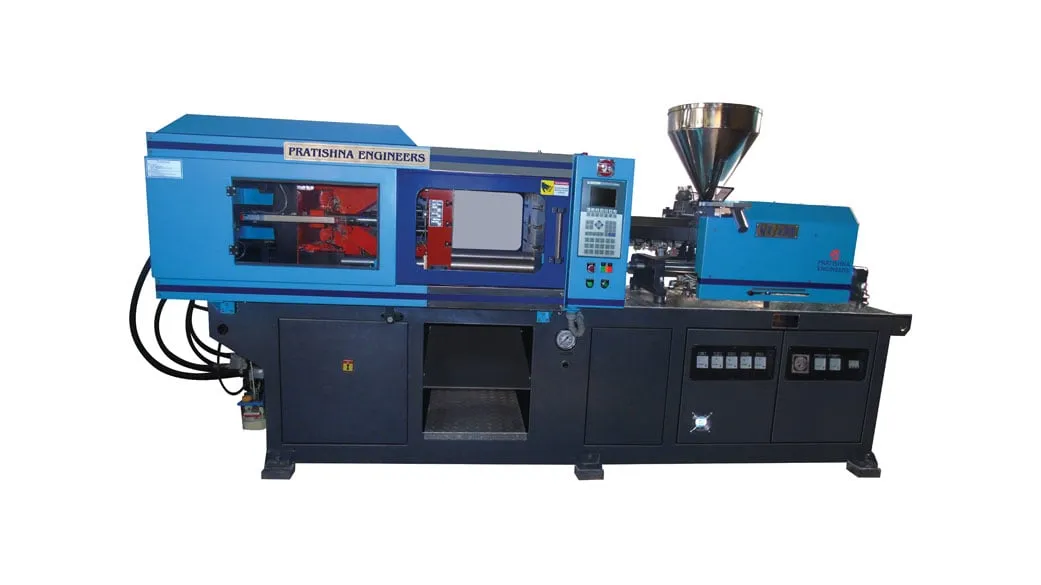

Two weeks into a new contract, the mould runs, but the shot uses a small share of the barrel and the recycled PP has started to streak. You call the seller and ask for a smaller screw. A trader has to ask someone else. Among moulding machine manufacturers in Mumbai, one with its own design office and machine shop can answer from drawings it owns. That difference, who holds the drawings and does the machining, is what this guide is about. Pratishna Engineers designs, machines, assembles and tests its machines in Mumbai, so we use our own works as the reference throughout.
Key Takeaways
- A manufacturer owns the drawings, so screw, barrel, platen and hydraulic changes can be designed and machined rather than sourced.
- In-house design matters most when your shot, resin or recycled content changes after the machine is installed.
- In-house machining and assembly mean spares are made to the same drawings as the original parts, so they fit.
- Ask to see parts being machined and machines under test; a trader cannot show you either.
What is the difference between a manufacturer and a trader?
A manufacturer designs the machine, makes or controls the making of its main parts, assembles it and tests it before dispatch. A trader buys finished machines from a maker, often overseas, and resells them. Both can deliver a working press; they differ in what they can change later.
The difference shows up after the sale. A change to the screw, a longer opening stroke, a different ejector pattern or a modified hydraulic circuit needs drawings, design knowledge and a machine shop. A manufacturer has all three under one roof. A trader has to request each change from its source and wait for a reply.
Neither model is wrong. A trader can suit a standard machine running a stable product, provided spares and service are agreed in writing. The risk grows when your products, resins or volumes are likely to change during the machine's life, because every change then depends on a third party you have never met.
Manufacturer and trader compared on what the buyer needs after delivery
| Need after delivery | Manufacturer | Trader |
|---|---|---|
| Smaller or larger screw | Designed and machined to own drawings | Requested from the original maker |
| Spare platen bush or tie-bar nut | Made to the same drawing | Sourced from the original maker |
| Hydraulic or control change | Engineered in-house | Depends on the maker's support |
| Root cause of a repeat fault | Traced back to design and test records | Limited to what the maker shares |
| Test before dispatch | Run on own test bay | Done by the maker, often abroad |
What does in-house design change for your moulds?
It lets the machine follow your product. When your shot weight, resin or recycled content changes, a manufacturer can redesign the screw and barrel, injection unit or controls to suit. With a resold machine, you usually adapt the process to the machine instead, which narrows your options.
Screw size is the common case. On the same injection unit, plastic pressure scales with 1 ÷ D² and swept volume with D². Going from a 35 mm to a 32 mm screw raises the available plastic pressure by about 20% and cuts swept volume by about 16%, which is often what a lightweighted part needs.
Recycled content raises the stakes. Under the PWM (Amendment) Rules notified on 31 March 2026, as reported by Polymerupdate, rigid plastic packaging must contain at least 30% recycled material in 2025-26, rising to 60% by 2028-29. If your customers fall under these targets, your resin is going to change, and your screw may need to change with it.
Entec Polymers, a resin compounder, advises a maximum residence time of 5 minutes for its post-industrial recycled PP compounds, typical melt temperatures of about 199 to 227 °C, and cold runners rather than hot runners, because small metal particles can plug hot tips. Meeting those limits on a part with a small shot can mean a smaller barrel. In our view, that is the single best reason to buy from a manufacturer: the screw can follow the resin.
Residence time needs the same care. Bozzelli notes in Plastics Technology that formulas based on barrel capacity miss resin trapped at the base of the screw flights, and he recommends measuring instead: drop a few granules of a different colour into the feed throat while the machine cycles, then count the shots until the colour clears.
Why do in-house machining and assembly matter after the sale?
Parts made to your machine's original drawings fit without rework. When platens, tie-bar nuts, screws and barrels are machined in the same works that built the machine, a replacement is a repeat job, not a reverse-engineering exercise. Assembly in the same works means the fitters know the build.
Alignment is a good test. Platen level and parallelism are held to a few hundredths of a millimetre on a well-built machine. Holding that after a platen repair, a tie-bar change or a relocation takes the same jig boring and assembly skills used to build the machine in the first place.
Testing closes the loop. A manufacturer that runs every machine on its own test bay holds a record of pressures, speeds and temperatures from the day it left the works. When a fault appears years later, an engineer can compare your machine with its own baseline instead of a general specification sheet. Wear works the same way: a maker can measure a worn screw or barrel against its own drawings and supply a replacement to the original dimensions, rather than copying a worn part.
How do you check which moulding machine manufacturers in Mumbai make their machines?
Ask to see machining in progress, an assembly bay with a machine part-built, and the test bay with a machine running. Ask who owns the drawings for the screw, platens and hydraulic manifold. A maker answers each question on the shop floor; a reseller answers with a catalogue.
- Ask which major parts are machined in-house and which are bought in, and see a sample of each.
- Ask for a test report from a recent machine, with pressures, temperatures and dry cycle time recorded.
- Ask how long a replacement screw to the original drawing would take, and who would make it.
- Ask whether the design team can change the injection unit or controls for a new resin, and for an example of a past change.
Write the answers down for each supplier you visit. A side-by-side note of who owns the drawings, what is machined in-house and what was tested gives you a fair basis for comparison later, when the quotes arrive and the purchase figures start to dominate the discussion.
How Pratishna Engineers builds its machines in Mumbai
Pratishna Engineers began with machine rebuilding, indigenisation and technology adaptation, then moved to complete machine design, manufacturing and automation. Import substitution remains a stated focus, which is why the drawings, machining and assembly of our machines stay in our own hands.
Our Mumbai works cover about 25,000 sq ft, with CNC turning centres, vertical and horizontal machining centres, jig boring machines, precision conventional machine tools, and assembly and testing facilities. The design team works on SolidWorks, Creo and AutoCAD, and an independent QA department follows written SOPs, using accredited external laboratories when required.
The range includes horizontal, vertical, vertical-horizontal combination, hydro-mechanical and hybrid machines, the last with hydraulic locking and electric injection. Group companies also build aluminium pressure die-casting machines, SPMs, hydraulic systems and automation, so the same engineering base supports more than one product line. That base has produced 9,000+ machines for 1,000+ customers across India and international markets in 35+ years.
What should you ask a manufacturer before you order?
Ask the manufacturer to size the screw and barrel from your shot, resin and cycle, and to show the calculation. Ask how the screw would change if your recycled content rises. If the answer comes back in numbers, you are talking to a maker. Bring your current resin datasheet and, if you are moving to recycled content, the compounder's processing guidance as well. Then compare machine types on the injection moulding machine range page.
Frequently Asked Questions About Moulding Machine Manufacturers in Mumbai
How can I tell whether a seller manufactures or trades?
Visit the works. A manufacturer can show machining in progress, an assembly bay with part-built machines and a test bay. Ask who owns the drawings for the screw, platens and hydraulic manifold, and ask for a recent test report. A trader will show finished stock and catalogues, not process.
Can a manufacturer change the screw after installation?
A manufacturer that owns the drawings can usually design and machine a different screw and barrel for the same injection unit. It will need your new shot weight, resin and cycle time. Ask how plastic pressure and swept volume change with the new diameter before you approve it.
Is buying direct from a manufacturer always cheaper?
Not always on the purchase line. The gain is in what happens after delivery: spares made to the original drawings, design changes when your resin or shot changes, and fault-finding against the machine's own test records. Compare those costs over the machine's life, not the purchase figure alone.
What should a manufacturer test before dispatch?
At minimum, dry cycles, hydraulic pressures, heater zones and safety interlocks, with readings recorded and signed. A run under load is better. Ask for the test report with your machine's serial number, and keep it, because it becomes the baseline when you need fault-finding years later.
Can a moulding machine be adapted for recycled resin?
Often yes, through screw and barrel changes, temperature control and runner choices. Recycled PP compounds can be sensitive to residence time and heat history, and a compounder may advise cold runners. Share the resin datasheet and your shot weight so the manufacturer can check barrel size and residence before you switch.
Where is Pratishna's factory located?
Pratishna Engineers is at A1-4, Vaibhav Ind. Premises, Opp. Oxford Chambers, Saki Vihar Road, Andheri (E), Mumbai 400 072. Design, manufacturing, assembly, testing and service are all done in-house, so a visit lets you see machining, assembly and testing in one place before you order a machine.
Related Articles
- Injection Moulding Machinery Suppliers Mumbai Maharashtra
- Plastic Injection Moulding Machine Price in Mumbai
- Injection Moulding Machine Exporters from Mumbai
- Indian vs Imported Injection Moulding Machines
Sources & References
- Plastics Technology, J. Bozzelli: A Simpler Way to Calculate Shot Size vs. Barrel Capacity
- Polymerupdate, D. K. Jha: India eases plastic recycling regulations
- Entec Polymers: Processing ECHO Post-Industrial Recycled Polypropylene Compounds
- Plastics Technology, J. Bozzelli: Injection Molding: A Practical Approach to Calculating Residence Time
Technical Disclaimer
Disclaimer: The information provided in this document is for general informational and educational purposes only. It is based on technical references and industry information available at the time of preparation and may be subject to change. It does not constitute engineering, technical, commercial or professional advice, nor does it constitute a quotation, specification, warranty or contractual commitment by Pratishna Engineers.
Actual injection moulding machine and process requirements vary according to the component design, material, mould, production volume, machine configuration and operating conditions. The information, examples, calculations and recommendations provided should be independently evaluated and verified for the specific application before making any equipment, process or production decision. Information obtained from third-party sources remains subject to the accuracy and limitations of those sources.
Limitation of Liability: Pratishna Engineers makes no representation or warranty, express or implied, regarding the completeness, accuracy or suitability of the information for any particular application. To the extent permitted by applicable law, Pratishna Engineers shall not be liable for any loss, damage, cost or consequence arising from reliance on or use of the information contained in this document. Final machine selection, configuration and application suitability should be confirmed with Pratishna Engineers based on complete and accurate project requirements.

