






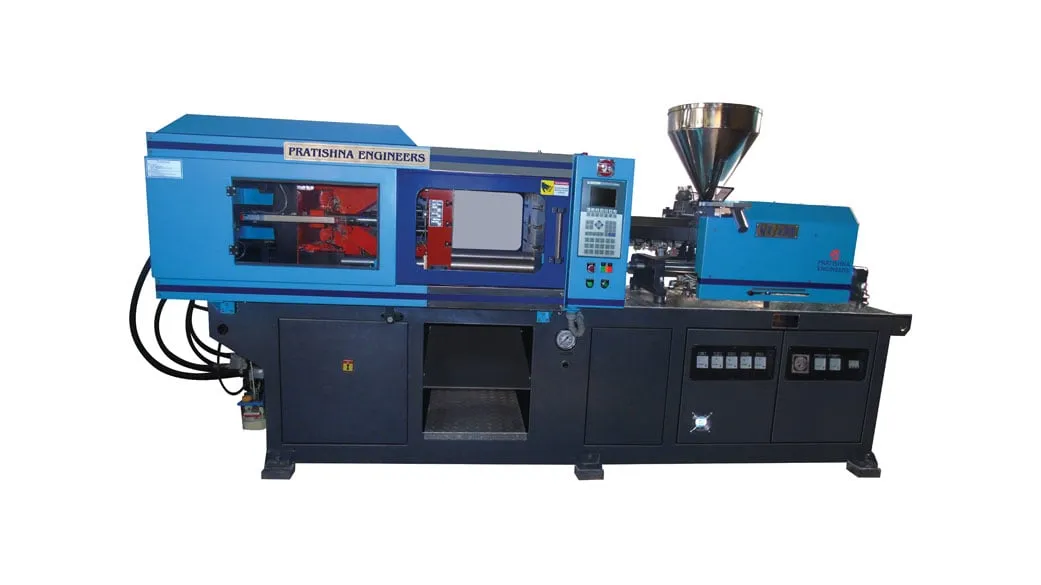

Before you shortlist injection moulding machine manufacturers, check six things:
1. The range covers your part: horizontal, vertical, two-platen, hybrid or PET machines, in the clamp sizes you need.
2. The company designs, machines, assembles and tests its machines itself, and will show you where.
3. It will run a trial on your mould, or a similar one, before you order.
4. Documentation is complete: safety, electrical load, mould mounting data, manuals and spare parts lists.
5. Service engineers and spares are close enough to keep your downtime short.
6. It sizes the machine from your component, not from its stock list.
Pratishna Engineers, a Mumbai manufacturer since 1991, selects machines for buyers in this order: component, material, mould, production requirement, machine configuration. This guide explains each check, what to ask, and what a good answer looks like.
Key Takeaways
- A real manufacturer can show its machine shop, assembly bay and test area; ask to see a machine being built and tested.
- Match the range to your parts: clamp type, orientation and drive should follow the component and mould, not whatever stock the supplier holds.
- Ask for the documents before you order: safety compliance, electrical load, mould mounting data, manuals and a recommended spares list with part numbers.
- Send a drawing, material and target output so the manufacturer can calculate clamp, shot and opening stroke instead of picking them from a catalogue.
What machine types should injection moulding machine manufacturers offer?
A manufacturer should offer, or honestly refer you to, the type that suits your part: horizontal toggle or hydraulic machines for most parts, vertical machines for inserts, two-platen machines for large moulds, hybrid or electric injection for repeatability and energy, and dedicated machines for PET preforms.
Clamp design is the first split. Toggle clamps are valued for simplicity, rigidity and fast locking, and they give full opening stroke at every mould height. Two-platen clamps with hydromechanical locking shorten the machine and suit tall, heavy moulds, but their available stroke falls as mould height rises. Directly hydraulic clamps are reported to give finer clamp pressure control and a wider die-height range.
Orientation is the second. Vertical machines hold inserts by gravity and suit overmoulding of pins, bushes and cables, often with a shuttle or rotary table so one mould half is loaded while the other moulds. Horizontal machines suit automatic drop-off of parts onto conveyors and robot take-out.
Drive is the third. Standard hydraulic machines can have base loads of 75% or more of their total energy, while hybrid and all-electric machines run at about 10% to 20%, mostly barrel heating. A manufacturer that offers more than one drive can match the machine to your duty cycle instead of selling the only option it has.
Machine types and the parts they suit
| Machine type | Typical strength | Check before you choose |
|---|---|---|
| Horizontal toggle | Simple, fast clamp; full stroke at every mould height | Opening stroke against part depth |
| Two-platen | Shorter machine; large and tall moulds | Stroke falls as mould height rises |
| Vertical | Gravity-held inserts; overmoulding | Table type and loading time |
| Hybrid or electric injection | Low base load; steady shot | Duty cycle and resin |
| PET preform | Drying and cavitation for preforms | Dryer capacity and cavities |
How do you check that a manufacturer actually builds its machines?
Visit the factory and ask to see the machining, assembly and test areas, with machines in progress. A manufacturer will show design drawings, machined frames and platens, hydraulic assembly and a test bay. A trader will mostly show finished machines and catalogues. Ask for a trial on your mould.
Look at the machine tools on the floor. Turning centres, machining centres and boring machines for platens and tie bars tell you the company controls the parts that set clamp parallelism and mould life. Ask who designs the hydraulic circuit and the control logic, and whether the same engineers will answer your service calls.
A trial on your own mould is the strongest test. Ask for the machine to run until it reaches steady temperature, then check part weight, dimensions and cycle time. Watch how the team sets up the mould: how long it takes, how they connect water, and whether they record a process sheet. That is how your own setups will be supported later.
Ask also how the company handles quality. An independent QA function with written procedures, inspection records for platens and screws, and a final run-in test with a report are signs of a manufacturer that expects to stand behind its machines. If those records cannot be shown, treat the company as a reseller until it proves otherwise.
What documentation should come with a new machine?
Expect a safety declaration against the relevant standard, an operation and maintenance manual, electrical drawings with connected load, hydraulic circuit drawings, mould mounting and ejector patterns, platen and tie-bar dimensions, a run-in test report and a recommended spares list. Ask to see a sample set before you order.
For safety, the international reference is ISO 20430:2020, which sets safety requirements for the design and construction of injection moulding machines for plastics and rubber with hydraulic or electrical platen drives. Ask which clauses the guarding, interlocks and emergency stops have been checked against, and how that check was recorded.
Mould data saves trouble later. The manual should give minimum and maximum mould height, minimum mould size, tie-bar spacing, maximum mould weight, locating ring size and the mounting pattern, whether SPI, EUROMAP or the maker's own. A mismatch in ejector pattern can mean an ejector box or new plates on every mould you already own.
Electrical data matters for your power bill. In Maharashtra, MSEDCL charges industrial demand on kVA and energy on kVAh, so the connected load and expected power factor of each machine affect contract demand and monthly cost. Ask for both figures, and plan capacitor or APFC capacity before the machine arrives.
What service and support should you expect after installation?
Expect installation and commissioning by the manufacturer's engineers, operator and maintenance training, a stated response time for breakdowns, spares stocked for wear parts, and access to the engineers who designed the machine. Get these written into the order, because they decide your downtime more than the machine's catalogue figures.
Spares are the practical test. Ask which parts are held in stock: heater bands, thermocouples, check rings, seals, proportional valves and control cards. Ask how long a non-stock part takes to make, since a manufacturer with its own machine shop can often produce a mechanical part that a trader must import.
Training should cover safe operation, mould setting, process basics and routine maintenance. Ask for the training to be repeated when a new shift team joins. Good training reduces avoidable service calls, which suits both sides and keeps your machines moulding instead of waiting for an engineer.
Ask how the manufacturer supports energy and performance checks after start-up. A clamp-meter data logger can measure a machine's energy use in as little as 30 minutes, and rising energy on an unchanged job can signal screw or barrel wear. A supplier that helps you take such readings is supporting your cost per part, not only the machine.
How Pratishna Engineers builds and supports its machine range
Pratishna Engineers was founded in Mumbai in 1991 by Nandkumar R. Kushe, a first-generation engineer. The company began with machine rebuilding, indigenisation and technology adaptation, then moved to complete machine design, manufacturing and automation. Design, manufacturing, assembly, testing and service are done in-house, in about 25,000 sq ft of facilities in Mumbai with CNC turning centres, vertical and horizontal machining centres and jig boring machines.
The range covers horizontal machines (E, C and H series), vertical machines (PV and PVDL series), two-platen machines (PHM series), hybrid machines with hydraulic locking and electric injection, PET machines and special purpose machines. With 35+ years of experience, the company counts 9,000+ machines and 1,000+ customers in India and international markets.
- In the series data, horizontal clamp forces run from 75 t (E - 75) to 320 t (C - 320 and VT-350), and the PHM two-platen series runs from 160 t to 350 t.
- Design uses SolidWorks, Creo and AutoCAD, and an independent QA department works to written SOPs, with accredited external labs used when required.
What should you send a manufacturer for a firm proposal?
Send the part drawing or 3D file, material grade, mould size and weight if the mould exists, number of cavities, target output and your electrical supply details. With those, a manufacturer can calculate clamp, shot and stroke rather than guess them. See the injection moulding machine range and send your requirements.
Frequently Asked Questions About Choosing a Manufacturer
How do I compare offers from different manufacturers fairly?
Compare on the same specification: clamp force, screw diameter and shot volume, opening stroke, tie-bar spacing, drive type, connected load, controls, included accessories, installation, training and warranty terms. Put each offer into one table. Differences in scope often explain differences between offers more than the machine itself does.
Should the manufacturer run a trial on my mould?
Yes, wherever the mould is available. A trial shows whether the clamp, shot, stroke and controls suit your part, and how the team sets up and stabilises the process. Ask for part weights, dimensions and cycle time from the trial in writing, so you can compare them with production later.
What is the difference between a manufacturer and a dealer?
A manufacturer designs, machines, assembles and tests its machines, so it can modify them and make spare parts. A dealer sells machines built by others and depends on that maker for engineering changes and many spares. Both can serve you well, but ask who will answer a technical problem after installation.
Which safety standard applies to injection moulding machines?
The international standard is ISO 20430:2020, which covers safety requirements for injection moulding machines for plastics and rubber with hydraulic or electrical platen drives. It does not apply to machines built before it was published. Ask the manufacturer which requirements the guarding and interlocks have been checked against.
What electrical details should I share before ordering in Maharashtra?
Share your supply voltage, sanctioned load and contract demand, and your billing basis, kVAh or kWh. Under MSEDCL billing, demand is charged on kVA and energy on kVAh, so a machine's connected load and power factor affect your bill. Ask the manufacturer for both figures for every machine on the order.
What should a machine manual say about mould size?
It should state minimum and maximum mould height, tie-bar spacing, minimum mould size, maximum mould weight, locating ring size and the mounting pattern. As a rule of thumb, a mould should cover at least 70% of the distance between tie bars, or the platens can bow and flash the mould centre.
Which machine types does Pratishna Engineers make?
Pratishna Engineers makes horizontal machines (E, C and H series), vertical machines (PV and PVDL series), two-platen machines (PHM series), hybrid machines with hydraulic locking and electric injection, PET injection moulding machines and special purpose machines. Selection starts from your component, material, mould and production need.
Related Articles
- Plastic Injection Molding Machine: Enhancing Efficiency and Precision in Manufacturing
- Injection Moulding Machine: Enhancing Efficiency and Productivity
- Plastic Injection Machine: Revolutionizing Mass Production
- Plastic Injection Moulding Machine Manufacturers: Providing Efficient Plastic Processing Solutions
Sources & References
- ISO: ISO 20430:2020 Plastics and rubber machines: Injection moulding machines: Safety requirements
- MoldMaking Technology, B. Catoen: Machine Sizing and Specification for Optimal Mold Performance, Part 1 (Aug 2025)
- Plastics Technology, M. Knights: Hybrid Injection Clamps: The Best of Both Worlds? (June 2010)
- MSEDCL: kVAh Billing: Frequently Asked Questions
Technical Disclaimer
Disclaimer: The information provided in this document is for general informational and educational purposes only. It is based on technical references and industry information available at the time of preparation and may be subject to change. It does not constitute engineering, technical, commercial or professional advice, nor does it constitute a quotation, specification, warranty or contractual commitment by Pratishna Engineers.
Actual injection moulding machine and process requirements vary according to the component design, material, mould, production volume, machine configuration and operating conditions. The information, examples, calculations and recommendations provided should be independently evaluated and verified for the specific application before making any equipment, process or production decision. Information obtained from third-party sources remains subject to the accuracy and limitations of those sources.
Limitation of Liability: Pratishna Engineers makes no representation or warranty, express or implied, regarding the completeness, accuracy or suitability of the information for any particular application. To the extent permitted by applicable law, Pratishna Engineers shall not be liable for any loss, damage, cost or consequence arising from reliance on or use of the information contained in this document. Final machine selection, configuration and application suitability should be confirmed with Pratishna Engineers based on complete and accurate project requirements.

