






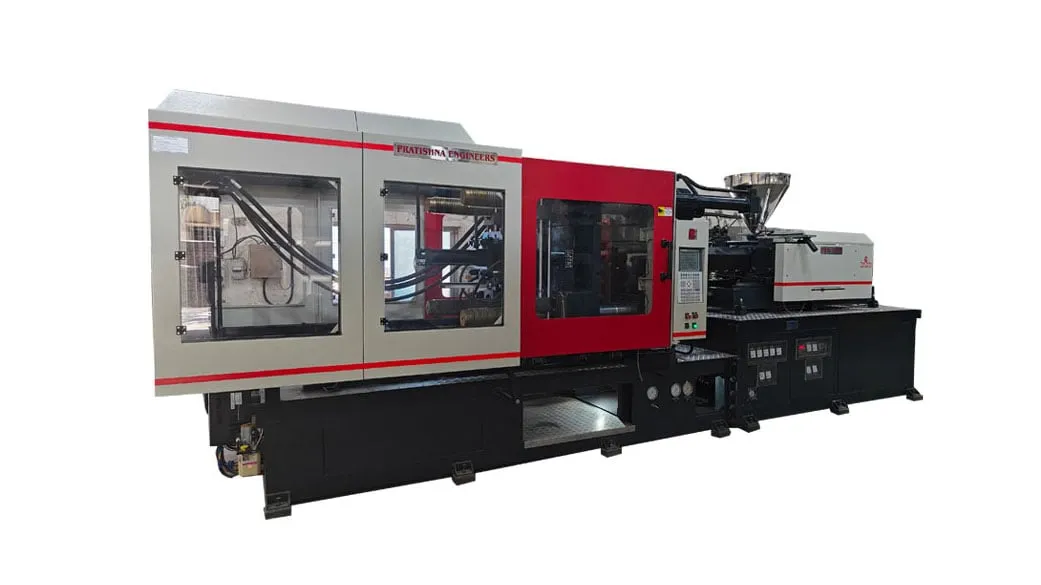

Plastic injection molding machine precision: four controls and what each holds steady
| Control | What it holds steady | What drifts if it is weak |
|---|---|---|
| Screw position and speed | Shot volume and fill speed | Short shots, flash, weight scatter |
| Pressure and transfer | Pack and hold | Sinks, size variation |
| Barrel and mould temperature | Melt viscosity and shrinkage | Dimensions shift over the shift |
| Clamp and platen parallelism | Even parting-line contact | Flash on one side, mould wear |
Precision on a moulding machine is not one figure in a brochure. It is how closely the machine repeats the same shot, the same pressures and the same temperatures, cycle after cycle, so that the part made on Friday night matches the part approved on Monday morning. It rests on three things you can measure: the resolution of the controls, the consistency of the shot, and the stability of barrel and mould temperatures. The table above maps each control to the defects that appear when it slips. The sections below show how to check each one before you trust a machine with a tight-tolerance part.
Key Takeaways
- Precision means repeatability: the same shot weight, pressures and temperatures every cycle, measured over a full shift rather than judged from one good sample.
- Keep the shot between about 20% and 65% of barrel capacity; outside that window melt quality and residence time start to hurt consistency.
- Fine control resolution helps only if the machine also holds cushion, transfer position and temperatures steady once the mould is warm and running.
- Test repeatability on your own mould: weigh consecutive shots, log the cushion and check dimensions after the mould and oil reach steady temperature.
What does plastic injection molding machine precision depend on?
It depends on how finely the machine can set and repeat speed, pressure, position and time, how evenly it melts and delivers each shot, and how steadily it holds barrel and mould temperatures. A weakness in any one of these shows up as weight or size scatter.
Control resolution is the smallest step the controller can set and read. For demanding thin-wall work, one trade source lists target resolutions of 1 bar for pressure, 0.01 s for time, 1 rpm for screw speed and about 0.1 mm (0.004 in) for position. Those figures are a useful yardstick even for ordinary parts, because a coarse controller cannot correct a drift it cannot see.
Resolution is not repeatability, though. A controller can display two decimals while the hydraulics wander. On hydraulic machines the controller usually reads hydraulic pressure and converts it to plastic pressure through the intensification ratio, which ranges from about 6:1 to 43:1 across machines and changes with screw size. Electric injection reads plastic pressure more directly, which helps electric and hybrid injection units hold shot weight closely.
The clamp matters too. Platen parallelism of about 0.025 to 0.05 mm is generally accepted on machines below 500 t. If the platens close out of parallel, one side of the parting line carries more load, and flash or size variation appears first on the cavities on that side.
How do you keep shot weight consistent from cycle to cycle?
Size the barrel so the shot uses about 20% to 65% of its capacity, keep a steady cushion at the end of hold, and control residence time. Then confirm consistency by weighing a run of consecutive shots, not a single part picked from the bin.
Below about 20% of barrel capacity the melt sits in the barrel for many cycles and can degrade. Above about 65%, the screw has too few turns to melt the pellets evenly, so unmelts, poor uniformity and long recovery follow. Machine shot ratings are usually given in grams of polystyrene, so convert your material to volume before you compare.
Cushion is the small amount of melt left in front of the screw when hold ends. If it is steady, the check ring is sealing and each part is packed the same way. A cushion that creeps down over a shift usually points to a worn check ring or barrel, and part weight will follow it.
Residence time is easy to underestimate. One trade study found resin trapped at the base of screw flights in nearly 90% of pulled screws, so formulas based on barrel volume alone can mislead. A practical test is to drop a few coloured pellets of the same resin into the throat and count the shots until the colour clears. A machine that cannot hold its cushion within a narrow band is not a precision machine, whatever the brochure says.
Why does temperature control decide part dimensions?
Melt and mould temperature set how much the plastic shrinks as it cools. If either one drifts during a shift, the shrinkage drifts with it and dimensions move even when the shot weight is steady. Stable heating, cooling water and oil temperature keep parts in tolerance.
Semi-crystalline resins such as PP and PE are the most sensitive. Typical mould shrinkage for PP runs from 1.0% to 2.5%, against 0.4% to 0.9% for ABS. On a 100 mm PP dimension that range is 1.0 to 2.5 mm, so a small change in cooling rate can move a part out of a tight tolerance.
Holding pressure reduces shrinkage only while the gate is still open. Once the gate freezes, the cooling rate decides the rest. That is why a mould temperature controller, steady chilled water and a warmed-up machine matter as much as the injection settings. Parts moulded in the first hour, before the oil and mould settle, can measure differently from parts made at steady state.
Indian resin data sheets give the window to work in. Reliance's Repol H110MAS, a nucleated PP homopolymer grade, lists a melt temperature of 200 to 250 °C and a mould temperature of 20 to 50 °C. Pick a point inside that window and hold it: precision comes from staying put, not from the setting you choose.
How should you test repeatability before you buy?
Ask for a trial on your own mould, or a similar one, and let the machine run until the oil and mould are at steady temperature. Then weigh a run of consecutive shots, log cushion and transfer position, and measure the critical dimensions. Compare machines on that data. See the injection moulding machine range to shortlist sizes.
Frequently Asked Questions About Injection Moulding Precision
What control resolution should a precision moulding machine have?
For demanding thin-wall work, one trade reference suggests about 1 bar for pressure, 0.01 s for time, 1 rpm for screw speed and about 0.1 mm for position. For ordinary parts these figures are a yardstick, not a requirement. What matters more is whether the machine repeats its settings once it is warm.
Is an all-electric machine always more repeatable than a hydraulic one?
Not always. Electric injection reads plastic pressure more directly and avoids oil temperature drift, which helps shot consistency. A well-maintained hydraulic machine with good closed-loop control can still hold tight tolerances on many parts. Judge on measured shot weight and dimensions from your own mould rather than on drive type alone.
What is cushion, and why should it stay steady?
Cushion is the melt left in front of the screw at the end of hold. A steady cushion shows the check ring is sealing and each part is packed the same way. If it shrinks or wanders through a shift, inspect the check ring, screw and barrel before you adjust the process.
How much can mould temperature change PP part size?
PP mould shrinkage typically runs from 1.0% to 2.5%, and cooling conditions decide where in that range a part lands. On a 100 mm dimension the spread is 1.5 mm. Keeping mould temperature steady with a controller and stable water flow is one of the lowest-cost precision steps available.
Can an older machine be made more repeatable?
Often, within limits. A new check ring, a recalibrated pressure transducer, a mould temperature controller and a correctly sized barrel can tighten shot weight. Worn tie bars, platens out of parallel or an old controller with coarse resolution are harder to fix, and may make a replacement the better choice.
Related Articles
- Injection Moulding Machine: Enhancing Efficiency and Productivity
- Plastic Injection Machine: Revolutionizing Mass Production
- Hybrid Injection Moulding Machines: Bridging Efficiency and Precision
- The Role of Toggle Moulding Machines in High-Precision Manufacturing
Sources & References
- PlasticsToday, G. Tremblay: Never too thin (Oct 2007)
- Plastics Technology, J. Bozzelli: A Simpler Way to Calculate Shot Size vs. Barrel Capacity
- LyondellBasell: Technical Tip: Mold Shrinkage
- Reliance Industries: Repol H110MAS Technical Data Sheet (July 2024)
Technical Disclaimer
Disclaimer: The information provided in this document is for general informational and educational purposes only. It is based on technical references and industry information available at the time of preparation and may be subject to change. It does not constitute engineering, technical, commercial or professional advice, nor does it constitute a quotation, specification, warranty or contractual commitment by Pratishna Engineers.
Actual injection moulding machine and process requirements vary according to the component design, material, mould, production volume, machine configuration and operating conditions. The information, examples, calculations and recommendations provided should be independently evaluated and verified for the specific application before making any equipment, process or production decision. Information obtained from third-party sources remains subject to the accuracy and limitations of those sources.
Limitation of Liability: Pratishna Engineers makes no representation or warranty, express or implied, regarding the completeness, accuracy or suitability of the information for any particular application. To the extent permitted by applicable law, Pratishna Engineers shall not be liable for any loss, damage, cost or consequence arising from reliance on or use of the information contained in this document. Final machine selection, configuration and application suitability should be confirmed with Pratishna Engineers based on complete and accurate project requirements.

