






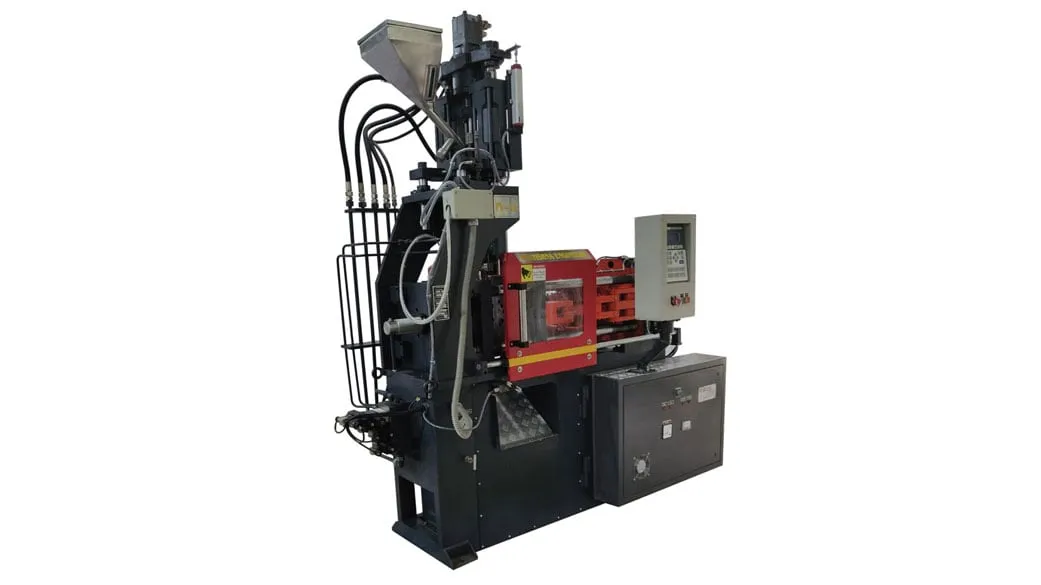

Take a two-cavity PP container with a 180 × 130 mm footprint. Each cavity projects 234 cm², so the mould needs 145 to 217 t of clamp at a PP factor of 2 to 3 US tons per square inch, plus a 10% reserve (a starting margin, not a rule). That one figure tells you which part of a range to look at, and it is the kind of number good plastic injection moulding machine manufacturers expect at the first meeting. A manufacturer such as Pratishna Engineers, building machines in Mumbai since 1991, will then check shot size, mould fit, cycle and automation before naming a machine. This page covers the range and customisation a manufacturer should offer, and how to brief one so the offer you receive fits your part rather than a catalogue.
Key Takeaways
- Bring numbers, not a product name: part drawing, projected area, shot weight, resin grade, target output and mould size let a manufacturer size the machine properly.
- A useful range steps through tonnage in small increments and offers more than one screw size per clamp, so you avoid buying clamp you never use.
- Customisation that matters sits in the injection unit, platen size, opening stroke, ejection and robot interface, not in the paint colour or the badge.
- Ask for a mould trial or a written sizing sheet before you order, and compare suppliers on the same brief and the same assumptions.
What range should plastic injection moulding machine manufacturers offer?
A sound range covers the tonnage band your parts fall into with small steps between sizes, two or three screw diameters per clamp, and horizontal and vertical layouts if you mould inserts. Gaps in the range push you onto a machine that is too large, which wastes energy.
Close size steps matter because an oversized machine is not a free safety margin. Energy guidance for moulders notes that a high base load can mean the machine is too large for the job, and excess clamp force can deform plates and crack the machine frame. A range with close steps lets you buy what the part needs.
Screw choice is the second axis. A shot should use roughly 20% to 65% of barrel capacity; below that the melt sits too long and degrades, above it you get unmelt and long recovery. Two or three screw diameters on one clamp let the manufacturer place your shot inside that window.
What a manufacturer's range should cover
| Range feature | Why it matters | What to ask |
|---|---|---|
| Tonnage steps | Avoids paying for clamp and energy you do not use | Which sizes sit either side of my requirement? |
| Screw options per clamp | Keeps the shot at 20% to 65% of barrel capacity | Which diameters fit this clamp, and at what pressure? |
| Machine layouts | Inserts and overmoulding often suit a vertical clamp | Do you build vertical and horizontal versions? |
| Drive options | Base load and idle energy differ by drive type | Hydraulic, servo-hydraulic or hybrid at this size? |
| Large-mould machines | Tall parts need opening stroke and daylight | What stroke is left at my mould height? |
Ask also how the range handles large moulds. Mould-sizing guidance says the mould should ideally sit inside the tie bars, with at least the projected area of the parts inside them, because platens can pull in near the tie bars and wear the parting line.
Which customisations are worth paying for?
Pay for changes that alter what the machine can mould: a different screw diameter or L/D, larger platens or tie-bar spacing, longer opening stroke, core-pull and valve-gate circuits, extra heater zones and a robot interface. Cosmetic options and unused features rarely earn back.
Each customisation should trace back to a line in your brief. If the part has a side hole, the mould needs core pulls and the machine needs the hydraulic circuit and sequence to drive them. If you run a hot runner with valve gates, count the zones: nozzles plus manifold plus sprue, with spares.
Opening stroke deserves a direct question. A common guide is a stroke of at least 2.5 times the part height so the part clears the core. On a toggle clamp the full stroke is available at every mould height; on a two-platen or piston clamp the stroke shrinks as mould height rises, so check it at your mould.
Ejection and automation interfaces come next. Ask whether the ejector stroke, force and pattern suit your mould, whether a robot interface and its safety signals are standard or optional, and how the control records process data. These details decide whether the machine can run with a picker or robot later without rework.
Our flat view: if a manufacturer cannot offer a different screw diameter on a given clamp without a long redesign, the range is narrower than the brochure suggests, and you will end up paying for clamp to get the shot you need.
How do you brief a manufacturer so the offer fits your part?
Send a brief that a design engineer can size from: part drawing or 3D file, resin grade, part weight, projected area, wall thickness, cavities, mould size and weight, target output per shift and any inserts or automation. Agree the sizing assumptions in writing before comparing offers.
The resin grade matters more than the resin family. An Indian PP homopolymer such as Repol H110MAS lists an MFR of 11 g/10 min, a melt range of 200 to 250 °C and compliance with IS 10910 for food contact. Naming the grade lets the manufacturer choose screw geometry and heater capacity with confidence.
Brief checklist for a machine enquiry
| Brief item | What to give | What it sizes |
|---|---|---|
| Part drawing or 3D file | Footprint, wall thickness, flow length | Projected area, clamp factor |
| Resin grade | Grade name and datasheet | Screw, heaters, clamp factor |
| Shot weight | Parts plus runner, in grams | Barrel size, screw diameter |
| Cavities and runner | Cavity count, cold or hot runner | Clamp force, hot runner zones |
| Mould data | Outer size, shut height, weight | Tie-bar gap, daylight, platen load |
| Output target | Good parts per shift, shifts per day | Cycle time, automation |
Write the output target as good parts per shift, not machine cycles. A manufacturer who sizes to that figure, using cycle, cavities and the share of good shots, can tell you whether a picker, robot or conveyor is needed to hold the cycle you have planned.
Add the plant side of the brief as well: supply voltage, available connected load, floor space, crane capacity and chilled water. A machine that suits the part can still fail on site if the mould cannot be lifted onto it or the cooling circuit cannot hold mould temperature.
Finally, ask each supplier to return the same sizing sheet: clamp required, shot as a share of barrel, mould fit between tie bars, opening at your mould height and expected dry cycle. Offers that skip these lines are harder to compare.
How should you compare offers from different manufacturers?
Compare offers line by line against your own sizing sheet, not against each other's brochures. Check that each machine meets the clamp, shot, mould fit and opening you calculated, then compare drive type, controls, service reach, spares stock and trial support on the same footing.
A larger machine in one offer is not extra value if your requirement sits at the bottom of its band. Ask what the energy and floor space difference will be, and whether the larger clamp brings a larger minimum mould size that your tool cannot meet.
Look for a mould trial on your tool, or at least on a similar mould, before dispatch. A trial confirms fill, cycle and part weight on the actual machine and settles questions about output before the machine reaches your floor.
Ask how service is delivered: who installs, who trains your operators, which spares are held in stock and how quickly an engineer can reach your plant. A manufacturer that designs and builds in-house can answer hydraulic, control and mechanical questions from its own drawings.
How Pratishna Engineers sizes and customises machines
Pratishna Engineers was founded in Mumbai in 1991 and has 35+ years of experience, 9,000+ machines and 1,000+ customers in India and international markets. Design, manufacturing, assembly, testing and service are done in-house, in about 25,000 sq ft of facilities with CNC turning centres, machining centres, jig boring machines and assembly and testing bays.
Machines are selected in a fixed order: Component, Material, Mould, Production Requirement, Machine Configuration. The design team works in SolidWorks, Creo and AutoCAD, and an independent QA department works to written SOPs. The range spans horizontal, vertical, two-platen, PET, hybrid and special purpose machines, so a brief can be matched to the nearest size rather than the nearest stock model.
- Horizontal E, C and H series machines run from 75 t (E-75) to 320 t (C-320 and VT-350), and PHM two-platen machines from 160 t to 350 t.
- Vertical PV and PVDL series serve vertical-clamp jobs such as insert moulding, and hybrid PH-120 and PH-140 machines pair hydraulic locking with electric injection.
What should you send a manufacturer first?
Start with the part drawing, resin grade, shot weight, cavities, mould size and output target, plus a note of any inserts or automation. Run the clamp and shot check below on your own numbers, then share it so every supplier sizes from the same base. See the injection moulding machine range.
Frequently Asked Questions About Plastic Injection Moulding Machine Manufacturers
What details should I send with an enquiry?
Send the part drawing or 3D file, resin grade, shot weight including runner, number of cavities, mould size and weight, and your output target in good parts per shift. Add inserts, automation and your plant's power supply. These let the manufacturer size clamp, shot and opening before making an offer.
Can a manufacturer change the screw on a standard machine?
Many ranges offer two or three screw diameters for one clamp. A smaller screw raises injection pressure and suits small shots; a larger one gives more volume at lower pressure. Ask which diameters are available for the clamp you need and what injection pressure each one delivers.
Is a bigger machine safer if my part might grow?
Only up to a point. Oversizing raises base energy, can push the minimum mould size above your tool, and puts small shots at the bottom of a large barrel where melt can degrade. Size for the current part with a modest reserve, and plan a second machine for growth.
How do I check that a manufacturer builds its own machines?
Ask to visit the machine shop, assembly bay and test area, and to see a machine under test. A builder can show drawings, machining, hydraulic assembly and electrical panels in progress. A trader may only be able to show finished stock and brochures from elsewhere.
Does Pratishna build special purpose injection moulding machines?
Yes. Pratishna's range includes special purpose machines alongside horizontal, vertical, two-platen, PET and hybrid models, and the company's background in machine rebuilding and technology adaptation feeds into custom builds. Share the part, mould and production brief so the team can confirm what changes are needed.
What should a mould trial prove before dispatch?
A trial should show complete fill without flash, a stable cycle, part weight within your tolerance and correct ejection, on the machine you are buying or one with the same clamp and screw. Record the settings so commissioning at your plant starts from known values.
Related Articles
- Injection Moulding Machine Payback Period
- New vs Used Injection Moulding Machine Cost
- Automatic Injection Moulding Machine Manufacturers
- Injection Moulding Machine Manufacturers
Sources & References
- Plastics Technology, J. Williams (RJG): Clamp Tonnage: More Is Better...Right?
- Plastics Technology, J. Bozzelli: A Simpler Way to Calculate Shot Size vs. Barrel Capacity
- MoldMaking Technology, B. Catoen: Machine Sizing and Specification for Optimal Mold Performance, Part 1
- Reliance Industries: Repol H110MAS Technical Data Sheet (July 2024)
Technical Disclaimer
Disclaimer: The information provided in this document is for general informational and educational purposes only. It is based on technical references and industry information available at the time of preparation and may be subject to change. It does not constitute engineering, technical, commercial or professional advice, nor does it constitute a quotation, specification, warranty or contractual commitment by Pratishna Engineers.
Actual injection moulding machine and process requirements vary according to the component design, material, mould, production volume, machine configuration and operating conditions. The information, examples, calculations and recommendations provided should be independently evaluated and verified for the specific application before making any equipment, process or production decision. Information obtained from third-party sources remains subject to the accuracy and limitations of those sources.
Limitation of Liability: Pratishna Engineers makes no representation or warranty, express or implied, regarding the completeness, accuracy or suitability of the information for any particular application. To the extent permitted by applicable law, Pratishna Engineers shall not be liable for any loss, damage, cost or consequence arising from reliance on or use of the information contained in this document. Final machine selection, configuration and application suitability should be confirmed with Pratishna Engineers based on complete and accurate project requirements.

