






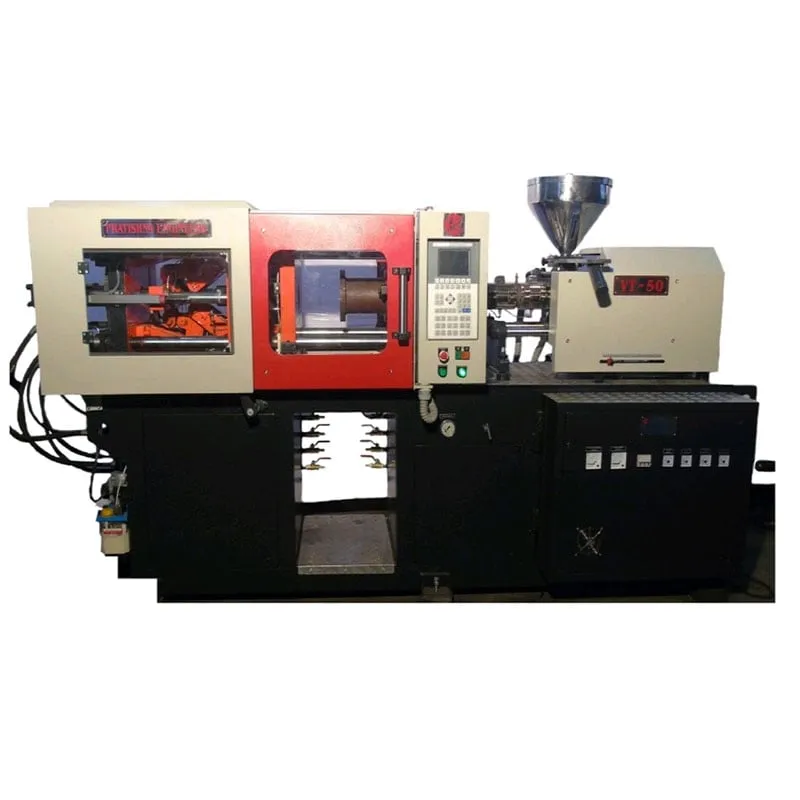

How to choose a PET preform moulding machine: the five figures to fix first
| Selection figure | What it depends on | How to work it out |
|---|---|---|
| Shot in PET | Preform weight × cavities | Convert to volume at a PET melt density of about 1.15 g/cm³, then add 10% |
| Barrel size | Shot volume | Keep the shot between 20% and 65% of barrel capacity |
| Cavitation | Output target and cycle time | Preforms per hour = 3,600 ÷ cycle × cavities × good-shot share |
| Clamp per cavity | Projected area per cavity, usually the neck ledge | Area × cavities × tonnage factor, plus a reserve |
| Drying capacity | Resin throughput in kg/h | Hopper holds 4 to 6 h of throughput, dew point -40 °C or lower |
Start with the preform, not the machine. Fix the preform weight and neck size, the output you need per hour and the resin you will dry. From those, five figures follow: the shot in PET, the barrel that suits it, the cavity count, the clamp per cavity and the dryer size. The table above shows how each one is worked out. A machine that matches all five gives you a stable starting point; one that misses the barrel or the dryer will create IV loss and acetaldehyde problems that no setter can fix at the press.
Key Takeaways
- Work the shot in volume: PET melt is about 1.15 g/cm³, so a barrel rated in grams of PS holds about 1.22 times that weight in PET.
- Keep the PET shot inside 20% to 65% of barrel capacity; an oversized barrel lengthens residence time and raises acetaldehyde, which matters most for water bottles.
- Size clamp from the neck ledge area per cavity; the answer swings widely between a 400 bar guide and a cautious 5 US t/in² factor.
- Size the dryer for 4 to 6 hours of resin residence at your real throughput, with dry air at a dew point of -40 °C or lower.
How to choose a PET preform moulding machine by shot and barrel?
Add preform weight times cavities, convert it to melt volume using about 1.15 g/cm³ for PET, and add 10% for check-valve leakage. Then choose a barrel where that shot sits between 20% and 65% of capacity. In grams of PS rating, that is about 1.39 to 4.5 times the shot.
Machine shot ratings are usually given in grams of polystyrene. PS melt is about 0.945 g/cm³ and PET melt about 1.15, so the same swept volume holds roughly 22% more weight in PET. Working in volume stops you from reading a PS rating as if it were a PET figure. A 1,000 g PS rating therefore holds about 1,217 g of PET melt at full stroke.
The upper limit protects melt quality; the lower limit protects the resin. Acetaldehyde rises with residence time and climbs steeply with temperature. Halving the shot on the same barrel and cycle doubles residence, so a lightweighted water preform run on an oversized barrel carries an acetaldehyde penalty the bottler can taste.
Injection rate matters too. Preform guidance puts it at about 10 to 12 g/s per cavity, so a 24-cavity mould needs roughly 240 to 288 g/s from the injection unit. Check that the machine can deliver that rate with the barrel size you have chosen.
How many cavities, and how much clamp per cavity?
Cavity count comes from output: preforms per hour equal 3,600 divided by cycle seconds, times cavities, times the good-shot share. Clamp then comes from the projected area of each cavity, normally the neck ledge, times cavities and a tonnage factor, plus a reserve you choose.
Cycle time follows wall thickness more than weight. Two preforms with the same wall can differ by only 1 to 2 s even if one weighs twice as much, so check the wall before you assume a cycle. Cooling grows with the square of wall thickness, which is why heavy-wall jar preforms run slower. Add about 20% to any calculated cooling time as a safety factor.
Neck size drives clamp more than any other preform detail. A 63 mm ledge has about 3.6 times the area of a 33 mm ledge, so the same clamp carries far fewer jar cavities than water-bottle cavities. In our view, a jar mould and a water mould seldom belong on the same machine.
The tonnage factor is the open question for PET. A 400 bar cavity-pressure guide gives about 0.408 t/cm², while a cautious 5 US t/in² gives 0.703 t/cm², about 72% more. Ask the mould maker which figure the mould was designed for, then add your reserve, for example 10%, which is a starting margin, not a rule.
Cavities by clamp at 260 t with a 10% reserve (clamp only; shot and mould layout may set a lower limit)
| Neck ledge diameter | Ledge area per cavity | Cavities at 400 bar guide | Cavities at 5 US t/in² |
|---|---|---|---|
| 30 mm | 7.07 cm² | 81 | 47 |
| 33 mm | 8.55 cm² | 67 | 39 |
| 38 mm | 11.34 cm² | 51 | 29 |
| 48 mm | 18.10 cm² | 32 | 18 |
| 63 mm | 31.17 cm² | 18 | 10 |
How big a dryer does a PET preform machine need?
Size the dryer from throughput. The hopper should hold four to six hours of resin at your real kg/h, with dry air at a dew point of -40 °C or lower and drying near 160 to 175 °C, so the resin reaches the throat below 50 ppm water.
PET is hygroscopic and moisture diffuses through the whole pellet. Poorly dried resin breaks down by hydrolysis, which shows up as IV loss. A drop of more than 0.04 dl/g from resin to preform counts as a fault, and you cannot see it in the preform; it needs an IV tester or melt viscometer.
Airflow matters as much as hopper size. One resin maker asks for at least 1 cfm of dry air per lb/h of throughput, about 28.3 L/min for every 0.45 kg/h. A dryer with a large hopper but too little air can still pass wet resin to the screw. Ask for a dew point readout after the desiccant bed so the setter can see it every shift.
For Indian food packaging, check the regulation as well as the resin. The FSSAI Packaging Regulations, 2018 require plastics in food contact to meet the listed Indian Standards, including IS 12252 for PET, and food businesses need an NABL lab certificate of conformity for direct-contact packaging.
What should you send for a PET machine proposal?
Send the preform drawing with weight, neck finish and wall, the resin grade, your hourly output target and whether the mould already exists. With those, the shot, barrel, cavities, clamp and dryer can all be checked before any machine is proposed. See the PET injection moulding machine page.
Frequently Asked Questions About Choosing a PET Preform Machine
Can a general-purpose injection moulding machine make PET preforms?
It can mould PET, but preform work asks more of the machine: a barrel and screw suited to PET, steady melt temperature near 280 °C, a desiccant dryer, mould water at 7 to 10 °C and good post-mould cooling. Without these, IV loss, acetaldehyde, wavy bodies and out-of-round necks become hard to control.
What dew point should a PET dryer reach?
A dew point of -40 °C or lower is the usual target for PET drying. If it rises above that, fix the dryer before you blame the process: check desiccant regeneration temperature and frequency, airflow and hopper residence time. Resin should reach the throat with less than 50 ppm water.
Why do water bottle preforms need low acetaldehyde?
Still water carries no sugar or flavour to mask acetaldehyde, so even small amounts can change its taste. Carbonated drinks and juices hide it better. Acetaldehyde forms when PET is heated, rises with residence time and climbs steeply with temperature, so barrel size and melt temperature both matter.
How cold should preform mould water be?
Preform troubleshooting guides commonly use mould cooling water at 7 to 10 °C, with flow to the mould and robot cooling tubes at the mould maker's rated figure. Warmer water or low flow shows up as wavy bodies, out-of-round necks and surface marks when warm preforms touch each other.
How much moisture is in PET resin straight from the bag?
One bottle-grade resin is packed with moisture below 0.2%, which is up to 2,000 ppm, against a drying target of 50 ppm at the throat. That gap is why PET must always go through a desiccant dryer, even when the bag is sealed and fresh from the supplier.
Related Articles
- How PET Injection Molding Machines Revolutionize the Beverage Industry
- Revolutionizing PET Manufacturing with PET Injection Moulding Machines
- PET Injection Moulding Machines: Mastering PET Processing
- Types of Injection Moulding Machines
Sources & References
- Alpek Polyester: Laser+ C (F65A) Product Information (drying guidance)
- PETplanet Insider, R. Unterlander and O. Brandau: The Rapid Guide to Perfect Preforms, 16. IV Loss
- PETplanet Insider, O. Brandau: Bottles, Preforms and Closures, 3.6 Acetaldehyde in PET Bottles
- FSSAI: Food Safety and Standards (Packaging) Regulations, 2018, compendium
Technical Disclaimer
Disclaimer: The information provided in this document is for general informational and educational purposes only. It is based on technical references and industry information available at the time of preparation and may be subject to change. It does not constitute engineering, technical, commercial or professional advice, nor does it constitute a quotation, specification, warranty or contractual commitment by Pratishna Engineers.
Actual injection moulding machine and process requirements vary according to the component design, material, mould, production volume, machine configuration and operating conditions. The information, examples, calculations and recommendations provided should be independently evaluated and verified for the specific application before making any equipment, process or production decision. Information obtained from third-party sources remains subject to the accuracy and limitations of those sources.
Limitation of Liability: Pratishna Engineers makes no representation or warranty, express or implied, regarding the completeness, accuracy or suitability of the information for any particular application. To the extent permitted by applicable law, Pratishna Engineers shall not be liable for any loss, damage, cost or consequence arising from reliance on or use of the information contained in this document. Final machine selection, configuration and application suitability should be confirmed with Pratishna Engineers based on complete and accurate project requirements.

