






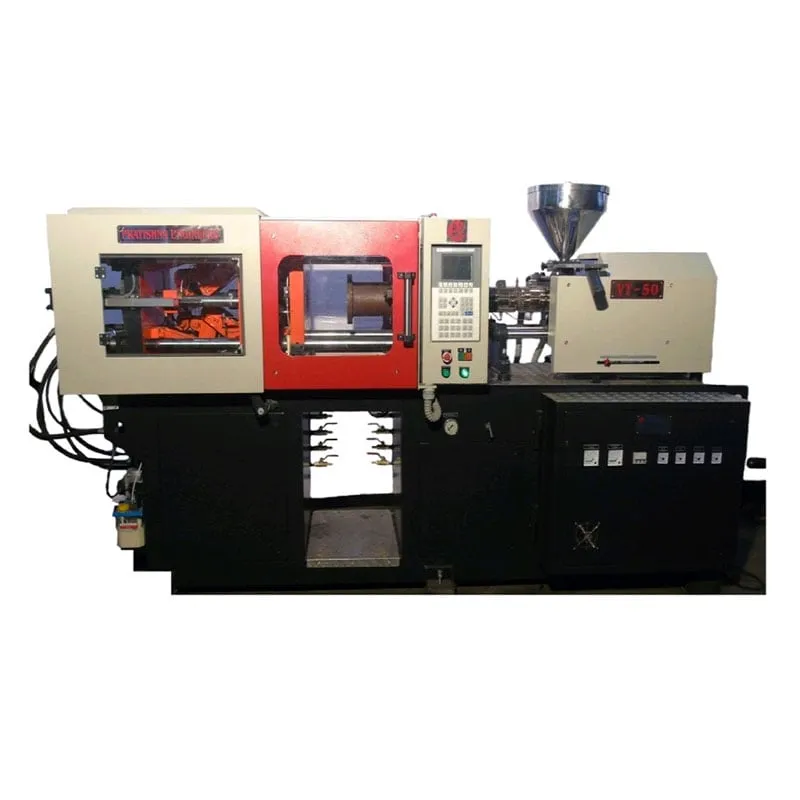

PET preform injection moulding requirements come down to a short checklist. Miss one line and the preform can look perfect while failing later in blowing or filling.
1. Dry the resin to below 50 ppm water before it reaches the screw.
2. Hold dryer dew point at -40 °C or lower.
3. Give the resin about 4 hours at 175 °C, or up to 6 hours at 160 °C.
4. Keep melt near 280 °C, within about 10 °C either side.
5. Test IV: a drop above 0.04 dl/g from resin to preform is a fault.
6. Match the injection unit to the preform weight to limit acetaldehyde.
Key Takeaways
- Moisture is the main enemy: PET is hygroscopic, and water above 50 ppm at the throat breaks chains, cuts IV and raises acetaldehyde.
- The dryer needs dew point, temperature, airflow and residence time all correct; good settings on three of the four can still give wet resin.
- IV loss cannot be seen in the preform, so a lab IV tester or melt viscometer is part of the requirement, not an extra.
- Acetaldehyde rises linearly with residence time and exponentially with temperature, which matters most for still water bottles, where even small levels affect taste.
How dry must PET be before it reaches the screw?
Below 50 ppm water at the extruder throat. PET is hygroscopic, and wetter resin suffers hydrolytic degradation in the barrel, losing molecular weight and IV. Reaching that level takes a desiccant dryer holding -40 °C dew point, with enough time, heat and dry airflow.
Bags do not arrive dry. Reliance's Relpet G5761, a copolymer bottle grade for still water, lists moisture when packed below 0.2%, which can be up to 2,000 ppm. The dryer may have to cut that by a factor of 40 before moulding, so no bag, opened or sealed, goes straight to the hopper.
Drying and melt requirements for PET preforms
| Requirement | Target | If missed |
|---|---|---|
| Moisture at the throat | Below 50 ppm | Hydrolytic degradation, IV loss |
| Dryer dew point | -40 °C or lower | Resin not dried to target |
| Drying time and temperature | About 4 h at 175 °C or up to 6 h at 160 °C | Residual moisture, IV loss |
| Dry airflow | At least 28.3 L/min per 0.45 kg/h | Uneven drying through the hopper |
| Dryer inlet air | Up to 171 °C, never above 180 °C | Discolouration |
| Melt temperature | About 280 °C ± 10 °C | Degradation and higher AA if too high |
| Back pressure | Typically 15 to 20 bar, minimised | Extra shear heat |
| IV drop, resin to preform | Not more than 0.04 dl/g | A fault that cannot be seen in the preform |
One resin maker's drying guidance sets dew point no higher than -37 °C and preferably -40 °C or lower, airflow of at least 28.3 litres per minute for every 0.45 kg/h of throughput, and hopper residence of at least 4 hours, preferably 6. Inlet air above 180 °C risks discolouration.
Residence time in the hopper equals hopper capacity divided by throughput, so a bigger mould on the same dryer quietly shortens drying. Check it whenever cavitation or cycle time changes. Log dew point and hopper temperature each shift, because a drift there can cost IV before anything shows.
What are the PET preform injection moulding requirements for melt temperature and IV?
Melt should sit at about 280 °C, within about 10 °C either side, with back pressure typically 15 to 20 bar and kept as low as possible. The IV drop from resin to preform should not exceed 0.04 dl/g; a larger drop is a fault.
IV loss cannot be seen. A preform with heavy IV loss looks the same as a good one, so the only check is a lab IV tester or a melt viscometer. The causes are hydrolytic degradation from wet resin or severe thermal degradation from too much heat or time in the barrel.
Screw speed should be as low as still allows recovery within the cycle, leaving about 2 seconds of stopped time at the end of recovery. Higher screw speed adds shear heat that the temperature display may not show. When IV drops, check the dryer first, then the silo, hopper cone, in-feed line and heaters.
A preform plant with no access to IV testing is guessing. Test resin and preforms on a fixed schedule and at every resin lot change, and keep the results with the dryer log, so a drift can be traced to its cause.
How do residence time and acetaldehyde limit the machine you choose?
Acetaldehyde (AA) rises linearly with residence time and exponentially with temperature, so an injection unit too large for the preform keeps melt hot for too long. For still water bottles, where taste reacts to small AA levels, extruder size must be matched to preform weight.
The trap is lightweighting. Cycle time follows wall thickness, not weight, so two preforms with the same wall but one twice as heavy may differ by only 1 to 2 seconds. Run the lighter one on the same extruder and its melt stays in the barrel almost twice as long.
Moisture adds to the problem, because water breaks PET chains and also creates AA. One preform processing guide reports that a resin temperature of 165 °C at the extruder throat has proven optimal for low AA, which ties dryer exit temperature directly to preform quality.
Makers of soft drink preforms, where sugar masks AA, also monitor it, because wear on the screw and barrel raises shear and pushes AA up. A rising AA trend at a steady setting is an early sign of wear. Ask for the shot weight range the injection unit is designed for, and check your lightest preform against it.
What should you check before your first preform trial?
Send the preform drawing and weight, neck finish, cavitation, target output, resin grade and your dryer's capacity, dew point and airflow, so drying can be checked against the real throughput. Bring resin and preform IV results if you have them. Then compare machines on the PET injection moulding machine page.
Frequently Asked Questions About PET Preform Moulding
Can PET go straight from a sealed bag to the machine?
No. Bottle-grade PET can be packed with far more moisture than moulding allows; one Indian still-water grade lists moisture when packed below 0.2%, or up to 2,000 ppm, against a target below 50 ppm. Sealed bags slow further pickup, but every lot needs full desiccant drying before it reaches the throat.
How can I tell if my preforms have lost IV?
You cannot tell by looking. Measure IV on the resin and on moulded preforms with a lab IV tester or a melt viscometer, and compare. A drop of more than 0.04 dl/g points to hydrolytic degradation from wet resin or thermal degradation from excess heat or residence time.
What dew point should a PET dryer hold?
Aim for -40 °C or lower, measured after the desiccant bed. One resin maker sets -37 °C as the upper limit, and preform troubleshooting guides treat any reading above -40 °C as a fault to correct. Check regeneration temperature and frequency too, because a tired desiccant bed lets dew point creep up.
Why do water preforms need tighter acetaldehyde control than soft drink preforms?
Still water has no flavour to hide acetaldehyde, so its taste reacts to small AA levels, while the sugar in soft drinks and juices masks it. A still-water grade such as Relpet G5761 lists AA of 1.0 ppm maximum, so the moulding process must not add much back through heat, residence time or moisture.
What should the dryer do during a long stoppage?
Do not leave resin cooking at full drying temperature. One resin maker advises dropping the air temperature to 116 °C or lower while keeping dry air flowing, so pellets stay dry without discolouring. Before restarting, bring the hopper back to temperature and allow enough residence for the resin now at the throat.
Related Articles
- Hybrid Injection Moulding Machine for High-Efficiency Manufacturing
- PET Preform Moulding for Beverage Bottles
- PET Injection Moulding Machines: Mastering PET Processing
Sources & References
- PETplanet Insider, R. Unterlander and O. Brandau: The Rapid Guide to Perfect Preforms, 16. IV Loss (Vol. 11, 11/2010)
- Alpek Polyester: Laser+ C (F65A) Product Information (PDS-F65A 230601MO)
- PETplanet Insider, O. Brandau: Bottles, Preforms and Closures extract, 3.6 Acetaldehyde in PET Bottles (Vol. 16, 03/2015)
- Reliance Industries: Relpet G5761 TDS (Aug 2022)
Technical Disclaimer
Disclaimer: The information provided in this document is for general informational and educational purposes only. It is based on technical references and industry information available at the time of preparation and may be subject to change. It does not constitute engineering, technical, commercial or professional advice, nor does it constitute a quotation, specification, warranty or contractual commitment by Pratishna Engineers.
Actual injection moulding machine and process requirements vary according to the component design, material, mould, production volume, machine configuration and operating conditions. The information, examples, calculations and recommendations provided should be independently evaluated and verified for the specific application before making any equipment, process or production decision. Information obtained from third-party sources remains subject to the accuracy and limitations of those sources.
Limitation of Liability: Pratishna Engineers makes no representation or warranty, express or implied, regarding the completeness, accuracy or suitability of the information for any particular application. To the extent permitted by applicable law, Pratishna Engineers shall not be liable for any loss, damage, cost or consequence arising from reliance on or use of the information contained in this document. Final machine selection, configuration and application suitability should be confirmed with Pratishna Engineers based on complete and accurate project requirements.

