






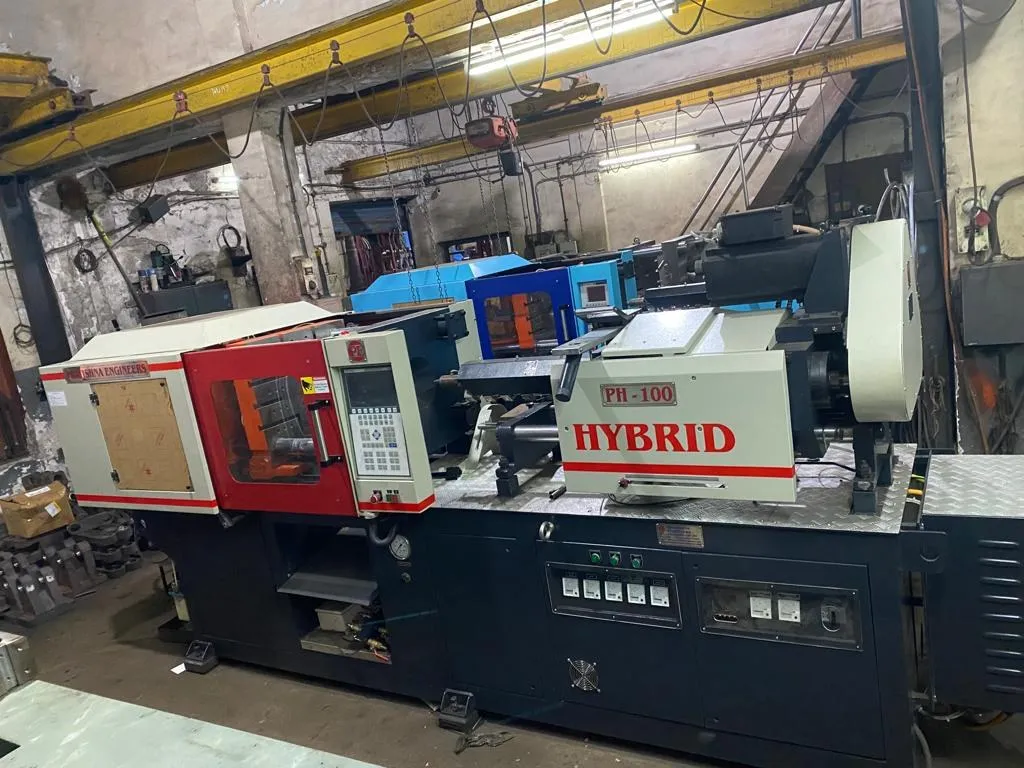

Hybrid injection moulding machine comparison: what 120 t and 140 t clamps hold with a 10% reserve (calculated)
| Measure | 120 t clamp | 140 t clamp |
|---|---|---|
| Usable clamp after 10% reserve | 109.1 t | 127.3 t |
| Largest total area, factor 2 US t/in² | 388 cm² | 453 cm² |
| Largest total area, factor 3 | 259 cm² | 302 cm² |
| Largest total area, factor 5 | 155 cm² | 181 cm² |
| Largest total area, factor 8 | 97 cm² | 113 cm² |
| Largest single round part, factor 3 | About 181 mm | About 196 mm |
Choose the larger hybrid when one of three things outgrows the smaller one: your clamp calculation lands between about 109 and 127 t, your regular shot sits above 65% of the smaller barrel, or the mould will not fit the smaller machine's tie bars, shut height or opening. If none of these applies, the 120 t machine is the better buy.
The 140 t clamp gives about 17% more force, so every area limit in the table rises by the same 17%. The question is whether your parts need it.
Key Takeaways
- With a 10% reserve, the 140 t clamp carries about 17% more projected area than 120 t at any tonnage factor.
- Stiff resins such as PC, at 3.0 to 5.0 US t/in² for one Makrolon grade, are where the extra clamp can matter most.
- Keep regular shots between about 20% and 65% of barrel capacity; a larger machine's barrel can push small shots below that.
- Mould width, shut height and part depth can force the larger machine even when clamp and shot fit the smaller one.
When Does Clamp Force Decide Between 120 t and 140 t?
When your calculation, with reserve, lands between about 109 and 127 t. Below that the smaller clamp is enough; above it, even 140 t is short. Stiff resins, more cavities and cold runners are what move a job into that band, so check each against the resin's real tonnage factor.
PC shows how wide the band can be. A Bayer MaterialScience datasheet for Makrolon 2558, a general-purpose PC now sold by Covestro, gives a clamp tonnage of 3.0 to 5.0 US t/in². At the low end a cover can fit 120 t comfortably; at the high end the same cover may need 140 t.
Electrical enclosures show why the margin matters. IS 14772:2020 covers boxes and enclosures for electrical accessories rated up to 440 V, indoor and outdoor. It requires lids, covers and screw fixings to protect against ingress of solids and water, so a lid that flashes or warps at the parting line is a failed part, not a cosmetic one.
That is why a lid running at the edge of a 120 t clamp is a risk. Our view: if your calculation lands within about 5% of the smaller machine's usable clamp, choose the larger one, because resin lots and mould temperature will move the real figure.
When Does Shot Size Decide It?
When your regular shot, converted to melt volume with 10% added, sits above about 65% of the smaller machine's swept volume. It also works the other way: a much larger barrel can push your smallest regular shots below about 20%, where melt stays in the barrel long enough to degrade.
John Bozzelli gives these limits in Plastics Technology, along with melt densities of 0.945 g/cm³ for PS and about 0.74 for PP. Since barrels are rated in grams of PS, a PP shot uses more of the barrel than its weight suggests. In PP terms, a barrel rated R grams of PS runs good shots from about 0.142 × R to 0.463 × R grams.
Bozzelli also warns against buying the biggest screw on offer, because big screws usually mean lower plastic pressure. The same thinking applies to moving up a machine size for one heavy part: check what the larger barrel does to your lighter parts first.
When Do Mould Size and Part Depth Decide It?
When the mould is too wide for the smaller machine's tie bars, outside its shut height range, or the part too deep for its opening stroke. These limits can force the larger machine even when clamp and shot fit, so measure the mould before comparing tonnage.
Brad Catoen sets out the checks in MoldMaking Technology. Ideally the mould fits within the tie bars; at minimum the parts' projected area must, because platens can pull in near the tie bars. Opening stroke should be at least 2.5 times the part height so the part can be ejected and removed.
Clamp type changes the arithmetic. On a toggle, maximum daylight equals maximum shut height plus stroke, so the full stroke is available at every shut height. On a piston clamp, maximum daylight equals minimum shut height plus maximum stroke, so a thick mould leaves less opening. Ask which applies before comparing two machines.
What Else Belongs in a Hybrid Injection Moulding Machine Comparison?
Running cost, floor space, mould changeover and what else the machine will run. A larger machine draws more power at idle and takes more room. If only one mould needs 140 t and ten others run happily on 120 t, the larger machine may cost more than it earns.
List every mould you expect to run in the next two or three years, with its clamp, shot and mould size. Mark which ones need the larger machine. If they are your highest-volume jobs, the choice is easy; if they are occasional, consider whether a different mould layout could fit the smaller one.
What Should You Send to Compare the Two Sizes?
Send drawings or samples of your main parts, resin grades, cavity counts and runner types, mould plate sizes and shut heights, part depths and monthly volumes. With those, each job can be checked against both clamp sizes and both injection units. See the 140 ton hybrid injection moulding machine page.
Frequently Asked Questions About a Hybrid Injection Moulding Machine Comparison
Can I run a 120 t mould on a 140 t machine?
Yes, if it fits the tie bars, shut height and locating ring. Set the clamp force to what the mould needs, not to the machine's maximum. Over-clamping a small mould can crush vents, deform the parting line and damage the platens, so record the correct clamp setting on the mould's process sheet.
Does a larger machine run slower cycles?
Not necessarily. Cooling time depends on the part's wall thickness and mould temperature, not on the machine size. Longer strokes and heavier platens can add a little to mould opening and closing, so set the opening stroke to what the part needs rather than to the machine's maximum.
Should I buy the smaller machine now and the larger one later?
That can work if your current parts sit comfortably inside the smaller machine's limits and the larger parts are still plans. It fails when a planned mould arrives early. List confirmed jobs separately from possible ones, and size the first machine on the confirmed list.
Is there a pressure penalty on the larger machine?
It depends on the screw sizes offered. A larger screw delivers more volume but less pressure on the same injection unit, falling with the square of the diameter ratio. Compare the maximum injection pressure on both datasheets against what your thinnest and longest-flow parts need.
What if my clamp calculation is right at 127 t?
Then 140 t has almost no reserve beyond the 10% already included, and 120 t is clearly short. Check whether a hot runner, a smaller cold runner or one fewer cavity brings the figure down. If the factor itself is uncertain, a filling study is cheaper than a wrong machine.
Related Articles
- What Can You Make on a 140 Ton Hybrid Injection Moulding Machine?
- Multi-Cavity Precision Moulds on a 140 Ton Hybrid Machine
- Thin-Wall Filling at 220 MPa on a 140 Ton Hybrid Machine
Sources & References
- Bayer MaterialScience (now Covestro) via IDES: Makrolon 2558 datasheet
- Plastics Technology, J. Bozzelli: A Simpler Way to Calculate Shot Size vs. Barrel Capacity
- MoldMaking Technology, B. Catoen: Machine Sizing and Specification for Optimal Mold Performance, Part 1 (August 2025)
- Bureau of Indian Standards: IS 14772: 2020 Boxes and Enclosures for Electrical Accessories, summary
Technical Disclaimer
Disclaimer: The information provided in this document is for general informational and educational purposes only. It is based on technical references and industry information available at the time of preparation and may be subject to change. It does not constitute engineering, technical, commercial or professional advice, nor does it constitute a quotation, specification, warranty or contractual commitment by Pratishna Engineers.
Actual injection moulding machine and process requirements vary according to the component design, material, mould, production volume, machine configuration and operating conditions. The information, examples, calculations and recommendations provided should be independently evaluated and verified for the specific application before making any equipment, process or production decision. Information obtained from third-party sources remains subject to the accuracy and limitations of those sources.
Limitation of Liability: Pratishna Engineers makes no representation or warranty, express or implied, regarding the completeness, accuracy or suitability of the information for any particular application. To the extent permitted by applicable law, Pratishna Engineers shall not be liable for any loss, damage, cost or consequence arising from reliance on or use of the information contained in this document. Final machine selection, configuration and application suitability should be confirmed with Pratishna Engineers based on complete and accurate project requirements.


