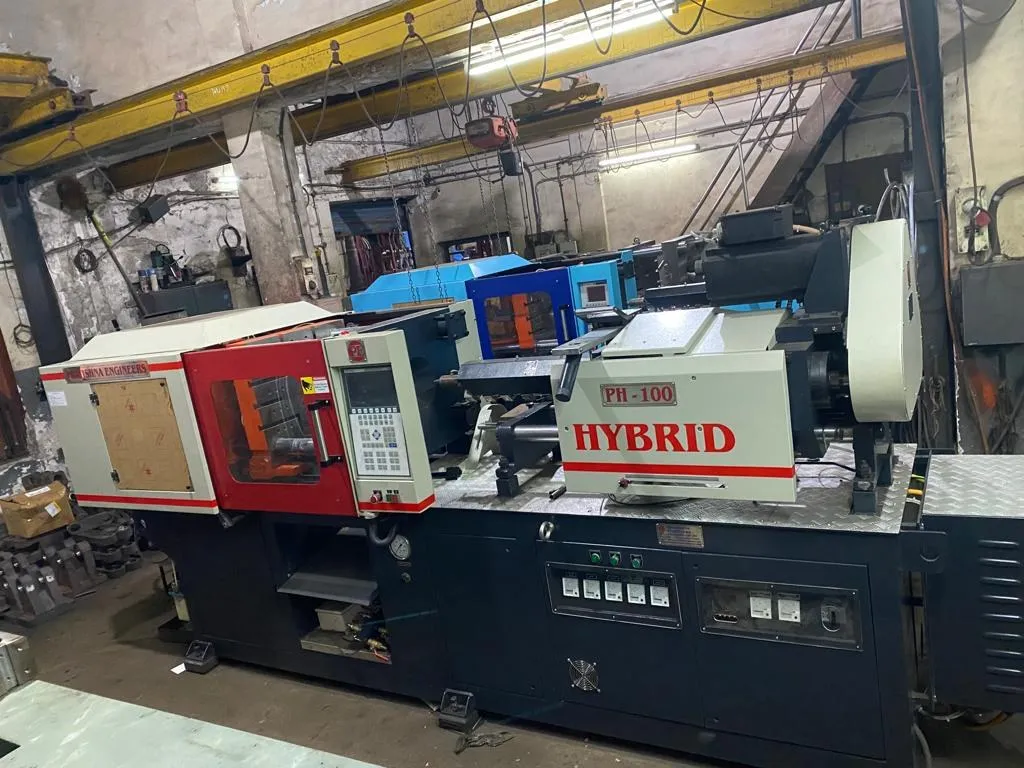
Short answer: a 140 ton hybrid moulding machine suits precision parts that are a little larger or heavier than small gears and connectors. Typical jobs are precision housings and covers, relay housings and switchgear parts, multi-cavity closures, medical device parts, optical and lighting parts, thin-walled packaging and glass-filled engineering components. With a 10% reserve, the clamp holds about 302 cm² of projected area at a tonnage factor of 3 US t/in².
Here, hybrid means servo-electric injection through a ball screw with a hydraulic clamp. The electric injection is the reason to choose it: these parts are judged on size, weight and fill, shot after shot.
Key Takeaways
- With a 10% reserve, 140 t holds about 453 cm² at a tonnage factor of 2 US t/in², 302 cm² at 3, 181 cm² at 5 and 113 cm² at 8.
- Housings, covers and lighting parts often need the higher tonnage factors of ABS and PC, which is where the extra clamp over 120 t is used.
- Glass-filled and optical parts bring their own demands: wear and weld-line strength for the first, surface and stress for the second.
- Many plastic electrical boxes and enclosures sold in India now need the BIS Standard Mark under the Electrical Accessories QCO, 2023.
Which Parts Suit a 140 Ton Hybrid Moulding Machine?
Precision parts with a moderate projected area or a heavier shot: housings, covers, switchgear parts, multi-cavity closures, medical, lighting and thin-walled packaging parts. If your clamp calculation lands between about 110 and 127 t, or the shot outgrows a smaller barrel, check 140 t.
Typical 140 t hybrid jobs and what to check first
| Product family | Common resins | What to check first |
|---|---|---|
| Precision housings and covers | ABS, PC, PC/ABS | Tonnage factor of the grade, flatness, sink at bosses |
| Relay housings and switchgear parts | FR PC, PA66, PBT | Flame rating at the wall used, drying, BIS mark for the product |
| Multi-cavity closures and caps | PP, HDPE | Cavities by clamp, hot runner balance, cooling |
| Medical device and diagnostic parts | PP, PC, PS | Cavity balance, cleanliness, validation |
| Optical and lighting parts | PC, PMMA | Surface finish, moulded-in stress, drying |
| Thin-walled packaging parts | High-flow PP | Tonnage factor of 5 or more, fill speed, barrel size |
| Glass-filled engineering parts | Glass-filled PA, PBT, PP | Screw and barrel wear, weld lines, gate size |
Most of these jobs sit at the stiffer end of the resin range. A cover in PP may need little more than half the clamp of the same cover in PC, which is why the extra 20 t over a 120 t machine matters most for ABS and PC housings.
Our view: buy 140 t for the parts you know will need it, not as spare capacity. A clamp sized far beyond the work adds cost and wastes power on every cycle. The comparison article in this series covers when the larger hybrid is worth it.
How Much Projected Area Does a 140 t Clamp Hold?
With a 10% reserve, 140 t leaves about 127 t to use. That holds roughly 453 cm² at a tonnage factor of 2 US t/in², 302 cm² at 3, 226 cm² at 4, 181 cm² at 5 and 113 cm² at 8. The resin and wall thickness set the factor.
Jeremy Williams of RJG sets out the method in Plastics Technology: projected area of one part minus through-holes, times cavities, plus the cold runner, times a tonnage factor. He lists 2 to 10 US t/in² as typical, with 3 as a reasonable start when nothing better is known.
For ABS, INEOS gives 2 to 4 US t/in² for its Lustran ABS 248, a grade it lists for small appliance housings. Converted to metric, that is 0.281 to 0.562 t/cm², the range used in the worked example below. The 10% reserve used throughout is a starting margin, not a rule.
In round numbers, a single round part can be up to about 240 mm across at a factor of 2, 196 mm at 3 and 152 mm at 5. Multi-cavity layouts share that area between cavities and the runner.
What Do Lighting, Optical and Glass-Filled Parts Need?
Lighting and optical parts need clean, dry resin, a good mould surface and low moulded-in stress. Glass-filled parts need a wear-resistant screw and barrel and careful gating, because glass fibres wear steel and weaken weld lines. Both benefit from repeatable injection, but neither depends on clamp alone.
Shrinkage shows why these families behave differently. LyondellBasell's technical tip lists mould shrinkage for PC at 0.005 to 0.007 in/in and ABS at 0.004 to 0.009, against 0.010 to 0.025 for PP. Amorphous resins such as PC and ABS shrink less and more evenly, which suits housings and lenses that must hold shape.
The same tip notes that laboratory shrinkage data are for comparing resins only, not for sizing cavities. Mould makers set cavity sizes from trials on the actual grade and part.
Glass-filled grades reverse part of that picture. Fibres cut shrinkage in the flow direction more than across it, so parts can warp if gating and fibre orientation are not planned. Ask the resin supplier for the shrinkage in both directions.
Which Indian Rules Apply to Electrical Housings?
Under the Electrical Accessories (Quality Control) Order, 2023, boxes and enclosures to IS 14772:2020, cable trunking and ducting, bayonet lamp holders and some switch-socket-outlets need the BIS Standard Mark. If your customer sells these in India, the moulded part must help the product pass.
The order, published in the Gazette in January 2024, came into force six months after publication, with nine months allowed for small enterprises and twelve for micro enterprises. Goods made for export are excluded, and penalties apply under the BIS Act, 2016.
For a moulder, the practical effect is that resin grade, wall thickness and dimensions become part of the customer's certification file. Agree the grade with the customer before trials, and do not change it later without telling them.
What Should You Send to Check Your Part on 140 t?
Send the part drawing or a sample, the exact resin grade and any flame rating needed, the cavity count, runner type, mould size and shut height, critical tolerances and your monthly quantity. With those, clamp, shot and mould fit can be checked before a trial. See the 140 ton hybrid injection moulding machine page.
Frequently Asked Questions About a 140 Ton Hybrid Moulding Machine
Can a 140 ton hybrid mould glass-filled parts?
Yes, if the screw, barrel and check valve are specified for abrasive resins. Glass fibres wear standard steel, which shows up as falling cushion and changing shot weight over time. Tell the machine supplier the glass content and the hours you expect to run filled grades, so wear parts can be chosen to suit.
Is a hybrid worth it for lighting and optical parts?
Often, because these parts need steady fill and packing to avoid visible flow lines and moulded-in stress. Repeatable injection helps, but drying, mould surface finish and mould temperature control matter as much. Check all four before blaming the machine for haze, streaks or cracking near the gate.
How do I find the tonnage factor for my exact grade?
Start with the resin supplier's datasheet; some list a clamp tonnage range, as INEOS does for Lustran ABS 248. If not, ask their technical service team, or use 3 US t/in² as a starting point and confirm it with a filling study before cutting extra cavities.
Does a 140 ton machine take bigger moulds than a 120 ton one?
Usually, since tie-bar space, platen size and daylight tend to grow with tonnage, but the figures vary by maker and model. Compare the datasheets of the two machines you are considering against your mould's width, height and shut height rather than assuming the larger clamp fits.
Can one 140 ton hybrid run housings and closures in the same week?
Yes, with planned changeovers. Housings in PC or ABS need dried resin and warmer moulds, while PP and HDPE closures need neither drying nor high mould temperatures. Group jobs by resin family to cut purging, and check the barrel suits both shot sizes.
Related Articles
- Multi-Cavity Precision Moulds on a 140 Ton Hybrid Machine
- PH 140 vs PH 120: When to Choose the Larger Hybrid
- Thin-Wall Filling at 220 MPa on a 140 Ton Hybrid Machine
Sources & References
- Plastics Technology, J. Williams (RJG): Clamp Tonnage: More Is Better...Right? (May 2017)
- INEOS ABS via UL IDES: Lustran ABS 248 technical data sheet
- LyondellBasell: Technical Tip: Mold Shrinkage
- Gazette of India (DPIIT): Electrical Accessories (Quality Control) Order, 2023, S.O. 43(E)
Technical Disclaimer
Disclaimer: The information provided in this document is for general informational and educational purposes only. It is based on technical references and industry information available at the time of preparation and may be subject to change. It does not constitute engineering, technical, commercial or professional advice, nor does it constitute a quotation, specification, warranty or contractual commitment by Pratishna Engineers.
Actual injection moulding machine and process requirements vary according to the component design, material, mould, production volume, machine configuration and operating conditions. The information, examples, calculations and recommendations provided should be independently evaluated and verified for the specific application before making any equipment, process or production decision. Information obtained from third-party sources remains subject to the accuracy and limitations of those sources.
Limitation of Liability: Pratishna Engineers makes no representation or warranty, express or implied, regarding the completeness, accuracy or suitability of the information for any particular application. To the extent permitted by applicable law, Pratishna Engineers shall not be liable for any loss, damage, cost or consequence arising from reliance on or use of the information contained in this document. Final machine selection, configuration and application suitability should be confirmed with Pratishna Engineers based on complete and accurate project requirements.