






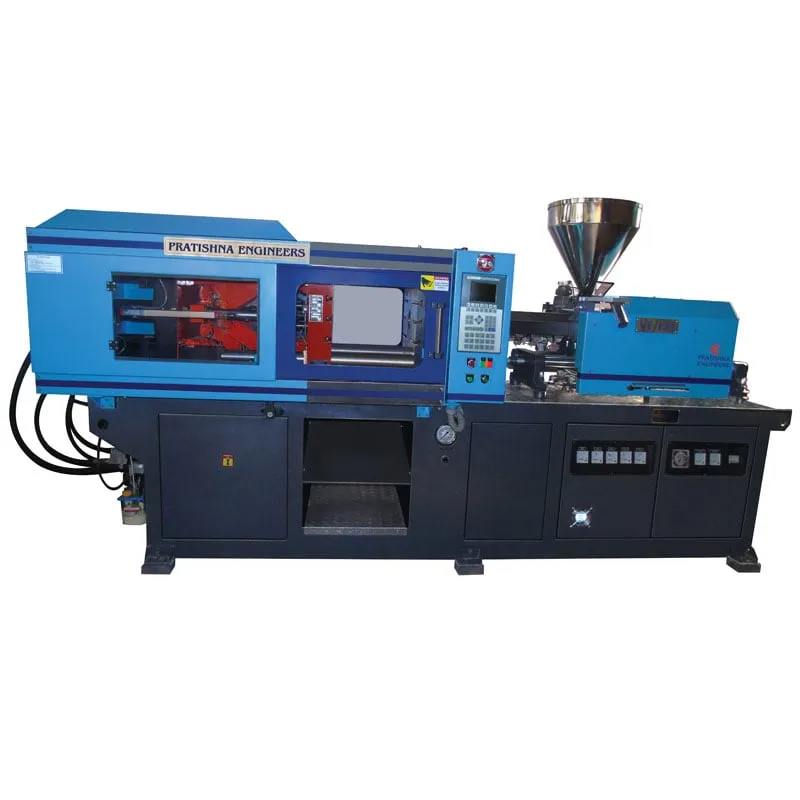

A toggle injection moulding machine for precision work is a sound choice when your parts need fast, repeatable clamp movement at a fairly constant mould height, and a weaker one when you need finely varied clamp force or frequent die-height changes. The table sets out the trade-offs first.
Toggle clamp vs direct hydraulic clamp on precision jobs
| Factor | Toggle clamp | Direct hydraulic clamp |
|---|---|---|
| Lock-up speed | Reported as slightly faster (0.2 s claimed) | 0.5 s claimed in the same report |
| Opening force | Greater; suits deep-draw parts | Lower by comparison |
| Clamp force control | Reported as hard to run below maximum or ramp in a cycle | Reported as finer and more uniform |
| Stroke at different mould heights | Full stroke at every shut height | Maximum daylight = minimum shut height + maximum stroke |
| Parallelism risk | Uneven linkage wear; force applied near the corners | Fewer linkages to wear; wider die-height range |
| Mould protection | Depends on low-pressure close settings | Reported as a strength |
On most precision jobs the clamp does not set your tolerance; the mould, the material and the process do. What the clamp decides is whether that tolerance holds steady across a full shift and over years of wear.
Key Takeaways
- Toggle clamps are reported to lock up faster and open with more force, which helps short cycles and deep parts that grip the core.
- Direct hydraulic clamps are reported to give finer clamp-force control and a wider die-height range, which suits frequent mould changes and low tonnage settings.
- Platen parallelism decides how evenly the parting line closes; for machines under 500 t, 0.025 to 0.05 mm is generally treated as acceptable.
- A mould covering less than about 70% of the tie-bar gap lets the platens bow under clamp, which shows up as flash in the mould centre.
When is a toggle injection moulding machine for precision work the right choice?
Choose a toggle injection moulding machine for precision work when cycles are short, the mould height stays fairly constant and the part needs a firm, fast lock rather than finely varied clamp force. Thin-wall packaging, small technical parts and multi-cavity moulds that run long batches fit this pattern.
A toggle multiplies the force of a small cylinder through its linkage. Near full extension the links lock almost straight, so the platen is held mechanically rather than by oil pressure alone. That is why a locked toggle holds position well, and why defenders of the design point to its simplicity, rigidity and reliability.
The same linkage gives a high opening force at the start of the stroke. Parts that shrink tightly onto a deep core, such as cups, housings and closures with long skirts, release more cleanly when the mould can break open hard. The reported faster lock-up also trims a fraction of a second from every cycle.
Where the toggle earns its place on precision work is repeatable movement. The crosshead travels the same path each cycle, so the mould closes along the same speed profile shot after shot. Thin-wall PP containers are a typical toggle job; Reliance lists its Repol H200MA grade, at an MFR of 25 g/10 min, for thin-walled containers and multicavity moulding.
Does a toggle clamp hold the mould parallel enough for tight tolerances?
Usually yes on a well-built and well-maintained machine, but parallelism has to be checked rather than assumed. For machines under 500 t, level and parallelism of 0.025 to 0.05 mm is generally acceptable; worn linkages and corner loading are the two things that push a toggle outside that band.
Most toggles apply force through the corners of the platen, near the tie bars. That can mean more platen deflection at the centre than a design that pushes from the middle. If the links on one side wear faster than the other, the platen closes slightly out of square and the parting line wears unevenly.
Mould size plays into this. A rule of thumb is that the mould should cover at least 70% of the distance between the tie bars. A smaller mould leaves the platen unsupported in the middle, so it bows under clamp and flash appears at the centre of the mould rather than at its edges.
Our view is flat: if your tolerance sits across the parting line, ask for a parallelism reading on the actual machine you are buying, taken under clamp. A brochure figure tells you how a machine left the assembly bay, not how its links behave after years of grease, heat and load.
Where does a hydraulic clamp fit better than a toggle?
A direct hydraulic clamp fits better when you change moulds of very different heights, need to run well below rated tonnage, or want clamp force ramped within the cycle. These clamps are reported to give finer, more uniform pressure control and better mould protection than toggles.
Toggles have a more limited stroke-adjustment range, and die-height adjustment brings its own risk. If die height is set with a cold mould closed, the mould can be over-clamped once it warms and expands. Over-clamping is not harmless: it can crush vents, roll the parting line, break inserts and crack mould blocks.
Low-tonnage precision work shows the difference most. A small, delicate mould on a large toggle may need only part of the machine's force, and toggles are reported to be hard to run well below maximum tonnage. A hydraulic or two-platen clamp lets you set the force the mould needs and no more.
Opening stroke is the other check. On a toggle, full stroke is available at every shut height. On a piston clamp, maximum daylight equals minimum shut height plus maximum stroke, so a tall mould eats into the stroke. Deep parts in tall moulds need that sum worked out before you choose.
What should you check before choosing a toggle clamp for precise parts?
Send the mould dimensions, part height, material and the tolerance on critical features, then ask for the tie-bar gap, stroke, shut-height range and a measured parallelism figure. Work the fit yourself with the example below. For machines with toggle clamps, see the horizontal injection moulding machine range.
Frequently Asked Questions About Toggle Clamps for Precision Moulding
Is a toggle machine more accurate than a hydraulic one?
Not by itself. Accuracy comes from the mould, the material and process control. A toggle repeats its closing motion well and is reported to lock up faster, while a direct hydraulic clamp is reported to control clamp force more finely. Pick the clamp that suits your mould heights, tonnage needs and cycle.
Why does flash appear in the middle of the mould on a toggle machine?
A common cause is a mould that is too small for the platens. When the mould covers less than about 70% of the tie-bar gap, the platens can bow under clamp and open slightly at the centre. Check mould size against the tie-bar gap before you raise clamp force.
Can I run a toggle machine at low tonnage for a small mould?
You can set lower tonnage on many toggles, but they are reported to be harder to run well below maximum than hydraulic clamps. For a small, delicate mould, check how the machine sets and monitors low clamp force, and avoid setting die height with a cold mould closed.
How often should toggle linkages be checked?
Follow the maker's lubrication and inspection schedule, and add a parallelism check whenever parting-line wear, flash or dimensional drift appears. Uneven linkage wear is the usual reason a toggle platen closes out of square, and it is easier to correct early than after the parting line has worn.
What opening stroke do I need for a deep part?
A common guide is an opening stroke of at least 2.5 times the part height, so the part clears the core and can drop or be picked out cleanly. On a toggle, that stroke is available at every shut height; on a piston clamp, check the stroke left at your mould height.
Related Articles
- The Benefits of Vertical Injection Moulding Machines for Compact Spaces
- How PET Injection Molding Machines Revolutionize the Beverage Industry
- How Horizontal Injection Moulding Machines Boost Efficiency in Manufacturing
- Types of Injection Moulding Machines
Sources & References
- Plastics Technology, M. Knights: Hybrid Injection Clamps: The Best of Both Worlds? (June 2010)
- MoldMaking Technology, B. Catoen: Machine Sizing and Specification for Optimal Mold Performance, Part 1 (Aug 2025)
- Plastics Technology, P. Witaszek, J. Klees, J. Fattori, E. Di Siro, J. Bozzelli: How to Mount an Injection Mold (June 2017)
- Reliance Industries: Repol H200MA Technical Data Sheet (July 2024)
Technical Disclaimer
Disclaimer: The information provided in this document is for general informational and educational purposes only. It is based on technical references and industry information available at the time of preparation and may be subject to change. It does not constitute engineering, technical, commercial or professional advice, nor does it constitute a quotation, specification, warranty or contractual commitment by Pratishna Engineers.
Actual injection moulding machine and process requirements vary according to the component design, material, mould, production volume, machine configuration and operating conditions. The information, examples, calculations and recommendations provided should be independently evaluated and verified for the specific application before making any equipment, process or production decision. Information obtained from third-party sources remains subject to the accuracy and limitations of those sources.
Limitation of Liability: Pratishna Engineers makes no representation or warranty, express or implied, regarding the completeness, accuracy or suitability of the information for any particular application. To the extent permitted by applicable law, Pratishna Engineers shall not be liable for any loss, damage, cost or consequence arising from reliance on or use of the information contained in this document. Final machine selection, configuration and application suitability should be confirmed with Pratishna Engineers based on complete and accurate project requirements.

