






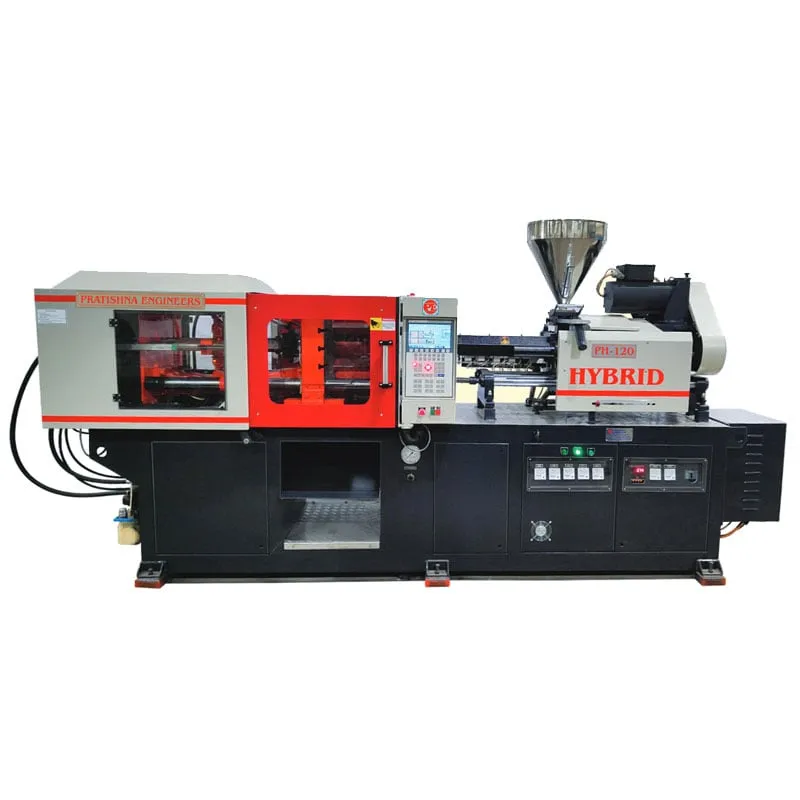

On a 40 mm screw, every millimetre of screw travel moves about 0.93 g of polypropylene melt (12.57 cm² of screw area × 0.1 cm × 0.74 g/cm³ melt density). Hold a 100 g shot to ±0.5 g and the screw has to finish each stroke within about ±0.54 mm, cycle after cycle. That is the real test of hybrid injection moulding machine precision. An electric injection axis meters that stroke with a servo motor and ball screw and reads position directly, while a hydraulic axis depends on valve response, oil temperature and the intensification ratio. This guide explains where each gains or loses grams.
Key Takeaways
- A hybrid machine in this sense pairs a hydraulic clamp with a servo-electric injection axis, so shot precision depends mostly on how well the electric axis repeats.
- Shot weight follows screw position: on a 40 mm screw with PP, a 1 mm error in stroke end changes the shot by about 0.93 g.
- Hydraulic injection multiplies every oil pressure drift by the intensification ratio, which ranges from 6:1 to 43:1, while an electric axis reads plastic pressure at about 1:1.
- Keep the shot within 25% to 65% of barrel capacity before blaming the drive, because a badly sized barrel scatters shot weight on any machine.
Why does an electric injection axis repeat shot weight better than hydraulic injection?
An electric axis drives the screw through a servo motor under closed-loop position and speed control, so the same command gives the same stroke each cycle. A hydraulic axis converts oil flow into screw movement, and oil temperature, valve response and pump behaviour all add variations to that conversion.
The intensification ratio explains much of the gap. On a hydraulic unit, plastic pressure equals hydraulic pressure multiplied by the ratio of ram area to screw area, and machines range from 6:1 to 43:1. On a 10:1 unit, a 2 bar wobble in oil pressure becomes a 20 bar wobble at the screw tip.
An electric machine reads plastic pressure directly, at an effective ratio of about 1:1, so the controller sees the melt rather than the oil. That matters most in the hold phase, where small pressure changes decide how much extra material packs into the cavity as the part shrinks.
Oil temperature is the other variable. Viscosity changes as the oil warms through the start of a shift, so a hydraulic injection unit often drifts until it stabilises. An electric axis has no oil in the injection path, which is why its first good part tends to come sooner.
How does hybrid injection moulding machine precision compare with hydraulic injection?
On shot weight, a hybrid with electric injection usually holds a tighter band than hydraulic injection, because stroke, speed and hold pressure repeat with less drift. The clamps behave alike, since both use hydraulic clamping. The gap shows most on thin walls and tightly packed small parts.
Where the injection drive affects shot consistency
| Factor | Hydraulic injection | Electric injection (hybrid) |
|---|---|---|
| Pressure sensing | Hydraulic pressure × intensification ratio (6:1 to 43:1) | Plastic pressure read at about 1:1 |
| Stroke end position | Set by valve closing and oil compressibility | Set by the servo position loop |
| Warm-up drift | Changes as oil viscosity settles | No oil in the injection path; barrel heat still settles |
| Hold pressure | Proportional valve control | Motor torque control |
| Screw recovery | Hydraulic motor, speed varies with oil | Servo motor, speed held by the encoder |
Thin-wall work shows why. Thin-wall parts often fill in under 1 s at injection speeds above 76 mm/s, and the control resolution quoted for such machines runs to 1 bar on pressure and 0.01 s on time. A drive that cannot repeat at that level turns every small variation into a short shot or flash.
Heavier parts with thick walls are more forgiving. Cooling dominates their cycle, and a few tenths of a gram is a tiny share of the part weight. For buckets, crates and similar work, a well-maintained hydraulic injection unit is often precise enough.
Our view is flat: if your rejects come from weight scatter on small precise parts, the electric injection axis earns its place. If they come from an unbalanced mould or wet resin, no drive will fix them. Measure before you decide: weigh a few dozen consecutive shots and look at the spread.
Which other machine factors decide shot weight consistency?
Barrel sizing, check-valve condition, melt temperature control and resin moisture decide as much as the drive does. A precise electric axis cannot repeat a shot whose melt changes from cycle to cycle, so check these before you pay for a different injection drive.
Start with the barrel. A shot should use 25% to 65% of barrel capacity. Below 25% the screw turns too few times to give a uniform melt, and below 20% residence time grows long enough to degrade the resin. Above 65% you risk unmelt and long recovery.
Shot ratings are usually given in grams of polystyrene, so convert before you compare. With PS melt at about 0.945 g/cm³, PP melt at about 0.74 g/cm³ and 10% added for check-valve leakage, a barrel rated 1,000 g PS covers PP shots of about 142 to 463 g between 20% and 65% use.
Then check the check ring. A worn ring lets melt slip back during injection and hold, so cushion wanders and shot weight follows it. Rising energy on the same job can also point to screw or barrel wear. Fix wear first; a new drive will only measure the leak more accurately.
Keep the barrel profile inside the resin's window. For a nucleated Indian PP homopolymer such as Repol H110MAS, the data sheet gives a melt range of 200 to 250 °C and an MFR of 11 g/10 min.
What should you measure before choosing an injection drive?
Weigh a run of consecutive shots on your machine, note cushion spread and oil temperature, and send those figures with your part drawing and resin grade. That data shows whether the drive, the barrel or the mould is the limit. Keep the same resin lot during the test so the figures compare fairly. See the hybrid injection moulding machine page.
Frequently Asked Questions About Hybrid Injection Precision
Is a hybrid machine as repeatable as an all-electric machine on injection?
On the injection side they can be close, because both use a servo-electric axis that reads plastic pressure directly. The differences sit elsewhere: clamp movement, ejection and base energy use. For parts where shot weight is the main concern, test the injection axis on your mould rather than judging by the label.
How do I measure shot weight consistency on the shop floor?
Run the machine until oil and mould temperatures settle, then weigh a run of consecutive shots with runners on a balance that reads to 0.01 g. Record cushion for each shot. Plot weight and cushion together; if they move together, look at the check ring or stroke control before the mould.
Does oil temperature affect the shot on a hybrid machine?
Much less than on a hydraulic injection unit, because the injection axis on a hybrid is electric. Oil still drives the clamp, so clamp speed and mould protection can change while the oil warms. Keep the oil cooler and its water supply in good order, since clamp drift can still affect flash on some moulds.
What is the intensification ratio and why should a buyer ask for it?
It is the ratio of the hydraulic ram area to the screw area, and it converts hydraulic pressure into plastic pressure. Ratios range from 6:1 to 43:1 and change with screw size. Ask for it per screw option, because a smaller screw raises plastic pressure but also multiplies any oil pressure variation.
Can a hydraulic machine be upgraded for better shot precision?
Partly. A servo pump or variable-speed motor retrofit improves energy use and can steady pressure response, and closed-loop injection control helps further. It will not turn a hydraulic axis into an electric one, so for very tight weight bands on small parts, compare the retrofit result with a trial on electric injection.
Related Articles
- Vertical Locking Horizontal Injection Moulding Machine: A Synergy of Design and Efficiency
- Vertical Locking Vertical Injection Sliding Double Station Machines
- Hybrid Injection Moulding Machine for High-Efficiency Manufacturing
- Hybrid vs Hydraulic Injection Moulding Machine
Sources & References
- Plastics Technology, J. Bozzelli: Understanding Intensification Ratio
- Plastics Technology, J. Bozzelli: A Simpler Way to Calculate Shot Size vs. Barrel Capacity
- PlasticsToday, G. Tremblay: Never too thin
- Reliance Industries: Repol H110MAS Technical Data Sheet
Technical Disclaimer
Disclaimer: The information provided in this document is for general informational and educational purposes only. It is based on technical references and industry information available at the time of preparation and may be subject to change. It does not constitute engineering, technical, commercial or professional advice, nor does it constitute a quotation, specification, warranty or contractual commitment by Pratishna Engineers.
Actual injection moulding machine and process requirements vary according to the component design, material, mould, production volume, machine configuration and operating conditions. The information, examples, calculations and recommendations provided should be independently evaluated and verified for the specific application before making any equipment, process or production decision. Information obtained from third-party sources remains subject to the accuracy and limitations of those sources.
Limitation of Liability: Pratishna Engineers makes no representation or warranty, express or implied, regarding the completeness, accuracy or suitability of the information for any particular application. To the extent permitted by applicable law, Pratishna Engineers shall not be liable for any loss, damage, cost or consequence arising from reliance on or use of the information contained in this document. Final machine selection, configuration and application suitability should be confirmed with Pratishna Engineers based on complete and accurate project requirements.

