






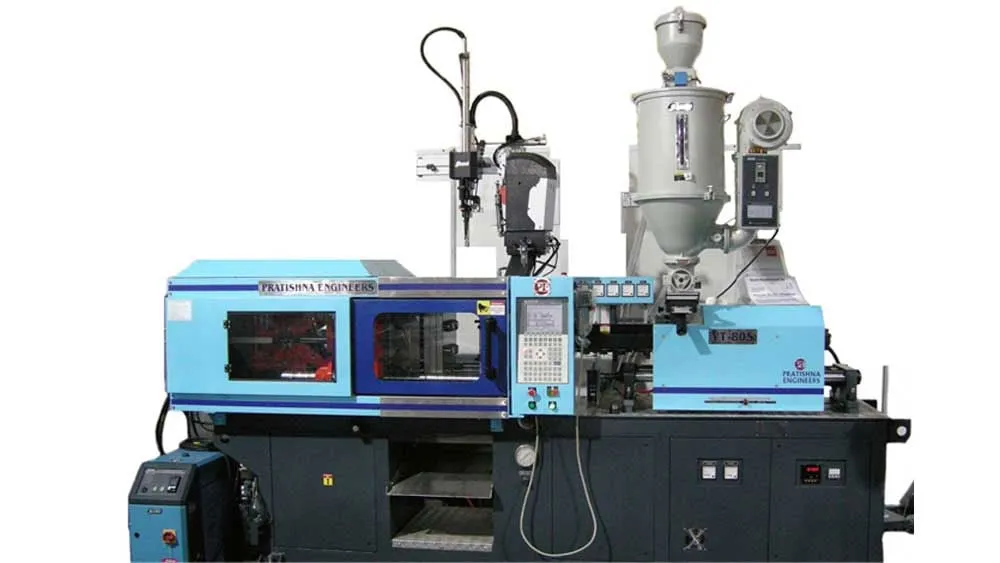

If you are buying from an injection moulding machine exporter India based, check these five points before you sign:
1. Supply. Your plant's voltage and frequency, written on the order and on the machine nameplate.
2. Guarding. The safety standard the machine is built to, and the one your country enforces.
3. Screen. The language and units of the operator screen, alarms and manuals.
4. Spares. A written first-year spares list that ships with the machine.
5. Support. How remote diagnosis works across time zones, and who travels when it does not.
Pratishna Engineers, a Mumbai manufacturer since 1991 with customers in India and international markets, is the author of this guide. The sections below explain each point.
Key Takeaways
- A machine built for 50 Hz runs its fixed-speed motors about 20% faster on 60 Hz. Specify the site supply before the machine is built.
- ISO 20430:2020 sets essential safety requirements for injection moulding machines. Ask which edition and which local rules the exporter has checked.
- Agree screen language, alarm text and pressure units at order stage, not at commissioning.
- Ship the second barrel and the first-year heater, thermocouple and seal kit with the machine.
What should an overseas buyer check about voltage and frequency?
Write the site voltage, number of phases and frequency on the purchase order, and ask the exporter to confirm that every motor, heater, transformer and control circuit is built for them. A mismatch shows up at commissioning as tripping drives, overheated motors or pumps delivering the wrong flow.
Frequency is the less obvious trap. A standard induction motor runs at a speed set by supply frequency, so a fixed-displacement pump on a 60 Hz supply turns about 20% faster than it would on 50 Hz. Flow and the power needed to drive it rise by about the same amount.
Servo and variable-speed drives behave differently. The drive converts the incoming supply before it reaches the motor, so motor speed is set by the drive, not by the mains. That makes them more tolerant of frequency, but the drive itself must still be rated for your voltage.
Heaters and control transformers need the same check. A heater band rated for one voltage gives a different output on another, and control circuits fed from the wrong tap can fail quietly. Ask for the electrical drawings before dispatch and have your electrician review them.
Which safety standard should the guarding meet?
ISO 20430:2020 is the international standard for injection moulding machine safety. It sets essential safety requirements for design and construction and gives information for safe use, for machines with hydraulic or electrical platen drives. Your country may add its own rules, so ask which ones the exporter has checked.
The standard has limits worth knowing. It does not cover the mould or the exhaust system, and it does not apply to machines built before its publication. If you also buy used machines locally, they may have been built to older rules.
Guarding questions to put to an exporter
| Area of the machine | What to ask |
|---|---|
| Mould area | How the safety gate is interlocked, and what stops the clamp if the gate opens mid-cycle |
| Clamp mechanism | How the toggle or clamp cylinders are guarded from the rear and sides |
| Nozzle and purge area | What shields the operator during purging and nozzle changes |
| Electrical cabinet | Which standard the panel wiring follows, and how live parts are covered |
| Automation openings | How the robot or conveyor opening is guarded when equipment is added later |
Plan the guarding of anything you add later. A robot, conveyor or insert-loading station changes the openings in the guard, and the combined cell needs its own safety check, not just the machine alone.
Ask for the risk assessment and the declaration the exporter will issue, and read them before the factory trial, not after the machine lands.
Can the operator screen run in your plant's language?
Ask the exporter which screen languages the controller supports, whether alarm messages are translated as well as menus, and which units the screen shows for pressure and temperature. Agree these at order stage, because changing them on site can mean controller software work and delays during commissioning.
Alarm text is where translation matters most. An operator who can read the menu but not the alarm will call for help on faults they could have cleared. Ask for a sample of the alarm list in your language before dispatch.
Manuals deserve the same attention. Maintenance staff read circuit drawings and lubrication charts more often than operators read the screen, so ask whether the maintenance manual, not only the operation manual, is available in your language.
Units cause quieter mistakes. Pressure may be shown in kg/cm², bar or MPa, and a setting copied from another machine without conversion can be badly wrong. Agree one set of units for screens, manuals and process sheets.
Injection moulding machine exporter India: how will spares and service reach you abroad?
Through three layers: spares shipped with the machine, remote diagnosis for most faults, and an agreed plan for when an engineer must travel. Get all three in writing. Shipping a single part across borders can take longer than the fault takes to fix, so the first layer matters most.
A second barrel is worth ordering with the machine. It can be low cost when ordered new, and a skilled operator can swap a barrel in under 30 minutes. That turns a worn or damaged screw from a long stoppage into a short one.
Our flat view: ship the second barrel and the first-year kit of heater bands, thermocouples, seals, fuses and proximity switches with the machine, not after the first breakdown.
Ask where wear parts are sourced as well. Standard items such as fuses, contactors and proximity switches may be available from distributors in your own country if the exporter names the exact part numbers in the spares list. That shortens many repairs to a local purchase.
For remote support, agree the hours your time zone overlaps with the exporter's, how alarm history and photos are shared, and who on your team is trained to take measurements. Train that person at the factory trial if you can attend it.
What should happen before the machine leaves India?
A factory acceptance trial on your mould, a signed test report, packing fit for the journey and a complete document set. Each one is far easier to fix at the exporter's factory than at your plant, where every missing item means waiting for another shipment.
Packing needs as much thought as the machine. Long sea routes bring humidity and salt, so ask how machined surfaces, tie bars and the barrel are protected against rust, how moving parts are locked for transit, and whether the hydraulic tank ships full or empty. Ask for photographs of the packed machine.
Check the document set against a list before dispatch: test report, operation and maintenance manuals, electrical and hydraulic circuit drawings, recommended spares list, packing list and the safety declaration. Missing drawings are the item most likely to slow down your own electrician and maintenance team after arrival.
How Pratishna Engineers works with overseas buyers
Pratishna Engineers has 35+ years of experience, with 9,000+ machines and 1,000+ customers in India and international markets. Design, manufacturing, assembly, testing and service are done in-house in Mumbai, and an independent QA department works to written SOPs, with accredited external labs used when required.
The range covers horizontal (E, C and H series), vertical (PV and PVDL series), PET, two-platen (PHM series), hybrid and special purpose machines. Catalogue data for the E, C, H and PHM series states injection pressure in kg/cm², so tell us if your plant works in bar or MPa.
- Machine selection follows the order Component, Material, Mould, Production Requirement, Machine Configuration.
- The design team works in SolidWorks, Creo and AutoCAD, so drawings can be shared in common formats.
What should you send an exporter before asking for a proposal?
Send the part and mould drawings, material, output target, site voltage, phases and frequency, the screen language and units you need, the safety rules your country enforces, and your spares expectations. Ask for the answers point by point. Then compare ranges on the products page.
Frequently Asked Questions About Buying an Exported Machine
Can a machine built for 50 Hz run on a 60 Hz supply?
Sometimes, but not without checks. Fixed-speed motors turn about 20% faster, so pumps deliver more flow and draw more power. Heaters, transformers and control circuits must also suit your voltage. Tell the exporter your supply at order stage so the machine is built and tested for it.
Does ISO 20430 apply to machines built before 2020?
No. ISO 20430:2020 states it is not applicable to injection moulding machines manufactured before its publication. A used machine may have been built to an older standard or to local rules. Check the declaration that came with it and have the guarding assessed against your current local requirements.
Which spares should travel with an exported machine?
At least heater bands, thermocouples, seals, fuses and proximity switches, plus a check ring and a second barrel if the job wears screws. Ask the exporter for a first-year list based on your material and running hours, and pack the spares with the machine so they clear customs together.
What should the factory acceptance trial prove?
That the machine runs your mould at the agreed cycle, at your supply settings where possible, with the safety interlocks working and the screen in your language. Record cycle time, shot weight and alarm checks in a signed report. Attend in person or by video if you can.
Which units should the operator screen show?
The ones your plant already uses on its other machines and process sheets. Pressure may be shown in kg/cm², bar or MPa, and temperature in °C or °F. Agreeing one set at order stage avoids conversion mistakes when settings are copied between machines.
Does Pratishna supply machines outside India?
Yes. Pratishna Engineers has supplied 9,000+ machines to 1,000+ customers in India and international markets. Share your site supply, safety rules, screen language and spares needs with the enquiry, and selection follows the order Component, Material, Mould, Production Requirement, Machine Configuration.
Related Articles
- Injection Moulding Machine Suppliers in India
- Injection Moulding Machine Suppliers in Maharashtra
- Injection Moulding Machine Exporters from Mumbai
- Indian vs Imported Injection Moulding Machines
Sources & References
- ISO: ISO 20430:2020 Plastics and rubber machines: Injection moulding machines: Safety requirements
- Plastics Technology, J. Bozzelli: A Simpler Way to Calculate Shot Size vs. Barrel Capacity
Technical Disclaimer
Disclaimer: The information provided in this document is for general informational and educational purposes only. It is based on technical references and industry information available at the time of preparation and may be subject to change. It does not constitute engineering, technical, commercial or professional advice, nor does it constitute a quotation, specification, warranty or contractual commitment by Pratishna Engineers.
Actual injection moulding machine and process requirements vary according to the component design, material, mould, production volume, machine configuration and operating conditions. The information, examples, calculations and recommendations provided should be independently evaluated and verified for the specific application before making any equipment, process or production decision. Information obtained from third-party sources remains subject to the accuracy and limitations of those sources.
Limitation of Liability: Pratishna Engineers makes no representation or warranty, express or implied, regarding the completeness, accuracy or suitability of the information for any particular application. To the extent permitted by applicable law, Pratishna Engineers shall not be liable for any loss, damage, cost or consequence arising from reliance on or use of the information contained in this document. Final machine selection, configuration and application suitability should be confirmed with Pratishna Engineers based on complete and accurate project requirements.

