






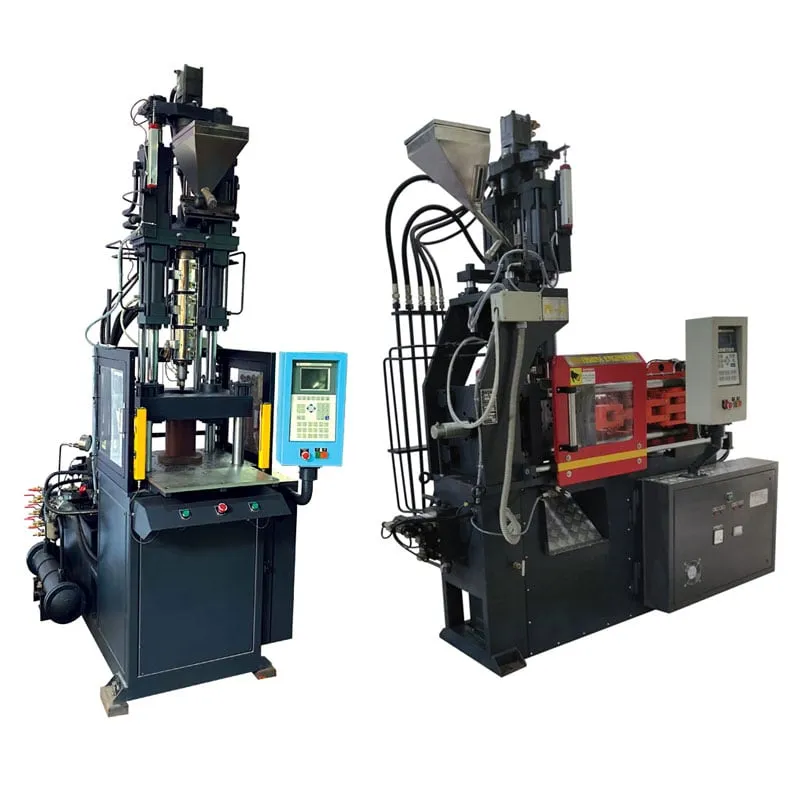

Picture a cable-assembly unit in a rented gala with a low mezzanine and no room for another long horizontal machine. The job is a brass terminal moulded into a nylon housing, and the operator keeps losing inserts that slide off a vertical mould face. The benefits of vertical injection moulding machines fit that problem: the mould lies flat, gravity holds the insert in place, and the machine stands on a small floor area. The trade-off is that parts do not fall out on their own, so loading and removal set the pace.
Key Takeaways
- A horizontal mould face lets gravity hold inserts, pins and wire ends in place, so fewer inserts shift as the clamp closes on them.
- The clamp stands upright, so the machine takes less floor area than a horizontal of similar clamp force, though it needs more height.
- Overmoulding a second material onto a preformed part is easier when that part rests in an open, flat cavity the operator can see.
- Parts and runners do not drop free, so manual removal and insert loading often set the cycle; plan a second station or robot early.
What are the real benefits of vertical injection moulding machines on a crowded floor?
The main gains are gravity-held inserts, a small footprint and easy access to an open, flat mould for loading and overmoulding. On a crowded floor, a vertical machine lets you add insert work without rearranging aisles, provided you have the ceiling height and a clear loading zone.
Footprint is the obvious one. The clamp unit sits above the mould rather than beside it, so the machine's length along the floor shrinks. What you give up is height: check the ceiling, any overhead crane path and the space needed to lift the mould in and out before you place the order.
Vertical vs horizontal clamp: where each layout helps
| Factor | Vertical clamp | Horizontal clamp |
|---|---|---|
| Insert holding | Gravity holds inserts on a flat mould face | Inserts need pins, magnets or retaining features |
| Floor area | Shorter along the floor; needs height | Longer along the floor; lower height |
| Part removal | Manual pick or robot; parts do not drop free | Parts and runners can drop by gravity |
| Overmoulding | Preformed part sits open in the cavity | Preformed part must be held on a vertical face |
| Automation | Rotary or shuttle tables, side pick and place | Robot over the platen, conveyor below |
Gravity is the bigger advantage for insert work. A brass bush, a pin or a wire end laid on a flat core stays where it is put, so the mould needs fewer retaining features for each insert. Inserts that float or shift can damage the mould or end up out of position, and a flat face cuts that risk.
Why does insert moulding favour a vertical clamp?
Insert moulding favours a vertical clamp because the insert rests on a horizontal face and stays put while the mould closes. A flat, open cavity also makes a visual check before each shot easier, so a missing or tilted insert is caught before the mould closes on it.
Moulding metal in is often treated as a last resort, because inserts can often be pressed, snapped or ultrasonically placed after moulding instead. It still makes sense for threads under stress or frequent disassembly, close-tolerance female threads and permanent joints between highly loaded parts. When you need it, the vertical layout makes it practical.
Design rules matter as much as the machine. Inserts should have rounded edges or rounded knurls, protrude at least 0.4 mm into the cavity and have plastic beneath them of at least one sixth of the insert diameter. A boss about 1.5 times the insert diameter is a common guide for inserts up to 12.9 mm.
Preheating the insert reduces the hoop stress that builds as plastic shrinks onto cold metal, and delayed cracking from that stress is the most common complaint in insert moulding. Many Indian electrical accessories carry metal parts in plastic, and items such as bayonet lamp holders (IS 1258) and switch-socket-outlets (IS 15787) now need the Standard Mark under the Electrical Accessories (Quality Control) Order, 2023.
What are the limits of a vertical machine on part removal and automation?
The main limit is that moulded parts and runners do not fall clear of a horizontal mould face. Someone or something has to lift them out, and on a fixed table that removal adds to the time the mould sits open, together with insert loading, every single cycle.
On a fixed-table machine, the clamp waits while the operator unloads parts and loads fresh inserts. On insert jobs that open-mould time can match the closed time, so hand loading can decide output more than injection or cooling does. The worked example below shows how quickly that sets a ceiling.
Shuttle and rotary tables answer this by loading one lower mould half while the other is in the clamp. A conventional shuttle uses one top half and two bottom halves. The catch is tooling: you pay for the extra lower half, and the machine still waits for each part to cool before the table moves.
Robots help, but vertical cells need planning. Overhead access is limited by the clamp above, so pick-and-place units often work from the side or from an index table. One published case used vision to confirm the cavities were clear of debris and the inserts seated before every shot. Our view is flat: if insert loading is longer than the closed-mould time, do not buy a fixed-table machine for that job.
What should you work out before buying a vertical machine?
Time one cycle by hand: insert loading, part removal and inspection, then the closed-mould time from a trial. Measure the ceiling height and the mould lifting route. With those numbers, decide between a fixed table, a shuttle and a rotary table. See the vertical injection moulding machine range.
Frequently Asked Questions About Vertical Injection Moulding Machines
Do vertical injection moulding machines save floor space?
Yes, along the floor. The clamp sits above the mould, so the machine is shorter in plan than a horizontal machine of similar clamp force. It is taller, though, so check the ceiling, any crane path and the clearance needed to lift moulds in and out before you plan the layout.
Can a vertical machine run without an operator?
It can, with a robot or pick-and-place unit for inserts and parts, and checks that confirm each insert is seated before the mould closes. Without that equipment, someone has to load and unload every shot, because parts do not drop free from a flat mould face.
Is overmoulding easier on a vertical machine?
Often, yes. The preformed part or substrate rests in an open, horizontal cavity, so it stays in position without extra holding features and the operator can see that it is seated. The second material still needs to bond with the first, so check the material pairing before tooling.
Should inserts be preheated before moulding?
Preheating is commonly recommended. A warm insert reduces post-mould shrinkage stress around it and improves weld lines, which lowers the risk of delayed cracking from hoop stress. Test finished parts with temperature cycling to confirm that the insert and the boss hold up in service.
When is a shuttle or rotary table worth adding?
When insert loading and part removal take about as long as the closed-mould time, a second station lets one half be loaded while the other moulds. The cost is an extra lower mould half. Time your loading by hand first, then compare it with the closed time.
Related Articles
- The Role of Toggle Moulding Machines in High-Precision Manufacturing
- How PET Injection Molding Machines Revolutionize the Beverage Industry
- Vertical Injection Moulding Machines: Innovating Manufacturing
- Vertical Injection Moulding Machine for Precision Moulding
Sources & References
- PlasticsToday (IMM), summarising A. Miller, DuPont: Design and material advice from the pros, Part 3: Insert molding essentials (Sept 2005)
- PlasticsToday: Shuttle table increases production (Aug 2008)
- Robotic Industries Association via Smart Molding, J. Clark: Automated injection molding operation
- Gazette of India (DPIIT): Electrical Accessories (Quality Control) Order, 2023
Technical Disclaimer
Disclaimer: The information provided in this document is for general informational and educational purposes only. It is based on technical references and industry information available at the time of preparation and may be subject to change. It does not constitute engineering, technical, commercial or professional advice, nor does it constitute a quotation, specification, warranty or contractual commitment by Pratishna Engineers.
Actual injection moulding machine and process requirements vary according to the component design, material, mould, production volume, machine configuration and operating conditions. The information, examples, calculations and recommendations provided should be independently evaluated and verified for the specific application before making any equipment, process or production decision. Information obtained from third-party sources remains subject to the accuracy and limitations of those sources.
Limitation of Liability: Pratishna Engineers makes no representation or warranty, express or implied, regarding the completeness, accuracy or suitability of the information for any particular application. To the extent permitted by applicable law, Pratishna Engineers shall not be liable for any loss, damage, cost or consequence arising from reliance on or use of the information contained in this document. Final machine selection, configuration and application suitability should be confirmed with Pratishna Engineers based on complete and accurate project requirements.

