






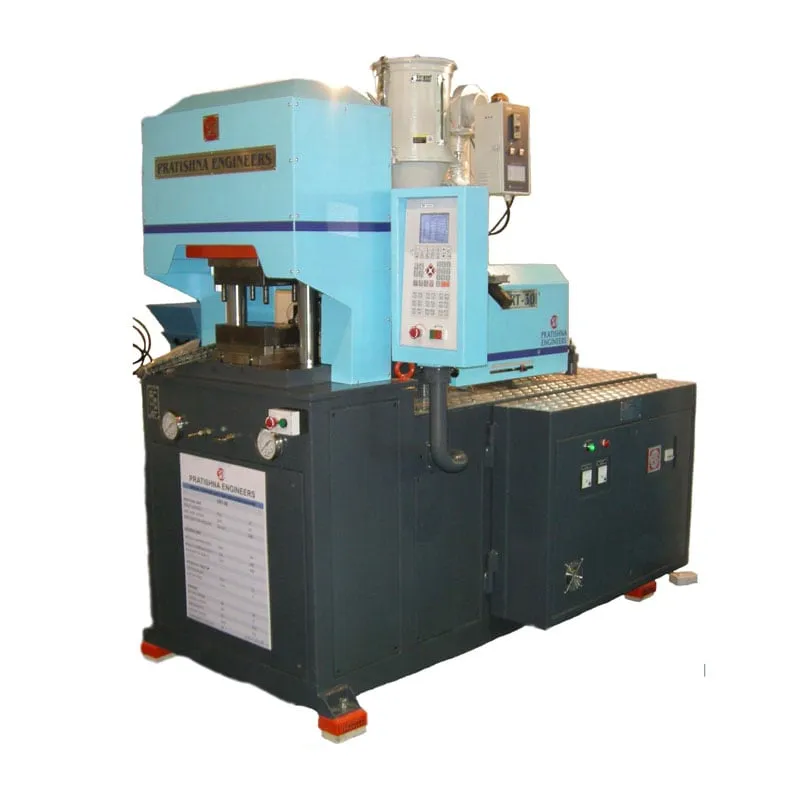

Start with the number. A 10 mm needle hub has a footprint of about 0.785 cm². Eight cavities plus a 4 cm² runner give 10.28 cm² of projected area, which needs only about 4.8 to 8.0 t of clamp at a PC tonnage factor of 3 to 5 US tons/in² with a 10% reserve (a starting margin, not a rule). So on a vertical locking machine for medical parts, clamp force is rarely the limit. Insert loading, clean handling, shot size and how well the mould covers the platen decide the result. Pratishna Engineers builds the PVDL series of vertical clamp, vertical injection machines from 40 to 100 t for insert moulding. This guide shows how to size one for hubs, connectors and other small device parts, and what Indian device rules mean for your line.
Key Takeaways
- Small medical parts such as needle hubs need very little clamp; an eight-cavity hub mould works out at about 4.8 to 8.0 t, far below any machine frame.
- Insert loading time, not moulding time, often sets the cycle on cannula and pin insert jobs, so plan the loading method before you fix the cavity count.
- The mould should cover at least 70% of the tie-bar gap, or the platens can bow under clamp and flash the centre of the mould.
- Hypodermic needles and syringes are notified devices in India, so your process records, cleanliness and hub bond testing all matter to the device maker.
Why choose a vertical locking machine for medical parts?
A vertical clamp holds loose inserts in the lower mould half by gravity, so a cannula, pin or metal bush stays where the operator or robot placed it. That makes a vertical locking machine for medical parts the natural choice when every shot carries a metal insert.
On a horizontal machine the parting line is vertical, so an insert must be held by a magnet, a spring pin or a vacuum port while the mould closes. Each of those adds tooling cost and one more way for an insert to drop. With a horizontal parting line, the lower half becomes a fixture the loader can see from above.
Needle hubs show why this matters. Published guidance on needle assembly notes that moulding the cannula into the hub is slow and costly, and must be very accurate to avoid leak paths. Many device makers bond the tube with adhesive instead. Where you do mould it in, the machine must close on every shot without disturbing the tube.
Common hub materials include ABS, acrylic, PC, PE, PP, polysulfone and PU. PE and PP need surface treatment before adhesive bonding, so with those grades, moulding the tube in or adding annular rings to the hub may be the cleaner route. Settle that choice with the device maker before you size the machine.
How do you size clamp, shot and platen for small medical parts?
Size in this order: projected area and clamp, then shot volume against the barrel, then mould size against the tie bars. For small medical parts the first check usually passes easily, and the shot and platen checks are the ones that decide which machine frame is right.
Shot comes next. Keep each shot between about 20% and 65% of barrel capacity. Below 20%, resin sits too long in the barrel and degrades; above 65%, melt quality suffers. A tiny hub shot on a large barrel is the common mistake, and it hits heat-sensitive grades hardest. Use the smaller of the two screw options where one is offered.
Then the platen. As a rule of thumb, the mould should cover at least 70% of the distance between the tie bars. On the 255 mm side of a 410 x 255 mm tie-bar space, that means a mould at least about 179 mm across. A compact hub mould can fall short of that on a larger frame.
When it does, the platens bow under clamp and flash appears in the centre of the mould, the very place your finest features sit. Very small moulds on big platens can even damage the platens. A larger machine adds nothing to a hub mould except platen area the mould cannot support and a barrel too big for the shot.
The flat rule here: on small medical parts, pick the smallest frame the mould covers properly, then check the shot against its smaller screw. Clamp margin is almost never the reason to go bigger.
How should insert loading and clean handling be planned?
Plan loading as part of the cycle, not after it. Time how long the loader takes to place every insert and remove the parts, then compare that with the moulding time. Whichever is longer sets your output, and a sliding table only helps when loading is the longer one.
A conventional shuttle table uses one top mould half and two bottom halves. The operator loads one bottom half while the press moulds the other. The catch is that the machine still waits for the first part to cool in the clamp before it can mould the second.
Insert loading methods on vertical machines
| Method | How it works | When it fits |
|---|---|---|
| Fixed lower half, manual load | Operator removes parts and places inserts between shots | Low volumes, trials, few inserts per shot |
| Sliding (shuttle) table | Two lower halves; one is loaded while the other is moulded | Loading time close to or above moulding time |
| Rotary table | Two or more lower halves index around the press | Several loading or checking steps per cycle |
| Robot with vision | Robot loads inserts; cameras confirm seating and clear cavities | High volume, many inserts, strict traceability |
Automation changes the picture. In one published robot cell for a four-cavity insert mould, 30 s went on unloading, checking cavities for debris and loading inserts by hand. A SCARA robot fed from a vibratory bowl took over, with vision confirming clear cavities and seated inserts before each shot.
Clean handling is the other half. Keep parts off the floor, drop them into covered bins or onto a conveyor, and keep regrind and other materials away from the press. Consistent mould-open times also hold mould temperature steady, which helps dimensions stay put from shot to shot.
What do Indian device rules mean for a moulder of medical parts?
Hypodermic needles, syringes, IV cannulae and similar items are notified devices under the Drugs and Cosmetics Act, with the Medical Devices Rules, 2017 in force from 1 January 2018. The device maker holds the regulatory duty, but your moulding records become part of its evidence.
A draft risk list annexed to a 2017 CDSCO notice placed single lumen hypodermic needles, disposable syringes and IV cannulae in Class B, and scalp vein sets in Class C. Check the current class with your customer, because that list was published as a draft.
ISO 7864, the international standard for sterile single-use hypodermic needles, covers the hub, its colour coding and the bond between hub and needle tube, with an informative annex on bond strength testing. If you mould the hub, expect your customer to test that bond on samples from your line.
For the machine, this points to repeatability you can record. Ask for a controller that logs set points and alarms, a fixed cycle that does not drift, and a way to lock settings once the process is validated. Those features do more for a device audit than extra clamp force.
How Pratishna Engineers builds the PVDL series for insert moulding
Pratishna Engineers was founded in Mumbai in 1991 and has supplied 9,000+ machines to 1,000+ customers in India and international markets. Design, manufacturing, assembly, testing and service are done in-house, and an independent QA department works to written SOPs, using accredited external labs when required.
The PVDL series is a vertical clamp, vertical injection machine made for insert moulding, from 40 to 100 t. Each size offers A and B screws, so you can match the barrel to a small shot. For loading-heavy jobs, the PVDL-S series adds sliding moulds from 60 to 140 t.
- Selection follows a fixed order: component, material, mould, production requirement, then machine configuration.
- Send your part drawing, insert details and target output, and the team checks clamp, shot and tie-bar fit against the series data below.
PVDL series figures relevant to small medical parts (from the series sheet, as given)
| Figure | PVDL-40 | PVDL-60 | PVDL-80 |
|---|---|---|---|
| Mould clamping force (Tons) | 40 | 60 | 80 / 100 |
| Screw diameter A / B (mm) | 35 / 32 | 38 / 35 | 42 / 38 |
| Max. shot weight (PS) A / B (gms) | 130 / 108 | 178 / 151 | 218 / 178 |
| Max. injection pressure A / B (Kg/cm²) | 1280 / 1531 | 1265 / 1491 | 1090 / 1330 |
| Space between tie bars H x V (mm) | 410 x 255 | 460 x 310 | 500 x 350 |
| Max. daylight opening (mm) | 400 | 475 | 475 |
What should you send before choosing a machine?
Send the part drawing, material grade, insert type and count, planned cavities and the output you need per shift. Add any cleanliness or record-keeping rules your customer sets. With those, the clamp, shot and platen checks above can be run on real numbers. See the PVDL series vertical injection moulding machine page.
Frequently Asked Questions About Vertical Machines for Medical Parts
Can a vertical machine mould a needle hub around the cannula?
Yes. The cannula sits in the lower mould half and gravity keeps it in place while the mould closes. The catch is accuracy: any gap around the tube becomes a leak path, so the mould needs close-fitting locators and the loader must seat every tube fully. Many device makers bond tubes with adhesive instead.
How much clamp force does a needle hub mould need?
Very little. A 10 mm hub has about 0.785 cm² of projected area, so eight cavities with a 4 cm² runner need roughly 4.8 to 8.0 t at PC tonnage factors of 3 to 5 US tons/in² with a 10% reserve. Shot size and mould fit usually decide the frame, not clamp.
Does a medical moulding machine need a clean room?
That depends on the device class and your customer's requirements, not on the machine. Many small medical parts are moulded in controlled areas with covered part collection, segregated materials and limited access. Ask your customer for its written handling rules before you plan the layout, and design the cell around them.
Which plastics are used for needle hubs?
Published guidance lists ABS, acrylic, PC, PE, PP, polysulfone and PU as common hub materials. PE and PP need corona or plasma treatment before adhesive bonding. The grade affects melt temperature, drying, shot size and tonnage factor, so fix the material before you size the barrel and clamp.
Is a sliding table worth it for medical inserts?
It pays when loading takes as long as moulding or longer. Time one full loading sequence, including part removal and insert checks, and compare it with the moulding time. If loading is clearly shorter, a fixed lower half is simpler and cheaper to tool, since a sliding table needs two lower mould halves.
What PVDL sizes does Pratishna offer?
The PVDL series of vertical clamp, vertical injection machines covers 40 to 100 t, with A and B screw options on each size. The PVDL-S series adds sliding moulds from 60 to 140 t for jobs where insert loading sets the cycle. Send your part details to check the right frame.
Related Articles
- Why Electric Injection Moulding Machines Are Becoming Industry Favorites
- Why Automatic Injection Moulding Machines Are Perfect for Mass Production
- Applications of PV Series Plastic Injection Moulding Machines in Consumer Electronics
- Vertical Injection Moulding Machine for Precision Moulding
Sources & References
- CDSCO: Notice dated 29 June 2017 with draft risk-class list for medical devices
- MD+DI, C. M. Salerni and J. A. Serenson: Light-Cure Adhesives for Needle Assembly (2003)
- ÚNMS SR: Preview of STN EN ISO 7864:2017, Sterile hypodermic needles for single use
- Plastics Technology: How to Mount an Injection Mold (June 2017)
Technical Disclaimer
Disclaimer: The information provided in this document is for general informational and educational purposes only. It is based on technical references and industry information available at the time of preparation and may be subject to change. It does not constitute engineering, technical, commercial or professional advice, nor does it constitute a quotation, specification, warranty or contractual commitment by Pratishna Engineers.
Actual injection moulding machine and process requirements vary according to the component design, material, mould, production volume, machine configuration and operating conditions. The information, examples, calculations and recommendations provided should be independently evaluated and verified for the specific application before making any equipment, process or production decision. Information obtained from third-party sources remains subject to the accuracy and limitations of those sources.
Limitation of Liability: Pratishna Engineers makes no representation or warranty, express or implied, regarding the completeness, accuracy or suitability of the information for any particular application. To the extent permitted by applicable law, Pratishna Engineers shall not be liable for any loss, damage, cost or consequence arising from reliance on or use of the information contained in this document. Final machine selection, configuration and application suitability should be confirmed with Pratishna Engineers based on complete and accurate project requirements.

