






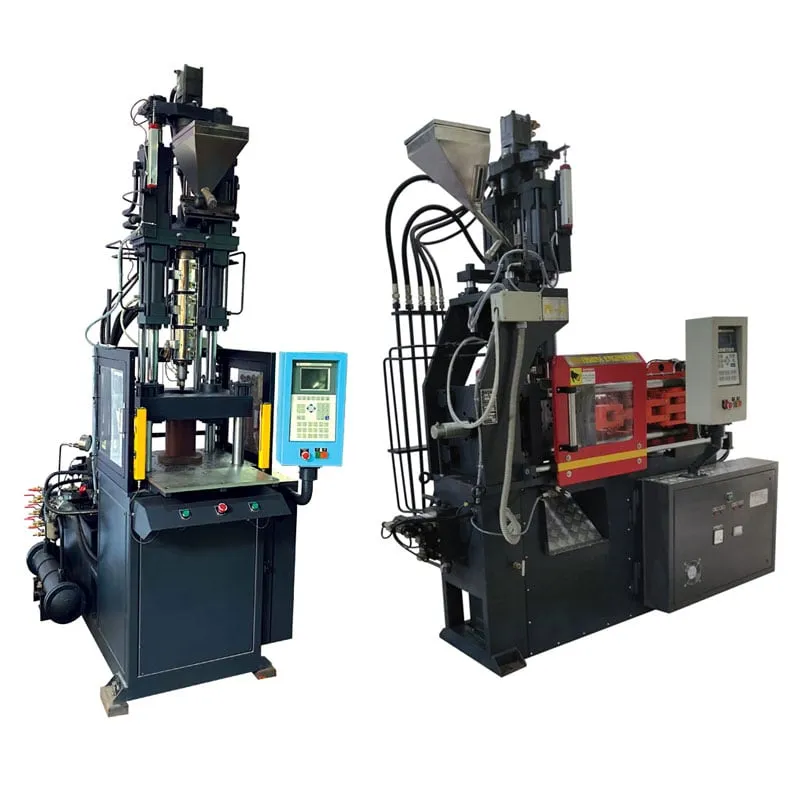

A sensor housing with two brass inserts runs on a vertical press. The first shift's parts gauge well. By the afternoon, one insert sits proud on every few parts, flash creeps into a thread, and part weight wanders. Nothing on the screen has changed. In a case like this, a vertical moulding machine for precision parts is losing accuracy in three places: where the insert sits, how evenly the clamp closes, and how repeatable each small shot is. This guide takes each in turn, shows what to check at a trial, and ends with a shot-sizing calculation you can repeat.
Key Takeaways
- Insert position is set by the fit between insert and locating pin, the insert's protrusion into the cavity and how consistently the operator loads it.
- Clamp parallelism of 0.025 to 0.05 mm is generally accepted below 500 t; keep the part's projected area inside the tie bars to protect the parting line.
- Small precision shots need a barrel sized so the shot uses roughly 20 to 65% of capacity; a large barrel adds residence time and degrades melt.
- Steady loading time keeps mould temperature steady; a vertical cell where loading time varies shot to shot can drift in size even with perfect settings.
Why does insert location decide precision on a vertical machine?
On a vertical machine the insert is placed by hand or robot into an open, horizontal parting face, and the moulded part can only be as accurate as that placement. Pin fit, insert protrusion and how cleanly the insert seats set the limit before any process setting does.
Inserts usually sit over locating pins in the core, so the clearance between pin and insert needs to be close. Too loose, and the insert tilts or floats under melt pressure; too tight, and the operator forces it home, slowing the cycle and wearing the pin. Flash inside internal threads is a known failure of loose seating.
Design rules help the machine hold position. One resin maker's design advice asks for the insert to protrude at least 0.4 mm into the cavity, for material beneath it of at least one sixth of its diameter, and for a boss about 1.5 times the insert diameter. Preheating the insert reduces post-mould shrinkage around it and improves weld lines.
Treat loading as part of the process. If the operator cannot seat every insert the same way in roughly the same time, no machine setting will save the tolerance. At a trial, watch an hour of real loading, not ten careful shots.
How does clamp parallelism affect a vertical moulding machine for precision parts?
Uneven clamping lets one side of the parting line open slightly under injection pressure, so you get flash on that side and thickness variation across the part. For machines under 500 t, platen level and parallelism of 0.025 to 0.05 mm is generally regarded as acceptable.
Vertical machines come with different frames. Tie-bar machines spread force through four columns, while C-frame designs leave three sides open for loading but can deflect more as clamp force rises. Ask which frame you are buying and how parallelism is measured, under load as well as with the clamp open.
Where precision is lost on a vertical machine and what to check at trial
| Source of error | What you see on the part | What to check at trial |
|---|---|---|
| Loose insert seating | Insert proud, tilted or flashed in the thread | Pin fit, insert tolerance, protrusion into the cavity |
| Variable loading time | Size drift through the shift | Spread of loading time over an hour of real running |
| Clamp parallelism | Flash or thickness change on one side | Parallelism under load and at the open position |
| Part area near the tie bars | Parting line wear, flash near the edge | Projected area fully inside the tie bars |
| Shot too small for the barrel | Weight scatter, discoloured or brittle parts | Shot as a share of barrel volume (20 to 65%) |
| Cold inserts | Weak weld lines, cracking round the insert | Insert preheating and its consistency |
Mould size matters too. On a tie-bar machine the part's projected area should sit fully inside the tie bars, because platens can pull in near the bars and wear the parting line over time. A precision mould centred on the platen, with its load spread evenly, gives the clamp its best chance.
Do not answer one-sided flash by adding clamp force. Extra force can damage the mould over time and hides a parallelism problem instead of fixing it. Check parallelism first, then set clamp force from projected area and material. A slow, low-pressure mould close also protects inserts that have lifted.
How do you keep shot weight repeatable on small precision shots?
Size the barrel to the shot, not to the clamp. A shot that uses a small share of the barrel spends longer in the heat and meters less consistently. Keep the shot within 20 to 65% of barrel capacity, worked out by volume rather than by the brochure's grams.
Shot ratings are usually given in grams of polystyrene. Melt densities differ: PS is about 0.945 g/cm³ as melt and PP about 0.74, so the same barrel holds less PP by weight. Convert your shot to volume, add 10% for check-valve leakage and melt uniformity, then compare it with the swept volume.
Below about 20% of capacity, residence time grows and heat-sensitive grades degrade. As a rough guide, residence equals barrel swept volume divided by shot volume, times the cycle, so halving the shot on the same barrel and cycle doubles the time the melt spends in heat.
Mould temperature is the other half. On a vertical cell, the mould sits open while inserts are loaded, so a slow or variable load lets it cool unevenly. Keep loading time steady, use a mould temperature controller, and judge repeatability on part weight logged over a shift, not on a single sample.
What should you send before a precision trial?
Send the part drawing with critical dimensions, insert drawings and tolerances, material grade, cavities and target output. For medical parts, add the device class; a draft CDSCO list under the Medical Devices Rules, 2017 placed hypodermic needles in Class B. Then compare machines on the vertical injection moulding machine page.
Frequently Asked Questions About Vertical Precision Moulding
Is a vertical machine more accurate than a horizontal one?
Not by itself. A vertical machine makes insert placement easier because gravity holds the insert on a horizontal face, which helps position. Accuracy still depends on mould quality, clamp parallelism, shot sizing and temperature control. A well-set horizontal machine can hold tight tolerances on parts without inserts.
Should metal inserts be preheated before moulding?
Often, yes. Preheating reduces post-mould shrinkage around the insert, pre-expands it and improves weld lines, which lowers the hoop stress that causes delayed cracking. Cold inserts pull heat from the melt at the worst point. Confirm the preheat temperature with your resin supplier and test parts with temperature cycling.
What platen parallelism should I ask a machine supplier for?
Ask for the measured figure and the method. One mould-sizing guide treats level and parallelism of 0.025 to 0.05 mm as generally acceptable on machines under 500 t. Ask whether it is measured under clamp load, and repeat the check after installation, because a poorly levelled floor can change it.
How small can a shot be on a given barrel?
As a working range, keep the shot between about 20% and 65% of barrel capacity by volume. Below 20%, the melt stays in the barrel too long and can degrade; above 65%, melt quality suffers. For heat-sensitive or engineering grades, stay well inside the range rather than at its edges.
Why does flash appear inside an insert's thread?
Resin reaches the thread when the insert does not seal against the core pin or mould face. Common causes are a loose pin fit, an insert out of tolerance, a tilted insert or excessive injection pressure. Check the insert seating first; raising clamp force rarely fixes flash that starts inside the insert.
Related Articles
- Hybrid Injection Moulding Machine for High-Efficiency Manufacturing
- Applications of PV Series Plastic Injection Moulding Machines in Consumer Electronics
- The Benefits of Vertical Injection Moulding Machines for Compact Spaces
- Vertical Injection Moulding Machines for Insert Moulding
Sources & References
- MoldMaking Technology, B. Catoen: Machine Sizing and Specification for Optimal Mold Performance, Part 1 (Aug 2025)
- PlasticsToday, summarising A. Miller (DuPont): Design and material advice from the pros, Part 3: Insert molding essentials (Sept 2005)
- Plastics Technology, J. Bozzelli: A Simpler Way to Calculate Shot Size vs. Barrel Capacity (2017, updated 2022)
- CDSCO: Notice dated 29 June 2017 with draft risk-class list
Technical Disclaimer
Disclaimer: The information provided in this document is for general informational and educational purposes only. It is based on technical references and industry information available at the time of preparation and may be subject to change. It does not constitute engineering, technical, commercial or professional advice, nor does it constitute a quotation, specification, warranty or contractual commitment by Pratishna Engineers.
Actual injection moulding machine and process requirements vary according to the component design, material, mould, production volume, machine configuration and operating conditions. The information, examples, calculations and recommendations provided should be independently evaluated and verified for the specific application before making any equipment, process or production decision. Information obtained from third-party sources remains subject to the accuracy and limitations of those sources.
Limitation of Liability: Pratishna Engineers makes no representation or warranty, express or implied, regarding the completeness, accuracy or suitability of the information for any particular application. To the extent permitted by applicable law, Pratishna Engineers shall not be liable for any loss, damage, cost or consequence arising from reliance on or use of the information contained in this document. Final machine selection, configuration and application suitability should be confirmed with Pratishna Engineers based on complete and accurate project requirements.

