






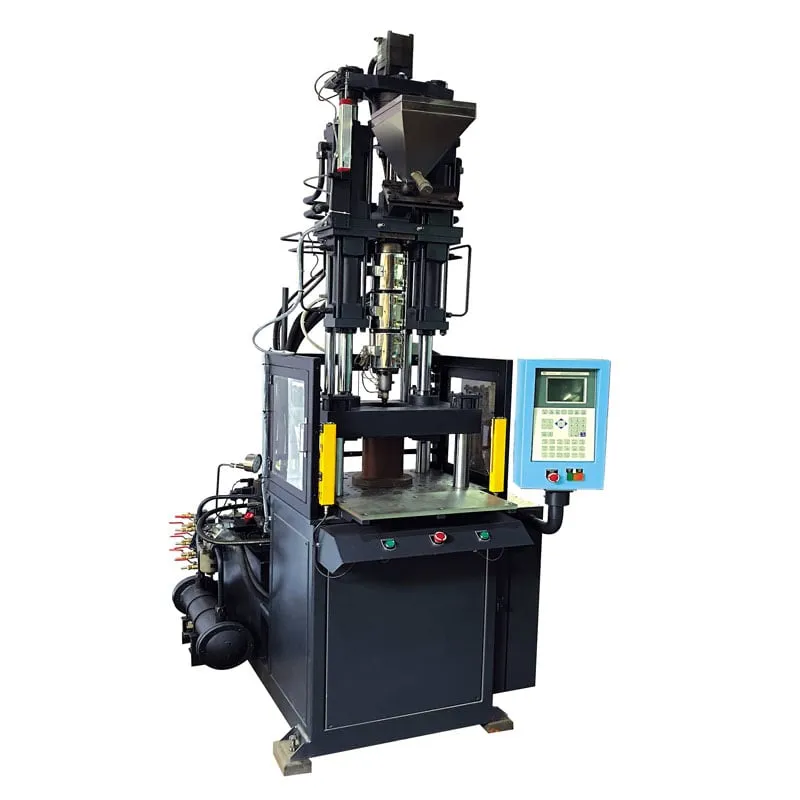

The best moulding machines for plastic industry work are the ones matched to the part, not the biggest or fastest on a spec sheet. Run this checklist before you compare any machine:
- Does the part carry metal or other inserts? Start with a vertical machine.
- Is it large, heavy or deep, with a big mould? Look at two-platen machines.
- Is it a thin-wall pack or a PET preform? Look for machines built for high injection speed or for PET.
- Does it run round the clock on a steady job? Weigh hybrid or electric-injection drives for energy.
Key Takeaways
- Machine type follows the part: geometry, inserts, material and output decide it before tonnage does.
- Vertical machines suit insert work, and shuttle or rotary tables let loading overlap moulding.
- Two-platen clamps shorten the machine for large moulds, but stroke falls as mould height rises.
- Thin-wall packs need high injection speed and pressure; PET preforms need thoroughly dried resin.
Which are the best moulding machines for plastic industry sectors?
The best machine for a sector is the type whose clamp, injection unit and layout suit that sector's typical parts. Packaging needs speed, electrical and medical inserts favour vertical machines, large crates and furniture favour two-platen clamps, and PET needs a dedicated preform setup.
Matching machine type to sector and part
| Sector and part | Machine type usually matched | Why |
|---|---|---|
| Packaging: thin-wall containers, lids | Horizontal with high-speed injection | Fill times under 1 s at high pressure |
| Beverage and FMCG: PET preforms | PET preform machine with drying | PET degrades if moulded wet |
| Electrical, medical: insert parts | Vertical, often with shuttle or rotary table | Inserts sit in the lower half; loading overlaps moulding |
| Crates, furniture, auto: large parts | Two-platen | Shorter machine for large moulds |
| General parts on long runs | Hybrid or electric-injection drive | Lower base load than standard hydraulic |
These are starting points. A small packaging lid can run well on a general horizontal machine, and a large part with inserts may suit a horizontal machine with a robot. The checklist decides the type; clamp force, shot size and mould fit come after.
Drive type is a separate choice from layout. Horizontal, vertical and two-platen machines can each come with different drives, and on long runs the drive decides much of the energy bill. Hydraulic machines, hybrids and electric-injection machines differ mainly in base load, so compare them on kWh per kg for your own part.
When does a vertical machine beat a horizontal one for insert parts?
A vertical machine wins when inserts must sit in the mould before every shot. Gravity holds them in the lower half, and with a shuttle or rotary table the operator loads one lower half while the machine moulds in the other, so loading time stops adding to the cycle.
A conventional shuttle uses one upper half and two lower halves. The catch is cooling: the machine still waits for each part to cool in the clamp before it can mould the next, so the gain comes from hiding loading time, not cooling time.
Our flat view: if your part carries inserts, start with a vertical machine and let the numbers argue you out of it, not the other way round.
Insert loading is also a safety question. On a vertical machine the operator works at the mould face, so check the guarding, light curtains and two-hand controls around the table, and keep the loading steps simple enough to repeat every cycle without reaching into a closing mould.
When do large parts call for a two-platen machine?
Large crates, furniture, bins and automotive parts need big moulds and long opening strokes. A two-platen clamp locks the moving platen mechanically, then short-stroke cylinders apply tonnage. Most such machines are shorter overall than toggle or fully hydraulic machines, which helps when floor length is limited.
Check the stroke trade-off. On a two-platen clamp the opening you get falls as mould height rises, while a toggle gives full stroke at every shut height. Compare the opening with your actual mould height, not the maximum in a brochure. Toggles remain sound for many mid-size jobs, and their defenders cite reliability, simplicity and rigidity.
Large parts also load the injection unit. A crate or table top needs a large shot, so size the barrel to put the shot in a comfortable share of its capacity rather than at the limit, and check that the screw can recover within the cooling time.
What do thin-wall packaging and PET preform moulders need?
Thin-wall packaging needs high injection speed and pressure, a stiff clamp and fine control; PET preforms need thoroughly dried resin, a screw suited to PET and tight melt temperature control. A general-purpose machine rarely meets either set of needs without compromise.
For thin walls, flow length to thickness ratios typically run 100:1 to 200:1, injection pressures are typically above 30,000 psi (about 2,068 bar), and clamp needs rise to 5 to 8 tons/in² against 3 to 5 for conventional work. Fill times under 1 s are common, and the same source advises against adapting conventional machines for this work.
Food packaging adds rules. Under the FSSAI Packaging Regulations, 2018, plastics in direct food contact must conform to listed Indian Standards, such as IS 10910 for PP and IS 12252 for PET, and food businesses need an NABL lab certificate of conformity. That is mostly a material matter, but it favours a machine that holds melt temperature and cycle steady.
How should you shortlist a machine type for your part?
Answer the checklist for your own part, then size the shortlisted type by clamp force, shot size and mould fit. Write down part weight, material, inserts, mould size and target output before you speak to any supplier. If two types pass the checklist, run the worked example below with your own numbers. Browse machine types on the injection moulding machine range page.
Frequently Asked Questions About Choosing Machines by Sector
Which machine type suits caps and thin-wall containers?
A horizontal machine with high injection speed and pressure, a stiff clamp and fine control usually suits thin-wall containers and lids. Thin-wall clamp needs run higher than conventional work, at 5 to 8 tons/in². Caps with standard walls can run on general horizontal machines; size them by clamp force, shot and cycle.
Is a vertical machine only for insert moulding?
No. Vertical machines also suit overmoulding of cables and pins, small parts where floor space is tight, and moulds that benefit from gravity holding loose components. Insert work is where they gain most, because a shuttle or rotary table lets loading happen while the machine moulds the previous set.
What is the difference between a toggle and a two-platen clamp?
A toggle uses linkages to multiply cylinder force and gives full stroke at every shut height. A two-platen clamp locks the moving platen, then short cylinders apply tonnage, and most such machines are shorter overall. On a two-platen clamp, opening stroke falls as mould height rises, so check it against your mould.
Do PET preforms need a special injection moulding machine?
In practice, yes. PET must be dried thoroughly before moulding, needs a screw and barrel suited to PET, and needs close melt temperature control to limit degradation. Preform moulds also run many cavities on short cycles, so injection rate, cooling and handling all matter. A general machine rarely meets all of these.
Can one machine type serve a plant that moulds for several sectors?
It can if the parts are similar in size, material and insert use. Once you add thin-wall packs, PET preforms, insert parts or very large moulds, a general machine starts to trade away output or quality on those jobs, so price a dedicated type for them. Group your parts by the checklist first.
Related Articles
- Cost of Injection Moulding Machines in Mumbai
- Who Manufactures Injection Moulding Machines in Mumbai: OEM Guide
- Where to Buy Plastic Moulding Machines in Mumbai: Trusted Local Supplier Guide
- How to Choose an Injection Moulding Machine
Sources & References
- PlasticsToday, G. Tremblay (Sabic Innovative Plastics): Never too thin (Oct 2007)
- PlasticsToday: Shuttle table increases production (Aug 2008)
- Plastics Technology, M. Knights: Hybrid Injection Clamps: The Best of Both Worlds? (June 2010)
- FSSAI: Food Safety and Standards (Packaging) Regulations, 2018, compendium
Technical Disclaimer
Disclaimer: The information provided in this document is for general informational and educational purposes only. It is based on technical references and industry information available at the time of preparation and may be subject to change. It does not constitute engineering, technical, commercial or professional advice, nor does it constitute a quotation, specification, warranty or contractual commitment by Pratishna Engineers.
Actual injection moulding machine and process requirements vary according to the component design, material, mould, production volume, machine configuration and operating conditions. The information, examples, calculations and recommendations provided should be independently evaluated and verified for the specific application before making any equipment, process or production decision. Information obtained from third-party sources remains subject to the accuracy and limitations of those sources.
Limitation of Liability: Pratishna Engineers makes no representation or warranty, express or implied, regarding the completeness, accuracy or suitability of the information for any particular application. To the extent permitted by applicable law, Pratishna Engineers shall not be liable for any loss, damage, cost or consequence arising from reliance on or use of the information contained in this document. Final machine selection, configuration and application suitability should be confirmed with Pratishna Engineers based on complete and accurate project requirements.

