






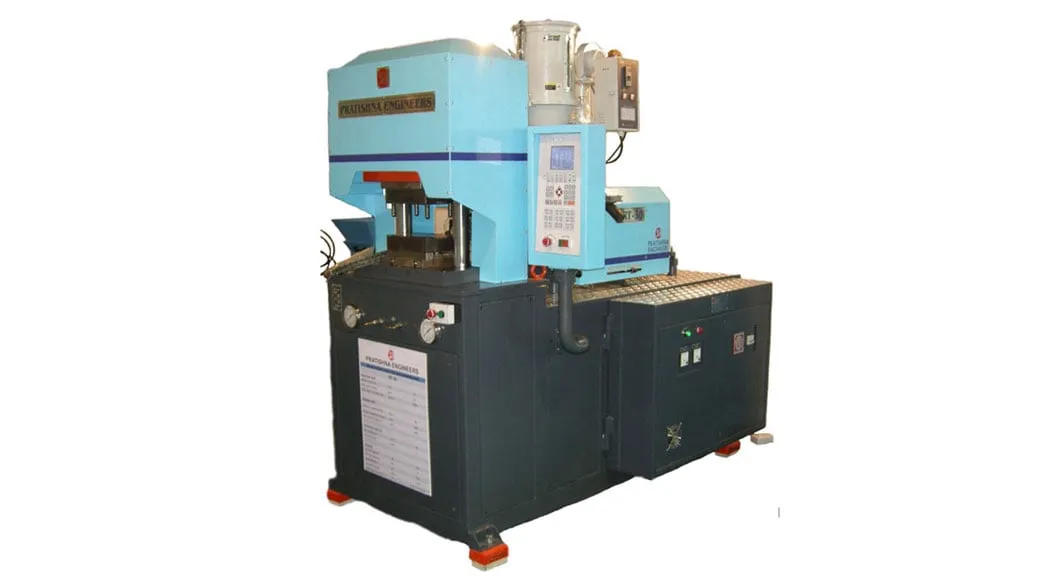

You have two quotations for the same tonnage. Both companies call themselves manufacturers. One has a machine shop, an assembly bay and a test bay; the other has an office and a warehouse. On paper you cannot tell which is which. The answer to who manufactures injection moulding machines is found on a factory floor: where platens are machined, where machines are assembled and where each one is tested. Pratishna Engineers manufactures in Mumbai, and this guide gives the checks to run on any maker, including us.
Key Takeaways
- A manufacturer designs the machine, machines key parts, assembles and tests it; a trader buys finished machines and resells them.
- The machine shop, assembly bay and test bay are the three places that show manufacturing.
- Design files, QA procedures and test records are the paper proof, so ask to see them.
- Run your trial on a machine sized for your mould, using your own clamp calculation.
Who manufactures injection moulding machines, and who only sells them?
A manufacturer designs the machine, machines its main parts, assembles it and tests it before dispatch. A trader or rebrander buys finished machines or kits and sells them under its own name. Both can be honest businesses. They differ in who can answer engineering questions later.
That difference shows up years after purchase. When a toggle link wears, a valve misbehaves or you want a longer opening stroke, a manufacturer has the drawings and the people who made the design decisions. A seller without design ownership has to pass the question on and wait for an answer.
Labels on websites do not settle the question. Words such as OEM, manufacturer and factory are used loosely, so treat them as claims to check, not as facts. The table below lists what to look for on a visit and what each finding tells you.
There is also a middle ground. Some makers design and assemble in-house but buy machined structures from job shops; others machine almost everything themselves. Ask where each major part is made, and judge the answer against how much the seller can change for you.
OEM check: what to look for and what it proves
| Area | What to look for | What it proves |
|---|---|---|
| Design office | CAD workstations, machine drawings with revision numbers | The company owns the design |
| Machine shop | CNC turning and machining centres working on platens, tie bars, screws or cylinders | Key parts are made, not bought finished |
| Assembly bay | Machines at different stages; hydraulic and electrical panels being built | Machines are built here, not repackaged |
| Test bay | Machines running dry cycles or mould trials, test sheets on file | Each machine is checked before dispatch |
| Quality records | Written SOPs, inspection reports, calibration records | Quality is controlled by procedure |
What should you see in the machine shop?
Look for machine tools cutting machine parts: platens, tie bars, cylinders or screws on CNC turning and machining centres. Ask what is made in-house and what is bought out, because pumps, motors and controllers are commonly bought from specialist suppliers. The machined structure is what matters most.
Platens and tie bars carry the full clamp force. Guidance on clamp sizing warns that excess clamp force can crack hydraulic cylinder mounting plates, deform plates and fracture the machine frame, so the way these parts are made decides how a machine survives years of clamping. A maker that machines them can tell you the material, the heat treatment and how flatness is checked.
Ask to see a platen being machined or inspected, and ask for its inspection sheet. If the answer is that platens arrive finished from elsewhere, ask who makes them and how incoming parts are checked. Neither answer is wrong in itself, but it tells you where engineering responsibility sits.
Look at the screw and barrel too. Ask whether screws are made or bought, what material and surface treatment they use, and whether a different screw design can be supplied for your resin, such as one for PVC or PET. A maker that controls the screw can match it to your material.
What should a working assembly bay and test bay show you?
The assembly bay should hold several machines at different stages, with hydraulic power packs and electrical panels being built. The test bay should have machines running dry cycles or mould trials, and test sheets recording clamp, injection and cycle readings for each machine before dispatch.
Dry cycle time is a quick test-bay check. A machine sizing guide gives dry cycles of 1 to 2.5 s for thin-wall machines and 3 to 5 s otherwise; ask the test bay to run one on the size you are considering and time it yourself. Then ask for the test sheet of a machine that was dispatched recently.
Our flat view: if a company calling itself a manufacturer will not show you its test bay, treat it as a trader until it does. Testing is the last point where a fault can be caught before the machine reaches your floor, and a maker that tests every machine has records to show for it.
Watch how the assembly bay handles hydraulic cleanliness and wiring. Capped hose ends, labelled cables, and panels built to a drawing rather than by eye are signs of a process. Loose fittings on the floor and unlabelled wiring are signs of improvisation.
Ask what the test covers and how long each machine stays on test: clamp force, injection pressure and speed, temperature control, safety interlocks and emergency stops. A short written test procedure, signed off for each machine, is a good sign.
Which documents prove a company manufactures machines?
Ask for machine drawings with revision control, written QA procedures, inspection and test records for a recent machine, and the company's plan for BIS compliance under India's machinery safety order. A trader can show brochures; a manufacturer can show the records behind each machine it built.
That order is the Machinery and Electrical Equipment Safety (Omnibus Technical Regulation) Order, 2024. It covers all machinery for working rubber and plastics under HS 8477 and names IS/ISO 20430:2020, the safety requirements for injection moulding machines, as the product standard, with IS 16819:2018/ISO 12100:2010 as the general one. Machines must carry the BIS Standard Mark under a licence, and the manufacturer must register with BIS first.
Enforcement was deferred to 1 September 2026, and in November 2025 that date was postponed again, with no new date communicated at the time of writing. A maker preparing for it should be able to talk you through its approach to guarding, interlocks and emergency stops. Re-check the status before you order.
Also ask for the hydraulic circuit and electrical wiring drawings that will ship with your machine. A manufacturer can supply drawings that match the machine as built, which saves hours when a fault has to be traced years later.
How Pratishna Engineers manufactures in Mumbai
Pratishna Engineers' manufacturing facilities in Mumbai cover about 25,000 sq ft, with CNC turning centres, vertical and horizontal machining centres, jig boring machines, precision conventional machine tools, and assembly and testing facilities. Design, manufacturing, assembly, testing and service are done in-house.
The design team works in SolidWorks, Creo and AutoCAD. An independent QA department works to written SOPs, with accredited external labs used when required. The company began with machine rebuilding, indigenisation and technology adaptation before moving to complete machine design, manufacturing and automation, and import substitution remains a stated focus.
The group comprises Pratishna Engineers Limited, Pratishna Greentech Private Limited and Pratishna Technologies Private Limited. Besides injection moulding machines, it makes aluminium pressure die-casting machines, SPMs, hydraulic systems and automation.
What should you bring to a factory visit?
Bring your part drawing, resin grade, mould dimensions and your own clamp calculation, so the trial runs on a machine of the right size. Ask to see the machine shop, assembly bay and test bay in one visit, and take notes against the table above. For machine types and sizes, see the injection moulding machine range.
Plan the visit for a working day, when the machine shop and test bay are running. Walk through each area before the commercial discussion, and photograph the trial set-up if the maker allows it, so your team can compare notes afterwards.
Frequently Asked Questions About Injection Moulding Machine Manufacturers
How can I tell if a company really manufactures injection moulding machines?
Visit and ask to see three places: the machine shop where platens, tie bars or cylinders are machined, the assembly bay with machines at different stages, and the test bay with test sheets for each machine. Then ask for drawings and QA procedures. A company that only resells cannot show all of these.
Is a machine assembled from bought-in kits a manufactured machine?
It is assembled, not designed and made, and the difference matters when you need a design change or a hard fault traced. Ask who holds the drawings, who can change the hydraulic or electrical design, and where spares for the structure come from. The answers show how much engineering sits with the seller.
What is a dry cycle test and why ask for one?
A dry cycle runs the clamp open and closed with no injection, showing how fast the machine moves. A machine sizing guide gives 1 to 2.5 s for thin-wall machines and 3 to 5 s otherwise. Timing one in the test bay is a quick check that the machine and its hydraulics perform.
Which Indian standard covers injection moulding machine safety?
Under the Omnibus Technical Regulation Order, 2024, the product standard for injection moulding machines is IS/ISO 20430:2020, with IS 16819:2018/ISO 12100:2010 as the general standard. Enforcement was postponed in November 2025 with no new date announced at the time of writing, so check the current status before ordering.
Should I attend my own mould trial at the maker's factory?
Yes, if you can. Watching the trial lets you see how the settings were reached, what changed between shots and how the parts looked straight off the mould. Take the trial sheet with barrel temperatures, pressures, hold and cooling times, so your team can start production from known settings.
Does Pratishna Engineers manufacture its machines in Mumbai?
Yes. Pratishna Engineers' Mumbai facilities cover about 25,000 sq ft, with CNC turning centres, machining centres, jig boring machines, and assembly and testing facilities. Design, manufacturing, assembly, testing and service are done in-house, and an independent QA department works to written SOPs.
Related Articles
- Where to Buy Plastic Moulding Machines in Mumbai: Trusted Local Supplier Guide
- Reviews of Plastic Injection Moulding Machines in Mumbai: What Buyers Are Saying
- Best Injection Moulding Machines for Plastic Industry in India
- Injection Moulding Machine Suppliers in Maharashtra
Sources & References
- Bureau of Indian Standards, Central Marks Dept-I: Circular CMD-1/3:3 with the Machinery and Electrical Equipment Safety (Omnibus Technical Regulation) Order, 2024 (12 Sept 2024)
- Manufacturing Technologies Association (UK): Postponement of India's Omnibus Technical Regulation
- SPE Plastics Engineering, A. Urbina: Mastering Clamping Force Calculation (Mar 2024)
- MoldMaking Technology, B. Catoen: Machine Sizing and Specification for Optimal Mold Performance, Part 1 (Aug 2025)
Technical Disclaimer
Disclaimer: The information provided in this document is for general informational and educational purposes only. It is based on technical references and industry information available at the time of preparation and may be subject to change. It does not constitute engineering, technical, commercial or professional advice, nor does it constitute a quotation, specification, warranty or contractual commitment by Pratishna Engineers.
Actual injection moulding machine and process requirements vary according to the component design, material, mould, production volume, machine configuration and operating conditions. The information, examples, calculations and recommendations provided should be independently evaluated and verified for the specific application before making any equipment, process or production decision. Information obtained from third-party sources remains subject to the accuracy and limitations of those sources.
Limitation of Liability: Pratishna Engineers makes no representation or warranty, express or implied, regarding the completeness, accuracy or suitability of the information for any particular application. To the extent permitted by applicable law, Pratishna Engineers shall not be liable for any loss, damage, cost or consequence arising from reliance on or use of the information contained in this document. Final machine selection, configuration and application suitability should be confirmed with Pratishna Engineers based on complete and accurate project requirements.

