






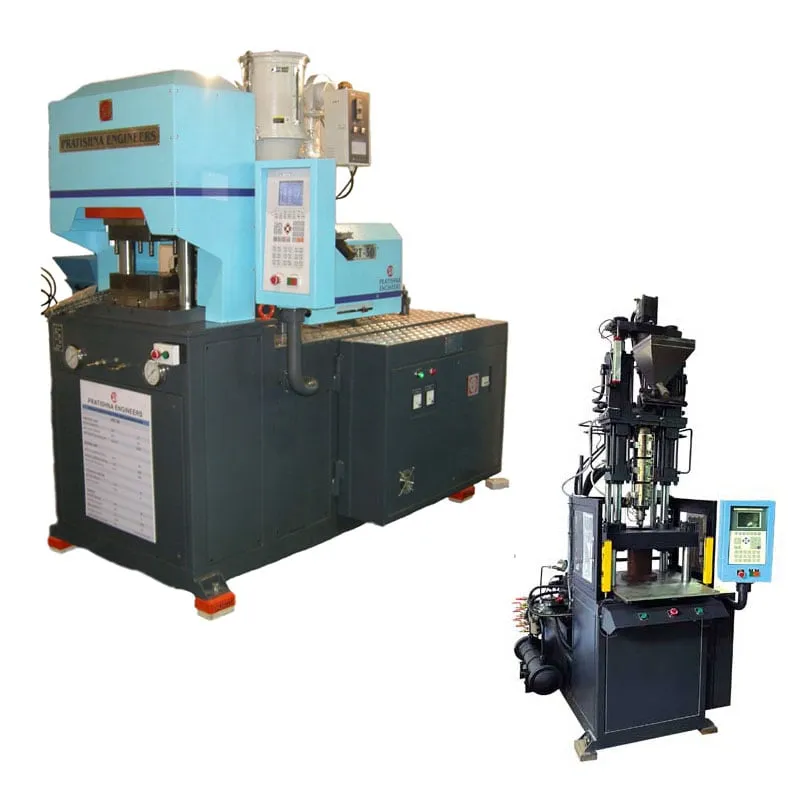

Start with one number. A 25 g PP part from a 4-cavity mould on a 20 s cycle, with 97% good shots, gives about 698 good parts an hour. At a typical site energy use of 0.9 to 1.6 kWh per kg and an assumed tariff of ₹10 per kWh, energy works out to about ₹0.23 to ₹0.41 per good part. That is the useful way to judge the cost of injection moulding machines in Mumbai: per good part, over years, not by the invoice alone. Pratishna Engineers, a Mumbai manufacturer, does not list machine figures here; this guide shows the arithmetic you can run on any machine.
Key Takeaways
- Judge a machine by cost per good part over its working life, not by the purchase invoice alone.
- Output per hour is 3,600 ÷ cycle time × cavities × good-shot share, and each term moves cost per part.
- Rejected shots use the same energy, resin and machine time as good ones.
- Use your latest electricity bill for rates; MSEDCL tariffs were the subject of a MERC order in March 2026.
Why judge the cost of injection moulding machines in Mumbai per part?
Because the purchase is paid once and the running costs are paid on every shot for years. An energy guide for moulders found that ten-year energy cost exceeds purchase cost in almost every case. Cost per good part captures energy, resin, labour time and rejects together.
Base load explains much of the difference between machines. The same guide puts the base load of a standard hydraulic machine at 75% or more of its total energy, against about 10 to 20% for all-electric and hybrid machines, mostly barrel heating. Base load runs whether the machine is making good parts or not, and a high base load can mean the machine is too large for the job.
So two machines that look close on paper can drift apart over ten years of shifts. The figure that decides it is not the invoice but the energy and output per hour on your part, which is why the rest of this guide works per part.
The purchase still matters, because it sets depreciation and interest for years. But it is one line among several, and the only one you pay once.
How do cycle time and cavities change cost per part?
Output per hour is 3,600 divided by the cycle time in seconds, multiplied by cavities and by the good-shot share. Halve the cycle or double the cavities and you double output, so every fixed hourly cost, from labour to base-load energy, spreads over twice the parts.
Cycle time is mostly cooling. Cooling time depends most on wall thickness, which is squared in the cooling equation, and in one trial on a 3.3 mm thick ABS part about 85% of the cycle was spent cooling. A wall 20% thinner needs about 36% less cooling, because 0.8² = 0.64.
Our flat view: part design and mould cooling set more of your cost per part than machine speed does. A faster clamp saves fractions of a second; a wall reduced from 3 mm to 2.4 mm cuts cooling time by about 36% on every shot. Talk to your mould maker about cooling before you pay for speed you cannot use.
Cycle time also depends on the machine's own movements: clamp opening and closing, ejection and, on hydraulic machines, how fast pressure builds. Read the cycle breakdown on the controller display of a running job, so you know which part of the cycle the machine controls and which part the mould controls.
Cavities raise output but also raise the clamp force, shot size and mould investment needed. An extra cavity pays only if the machine and mould hold quality across every cavity, so check the good-shot share per cavity, not just per shot.
Why does the good-shot share matter as much as speed?
Every rejected shot uses the same energy, resin and machine time as a good one, then adds regrind or scrap handling. Moving from 94% to 99% good shots raises saleable output by about 5% with no change in cycle, cavities or machine.
Good parts per hour and energy per good part (25 g PP, 4 cavities, 20 s cycle, 0.9 to 1.6 kWh/kg)
| Good-shot share | Good parts per hour | Energy per good part (kWh) |
|---|---|---|
| 99% | 712.8 | 0.0227 to 0.0404 |
| 97% | 698.4 | 0.0232 to 0.0412 |
| 94% | 676.8 | 0.0239 to 0.0426 |
Rejects also hide in start-up, mould change and colour change shots. Count them in the good-shot share for a full week, not a good hour, or the figure will flatter the machine. Track rejects by cause as well, because flash, short shots and sink marks point to different fixes in the mould, the process or the machine.
Resin adds to the bill for rejects. Sprues, runners and rejected parts can go back as regrind only within the limits your customer and material allow, and each pass through the barrel adds heat history to the material.
How much electricity goes into each kilogram?
A survey-based energy guide gives typical variable site energy of 0.9 to 1.6 kWh per kg, on top of a base load that is typically 20 to 40% of total site energy. Your own figure depends on machine type, size, material, idle time and auxiliaries.
The same guide puts polymer processing at about 66% of a typical plant's energy, with chillers at 11% and compressed air at 10%. The machine matters most, but not alone: an oversized chiller or a leaking air line adds to every kilogram as well.
Idle time is the hidden one. Idling machines have been measured drawing 52% to 97.5% of their full moulding energy, and idle periods longer than 1.5 hours may be cheaper to switch off and restart. A machine that waits for moulds, material or operators adds energy to every part it later makes.
Use your own bill for the rate. MSEDCL's industrial tariffs effective from 1 July 2025 were affected by litigation that led to a MERC order on 25 March 2026, so rates in older spreadsheets may be out of date. Since energy is billed in kVAh, a low power factor also raises the energy you pay for, so check it on the same bill.
To find your own figure, divide a month's kWh from the bill by the kilograms of resin processed in the same month. Repeat it for several months and you have a plant baseline in kWh per kg, against which any new machine can be judged.
Where Pratishna Engineers fits in a cost-per-part review
Pratishna Engineers selects machines by application, in the order Component, Material, Mould, Production Requirement, Machine Configuration. That order puts the inputs of a cost-per-part calculation, such as part weight, material, cavities and target output, on the table before a machine is named.
The range includes hybrid machines with hydraulic locking and electric injection, alongside horizontal, vertical, vertical-horizontal combination and hydro-mechanical machines. Product pages cover the E, C and H horizontal series, the PV and PVDL vertical series, PET machines, the PHM two-platen series, hybrid and special purpose machines.
Design, manufacturing, assembly, testing and service are done in-house in Mumbai, by a company founded in 1991 with 35+ years of experience and 9,000+ machines supplied.
What numbers should you collect before comparing machines?
Collect part weight, cavities, a realistic cycle time, a week's good-shot share and your latest electricity bill, then work out cost per good part for each machine you are considering. Send the same inputs to every supplier so the answers can be compared on equal terms. See the injection moulding machine range.
If you can, measure an existing machine on the same part before you buy. A week of meter readings, shot counts and reject counts gives you a baseline, and the new machine's figures can then be checked against it after installation rather than against a brochure.
Frequently Asked Questions About Injection Moulding Cost per Part
How do I calculate cost per part for an injection moulding machine?
Work out good parts per hour as 3,600 ÷ cycle time × cavities × good-shot share. Then add the hourly costs of energy, labour, resin and machine time, and divide by good parts per hour. Use your own bill, wage and resin figures, and recalculate whenever cycle time or reject rate changes.
Does a faster machine always give a lower cost per part?
No. If cooling sets most of your cycle, a faster clamp or injection unit saves little, while a larger or more powerful machine may carry a higher base load. Lower cost per part comes from matching the machine to the part, then shortening cooling through wall thickness and mould cooling design.
How much electricity does injection moulding use per kilogram?
An energy guide based on surveys of moulding sites gives a typical variable load of 0.9 to 1.6 kWh per kg, with site base load typically 20 to 40% of total energy. Your figure depends on machine type and size, material, idle time and auxiliaries, so measure your own plant where you can.
Why should I use my own electricity bill instead of a standard tariff?
Tariffs, demand charges and power factor effects differ between connections, and MSEDCL tariffs were the subject of a MERC order in March 2026. Your latest bill shows the rate you actually pay, including kVAh billing effects. A cost-per-part figure built on a generic tariff can be wrong before you start.
Is a hybrid machine cheaper to run than a standard hydraulic one?
It often has a much lower base load. An energy guide gives about 10 to 20% base load for all-electric and hybrid machines, against 75% or more for standard hydraulic machines. Actual savings depend on your part, cycle and utilisation, so compare kWh per kg on the same job where possible.
What reject rate should I use in a cost-per-part estimate?
Use your own measured figure over at least a full week, including start-up, mould change and colour change shots. If the part is new, use a cautious estimate and label it as an assumption, then replace it with measured data after the first production weeks. Never use the best hour as your basis.
Related Articles
- Where to Buy Plastic Moulding Machines in Mumbai: Trusted Local Supplier Guide
- Reviews of Plastic Injection Moulding Machines in Mumbai: What Buyers Are Saying
- Plastic Injection Moulding Machine Price in Mumbai
- Best Injection Moulding Machines for Plastic Industry in India
Sources & References
- ExxonMobil, AMI and Tangram Technology: An Energy Saving Guide for Injection Moulders
- RJG Inc.: How to Determine Injection Molding Cooling Time (Mar 2021)
- PlasticsToday, R. Kent: Getting to know your real energy use and cost (Jan 2010)
- Deccan Chamber of Commerce, Industries and Agriculture, Pune: Circular No. 085: MERC Order dated 25 March 2026 on MSEDCL Review Petition (27 Mar 2026)
Technical Disclaimer
Disclaimer: The information provided in this document is for general informational and educational purposes only. It is based on technical references and industry information available at the time of preparation and may be subject to change. It does not constitute engineering, technical, commercial or professional advice, nor does it constitute a quotation, specification, warranty or contractual commitment by Pratishna Engineers.
Actual injection moulding machine and process requirements vary according to the component design, material, mould, production volume, machine configuration and operating conditions. The information, examples, calculations and recommendations provided should be independently evaluated and verified for the specific application before making any equipment, process or production decision. Information obtained from third-party sources remains subject to the accuracy and limitations of those sources.
Limitation of Liability: Pratishna Engineers makes no representation or warranty, express or implied, regarding the completeness, accuracy or suitability of the information for any particular application. To the extent permitted by applicable law, Pratishna Engineers shall not be liable for any loss, damage, cost or consequence arising from reliance on or use of the information contained in this document. Final machine selection, configuration and application suitability should be confirmed with Pratishna Engineers based on complete and accurate project requirements.

