






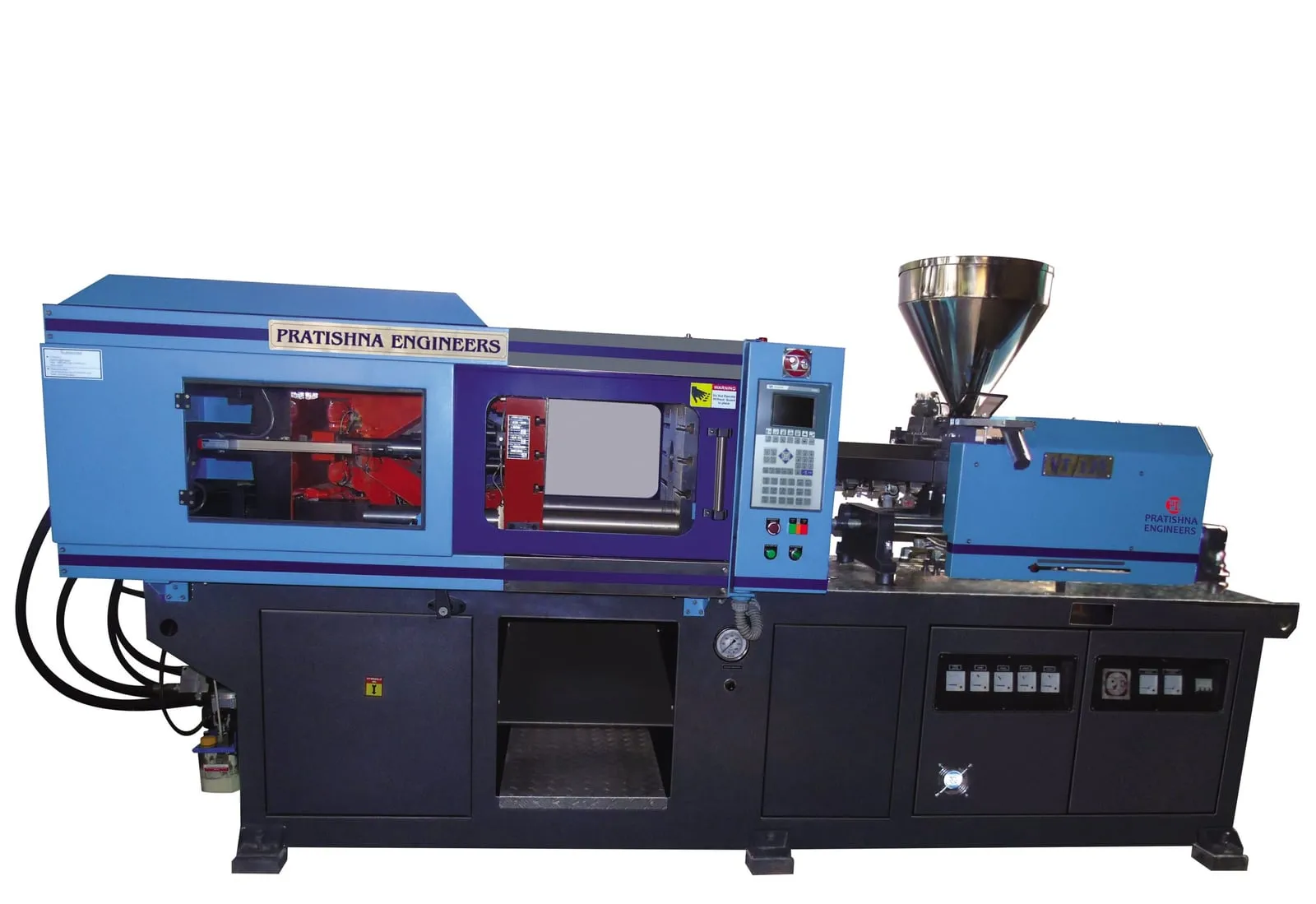

Plastic moulding machine reviews Mumbai buyers post online tell you who is pleased, not why. A review worth reading names the part, the material, the cavity count, the cycle time and how long the machine has run. Use everything else only to pick plants to call, then confirm the claims on a reference visit where you watch the machine work and question the people who run it. This guide from the Pratishna Engineers technical team shows what to ask, what to check and how to test a claim with simple arithmetic.
Key Takeaways
- A useful review states part, material, cavities, cycle time and months in service; star ratings alone prove little.
- Treat reviews as a shortlist tool and confirm every claim on a reference call or visit.
- Ask reference users for numbers from a display, a log or a bill, not for opinions.
- Check any output claim against cycle time and cavity count before you believe it.
Which plastic moulding machine reviews Mumbai plants share are worth your time?
Reviews that state the part, the resin, the cavity count, the cycle time, the running hours and what happened when something failed are worth your time. Star ratings, unnamed quotes and savings percentages with no baseline are not evidence. Use them only to decide which plants to call.
A review is a claim made by someone you cannot question. It may be honest and still of little use to you, because a machine that runs PP caps well tells you little about how it will run glass-filled nylon or a 2 kg crate. Read every review through one filter: how close is the reviewer's job to yours?
A plant moulding your material, at a similar shot weight and cavity count, is worth more than a page of praise from unrelated work. Note the date too. A review written a month after installation describes commissioning; one written after two years describes the machine.
Reading a machine review: what it shows and what to ask next
| Review says | What it shows | Ask the reviewer |
|---|---|---|
| "Very good machine, 5 stars" | Satisfaction, nothing about your job | Which part, resin and mould do you run on it? |
| "Energy dropped 25%" | A change against an unknown baseline | Old and new kWh per kg on the same job and bill period |
| "Service is fast" | Possibly one good experience | Date of the last breakdown, arrival time, hours to restart |
| "Output went up" | Unclear: cycle, cavities or rejects | Cycle time, cavities and reject rate before and after |
| "Running for years without problems" | Age, not condition | Hours run, screw and barrel changes, hydraulic repairs |
What should you ask an existing user on a reference call?
Ask for facts the user can read off a display, a log or a bill: cycle time on a named job, reject rate, the last breakdown and how long the restart took, spares lead times, and electricity per kilogram. Opinions come last, after the numbers.
- Which part, resin and mould do you run on this machine, and on how many shifts?
- What is the cycle time on that job today, and what was it in the first month?
- When did the machine last stop for a fault, who came, and how many hours passed before it ran again?
- Which spares have you bought, and how long did each take to arrive?
- Would you buy the same machine again for the same job, and why?
For energy, ask for the bill, not a percentage. Under MSEDCL's kVAh billing, demand is charged on kVA and energy on kVAh, so power factor shows up in the bill. MSEDCL's own explanation is that at a power factor of 0.85, 15% of the power drawn does no useful work, and it recommends capacitors or APFC panels.
A reference user who quotes savings without knowing the plant's power factor or kVAh per kilogram has not measured them. One who can show two bills, before and after the machine arrived, on the same product mix, has.
Try to speak to two people at each reference plant: the owner or plant head, and the setter or shift supervisor who runs the machine every day. The owner knows what the machine earns. The setter knows how it behaves on a mould change, after a power cut and at the end of a long shift.
What should you check during a reference visit on the shop floor?
Watch the machine run a production job, read the cycle time and cushion on the display over several shots, look at the parts coming off, and ask to see the maintenance log. A visit shows what no review can: how the machine and its owner's records look today.
A steady cushion and a cycle time that repeats shot after shot tell you the screw, check valve and hydraulics are in order. Oil under the machine, patched hoses or a heater band left disconnected tell you the opposite. Look at the parts as well: flash, short shots or sink marks on a running job deserve a question.
Then read the maintenance log. Look for repeated entries against the same item, such as a valve, a heater zone or a proximity switch, because a fault that returns every few weeks costs more than one large repair. Check when the oil and filters were last changed and whether the screw has been pulled for inspection. A plant that keeps a clean log is also a plant whose numbers you can trust.
If the user allows it, an energy reading is quick. A clamp-meter data logger can measure a machine in as little as 30 minutes, with heater load averaged over 10 to 15 minutes. Energy that rises on the same job over months can point to screw or barrel wear, which is a good question for a long-term user.
How do you spot a review that cannot be trusted?
Distrust a review that gives no part, resin or cycle data, quotes a round savings figure with no baseline, repeats wording found in other reviews, or comes from a reviewer you cannot contact. Distrust any review promising a fixed output, because output depends on your mould and material.
Our flat view: a review that gives no cycle time, cavity count or material is advertising, not evidence. Ask the supplier to put you in touch with the reviewer. If that cannot be arranged, give the review no weight in your decision.
Supplier case studies deserve the same treatment. A case study can be accurate and still describe a job unlike yours, so ask for the data behind it and judge it as you would a review.
Watch for claims that sound precise but cannot be checked, such as an exact payback in months with no energy rate, utilisation or product named. Payback depends on your mould, your shifts and your tariff, so a figure from another plant cannot transfer to yours. The same goes for rejection rates quoted without the job, the period or the way rejects were counted.
Checking Pratishna Engineers the same way
Apply the same test to us. Pratishna Engineers was founded in Mumbai in 1991 by Nandkumar R. Kushe, a first-generation engineer, and reports 35+ years of experience, 9,000+ machines and 1,000+ customers in India and international markets. Those are company figures. A reference visit is how you test them against your own part.
Design, manufacturing, assembly, testing and service are done in-house, so questions about how a machine behaves go to the people who designed and built it. The Mumbai facilities cover about 25,000 sq ft, with CNC turning centres, vertical and horizontal machining centres, and assembly and testing facilities. An independent QA department works to written SOPs.
- When you contact the team, ask for a reference running a part, resin and cavity count close to yours.
- Ask for the machine selection reasoning in the order the team uses: Component, Material, Mould, Production Requirement, Machine Configuration.
What should you do before you rely on a review?
Use reviews to build a shortlist, then make reference calls and at least one visit to a plant running work close to yours. Bring your part drawing, resin grade and target output so every answer can be compared with your job. Write the answers into one sheet with the same rows for every plant, so gaps stand out. Where a reference cannot answer a question, record that as a gap rather than filling it with a guess. To match a machine type and size to that job, see the injection moulding machine range.
Frequently Asked Questions About Machine Reviews and Reference Checks
Are online reviews of injection moulding machines reliable?
They show that a buyer was pleased, but rarely why. A review that leaves out the part, resin, cavity count and cycle time gives you no way to judge whether the reviewer's job resembles yours. Use reviews to choose which plants to contact, then confirm each claim yourself on a call or visit.
How many reference calls should I make before buying a machine?
Two or three calls and one shop-floor visit is a starting point, not a rule. Pick plants whose part, resin and shot weight are close to yours. One relevant reference tells you more than several unrelated ones, so choose for similarity of work rather than for the size of the plant.
What should I ask a reference user about after-sales service?
Ask for the date of the last breakdown, who attended, how long the engineer took to arrive and how many hours passed before production restarted. Then ask which spares were bought and how long each took. Dates and hours from a log are evidence; general praise for service is not.
Can I check a machine's energy use during a reference visit?
Yes, if the plant agrees. A clamp-meter data logger can measure a machine in about 30 minutes, with heater load averaged over 10 to 15 minutes. Divide the energy by the kilograms moulded on the same job in the same period to get a kWh per kg figure you can compare.
Should I trust case studies published by a machine supplier?
Treat them as you would treat reviews. A case study can be accurate and still describe a job unlike yours. Ask for the part, resin, cavities, cycle time and the measured before and after figures, and ask to speak to the plant. Without that data, give the case study little weight.
How do I compare two machines that both have good reviews?
Ask both reference users the same questions and record the answers in the same format: cycle time on a similar job, reject rate, kWh per kg, breakdowns in the last year and spares lead times. Compare the numbers side by side. Where a plant cannot give a number, mark it unknown, not good.
Related Articles
- Where to Buy Plastic Moulding Machines in Mumbai: Trusted Local Supplier Guide
- Who Manufactures Injection Moulding Machines in Mumbai: OEM Guide
- Cost of Injection Moulding Machines in Mumbai
- Best Injection Moulding Machines for Plastic Industry in India
Sources & References
- Maharashtra State Electricity Distribution Co. Ltd. (MSEDCL): kVAh Billing: Frequently Asked Questions
- PlasticsToday, R. Kent: Getting to know your real energy use and cost (Jan 2010)
Technical Disclaimer
Disclaimer: The information provided in this document is for general informational and educational purposes only. It is based on technical references and industry information available at the time of preparation and may be subject to change. It does not constitute engineering, technical, commercial or professional advice, nor does it constitute a quotation, specification, warranty or contractual commitment by Pratishna Engineers.
Actual injection moulding machine and process requirements vary according to the component design, material, mould, production volume, machine configuration and operating conditions. The information, examples, calculations and recommendations provided should be independently evaluated and verified for the specific application before making any equipment, process or production decision. Information obtained from third-party sources remains subject to the accuracy and limitations of those sources.
Limitation of Liability: Pratishna Engineers makes no representation or warranty, express or implied, regarding the completeness, accuracy or suitability of the information for any particular application. To the extent permitted by applicable law, Pratishna Engineers shall not be liable for any loss, damage, cost or consequence arising from reliance on or use of the information contained in this document. Final machine selection, configuration and application suitability should be confirmed with Pratishna Engineers based on complete and accurate project requirements.

