






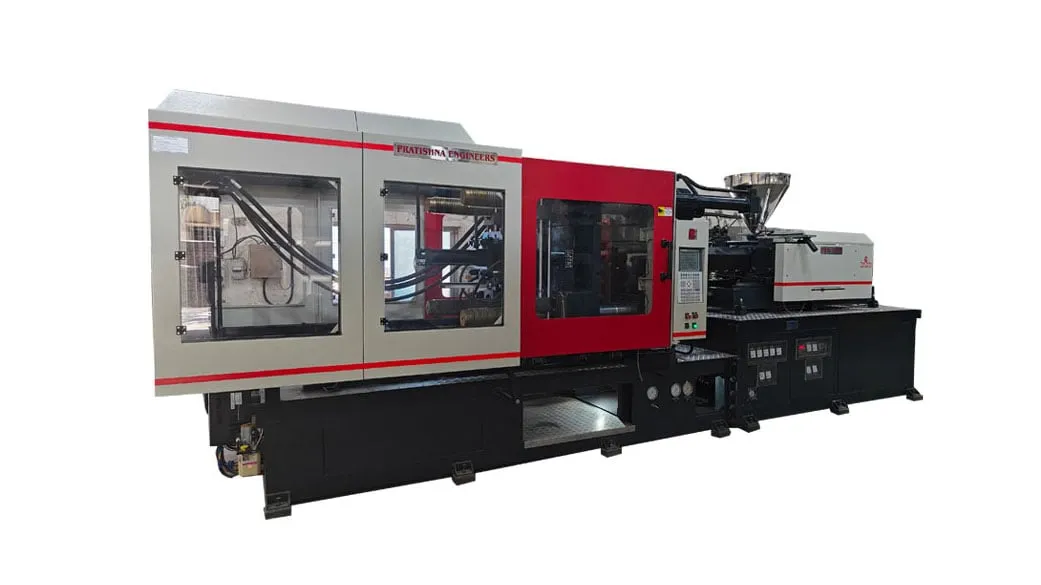

Picture a plant moulding switch plates and socket bodies. The first-off samples pass, but a later lot shows burn marks near the gate, and a socket cracks around its brass contact during assembly. The mould is rarely the only cause. An injection moulding machine for electrical parts needs steady melt temperature for flame-retardant grades, well-dried resin, enough clamp for flat covers, and repeatable cycles when metal inserts go in. This page covers the standards that shape the part, the resins that meet them, and how insert moulding changes the machine you need.
Key Takeaways
- Switches, enclosures and switch-socket-outlets fall under BIS compulsory certification, so every moulded lot must pass the tests set in the Indian Standard.
- Flame-retardant grades such as FR polycarbonate carry UL 94 and glow-wire ratings that depend on wall thickness, so the moulded wall must hold.
- FR resins need tight drying and melt control, and acetal must never share a barrel with flame-retardant grades without a full purge.
- Moulded-in brass contacts and bushes add loading time and hoop stress, which the machine layout and the material choice must allow for.
Which standards shape moulded electrical parts in India?
Switches to IS 3854 need the ISI mark under compulsory certification, and a 2023 order added boxes and enclosures to IS 14772:2020 and switch-socket-outlets to IS 15787. Plugs and sockets follow IS 1293. These standards test heat, fire, strength and repeated use, so moulding must stay consistent.
Indian standards and what they ask of the moulded part
| Standard | Covers | What it means for moulding |
|---|---|---|
| IS 3854 | Switches for domestic and similar purposes | Dimensions, resistance to abnormal heat and fire, mechanical strength |
| IS 1293 | Plugs and socket-outlets | Pendulum hammer strength, 10,000 insertions and withdrawals, heat and fire |
| IS 14772:2020 | Boxes and enclosures up to 440 V a.c. | Ingress protection at lids, knock-outs and fixings; mechanical and thermal strength |
| IS 15787:2008 | Switch-socket-outlets (non-interlock) | Standard Mark compulsory under the 2023 order |
The Electrical Accessories order came into force six months after publication, with nine months for small and twelve for micro enterprises, and goods made for export are excluded. If you mould for a brand owner who holds the licence, the parts you supply still have to pass the tests their samples face.
The tests explain the machine needs. IS 1293 and IS 3854 check resistance to abnormal heat and fire, strength under a pendulum hammer, and normal operation with a plug inserted and withdrawn 10,000 times. A short shot, a weak weld line or a burnt section near the gate can fail any of them.
These accessories are made from both thermoplastics and thermosets. Thermoset parts run on dedicated presses or modified machines with different screws and heating, so confirm which family your part uses before you size anything. The rest of this page covers thermoplastic parts.
What should an injection moulding machine for electrical parts handle?
It should hold melt temperature steady for flame-retardant grades, feed from properly dried resin, clamp flat covers without flash, and repeat shot size closely across a shift. Small electrical parts often run in multi-cavity moulds, so shot repeatability and clamp parallelism matter more than raw tonnage.
Take FR polycarbonate as an example. One grade is rated UL 94 V-0 at 3.0 mm but only V-2 at 1.0 mm, with a glow-wire flammability index of 960 °C at 1.5 and 3.0 mm and 875 °C at 0.75 mm. Thin walls lose rating, so the moulded wall must match the design.
The same grade asks for drying at 120 °C for 2 to 3 hours to a maximum moisture of 0.02%, a melt around 300 °C, a mould at 80 to 120 °C, and a shot of 30 to 70% of cylinder capacity. Back pressure runs 50 to 150 bar. Those windows suit a machine with stable barrel control.
Our flat view: keep flame-retardant grades and acetal on separate machines. Acetal must never be processed with flame-retardant resins, because the acid gases they release cause rapid degradation. A shared barrel and a rushed purge is a risk that no audit sample will show until a lot fails.
How does insert moulding change the machine choice?
Moulding brass contacts or threaded bushes into a part adds loading time, needs preheated inserts and brings a risk of hoop-stress cracking. A vertical clamp with a shuttle or rotary table helps, because one lower mould half is loaded while the other is moulding.
Insert moulding is often treated as a last resort, because heat staking, ultrasonic insertion or pressing into a moulded part can do many jobs. Mould the insert in when you need full encapsulation for the best pull-out and torque resistance, or a permanent joint between high-load parts.
Delayed cracking from hoop stress is the most common complaint. A rough estimate is mould shrinkage times flexural modulus. Use rounded inserts or rounded knurls, no sharp corners, a boss about 1.5 times the insert diameter, and at least one sixth of the insert diameter of plastic beneath it.
Preheating the insert reduces post-mould shrinkage around it and improves weld lines. Through-threaded inserts must touch both core and cavity to keep resin out of the thread. For a 6.0 mm bush, those rules give a 9.0 mm boss with a 1.5 mm wall and at least 1.0 mm below.
What should you share before sizing a machine for electrical parts?
Send the part drawing, the standard it must pass, the resin grade and its flammability rating, the insert type and count, cavities and monthly volume. Mention if the part is a thermoset. With that, cycle, clamp and table options can be checked together. See the electrical and electronics solutions page.
Frequently Asked Questions About Moulding Electrical Parts
Do moulded switch parts need the ISI mark?
Switches for domestic and similar purposes to IS 3854 are under compulsory certification, so they need the ISI mark. Boxes and enclosures to IS 14772:2020 and non-interlock switch-socket-outlets to IS 15787 were added by the 2023 Electrical Accessories order. Check the current BIS list for your exact product before production starts.
What is GWFI and why does it matter?
GWFI is the highest glow-wire temperature at which a material does not ignite, or goes out within 30 seconds of removing the wire without being totally consumed, and its drips do not ignite the tissue below. It is a material test that helps you preselect resins before the end-product test.
Can thermoset electrical parts run on a thermoplastic machine?
Not as built. Thermoset compounds cure with heat in the mould, so they need a different screw, barrel temperature control and mould heating. Electrical accessories are made in both families, so confirm the material first. If your range is mixed, plan separate machines for thermoset and thermoplastic parts rather than converting one.
Why do FR parts show black specks or burn marks?
Flame-retardant grades are sensitive to heat history. Specks and burns often come from melt held too long in the barrel, hang-ups at dead spots, or a melt temperature above the supplier's window. Measure residence time on the machine, and keep the shot inside the grade's recommended share of cylinder capacity.
Is a rotary table better than a shuttle for inserts?
A shuttle moves two lower halves side to side, while a rotary table holds two or more and turns. Both let an operator or robot load one half while the other is moulding. The choice depends on loading time against moulding time, floor space and how many stations your inserts need.
Related Articles
- Injection Moulding Machine for Luxuries & Travel
- Injection Moulding Machine for Engineering
- Vertical Injection Moulding Machines: Innovating Manufacturing
Sources & References
- BIS: Scheme I (ISI Mark Scheme) products under compulsory certification
- BIS Blog, N. Agarwal: Standards for Plugs-Socket-Outlets and Switches (Feb 2023)
- Covestro: Makrolon 6555 product page
- PlasticsToday (IMM), summarising A. Miller, DuPont: Insert molding essentials (Sept 2005)
Technical Disclaimer
Disclaimer: The information provided in this document is for general informational and educational purposes only. It is based on technical references and industry information available at the time of preparation and may be subject to change. It does not constitute engineering, technical, commercial or professional advice, nor does it constitute a quotation, specification, warranty or contractual commitment by Pratishna Engineers.
Actual injection moulding machine and process requirements vary according to the component design, material, mould, production volume, machine configuration and operating conditions. The information, examples, calculations and recommendations provided should be independently evaluated and verified for the specific application before making any equipment, process or production decision. Information obtained from third-party sources remains subject to the accuracy and limitations of those sources.
Limitation of Liability: Pratishna Engineers makes no representation or warranty, express or implied, regarding the completeness, accuracy or suitability of the information for any particular application. To the extent permitted by applicable law, Pratishna Engineers shall not be liable for any loss, damage, cost or consequence arising from reliance on or use of the information contained in this document. Final machine selection, configuration and application suitability should be confirmed with Pratishna Engineers based on complete and accurate project requirements.

