






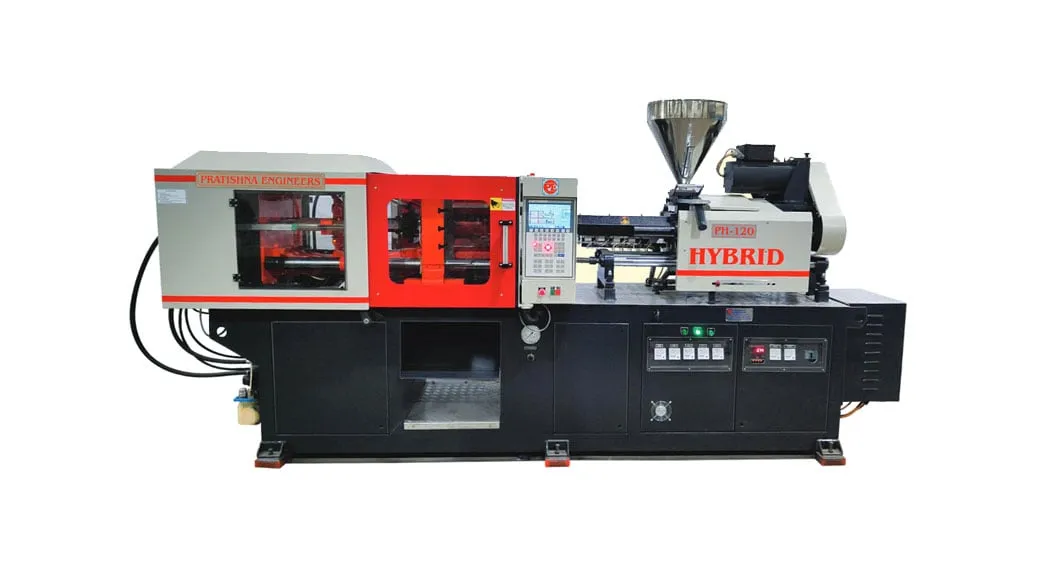

An injection moulding machine for luggage shells has to clamp a large, shallow, thin-walled half with a cosmetic face, shot after shot. That calls for a generous platen and tie-bar gap, a clamp sized on PP impact copolymer, a shot unit that fills a long flow path fast, and enough opening stroke to release a deep shell. The table below maps each luggage part to its usual material and the machine feature that decides the job. Trolley parts such as wheels and grips are smaller jobs and usually suit a separate, smaller machine.
Luggage parts, typical materials and the machine feature that decides the job
| Part | Typical material | Machine feature that matters most |
|---|---|---|
| Shell half (cabin or check-in) | PP impact copolymer | Platen size, tie-bar gap, fast injection, opening stroke |
| Handle grips and tube ends | PP or ABS | Multi-cavity moulds, short cycle |
| Wheels and wheel housings | PP, nylon or acetal | Shot repeatability, core pins for axles |
| Corner guards and feet | PP or TPE | Small clamp, quick colour change |
Key Takeaways
- Shell halves are large, shallow and thin, so platen size, tie-bar gap and opening stroke often decide the machine before clamp tonnage does.
- PP impact copolymer is the usual shell resin; Indian grades listed for luggage carry an IS 10951-3 designation and an antistatic additive.
- Size the clamp on the full projected area of the shell face at a PP tonnage factor of 2 to 3, plus a reserve.
- Cosmetic faces need even mould cooling, steady melt temperature and care with pigments, because colour can change shrinkage and warpage on a shell.
Which materials work for injection moulded luggage shells?
Most injection moulded luggage shells use a PP impact copolymer, because it combines low density, toughness at low temperature and easy colouring. Grades listed for luggage are high-impact or impact-stiffness balanced, antistatic types. Polycarbonate shells are usually formed from sheet, not injection moulded.
Two Indian grades show the pattern. One is listed as high-impact and antistatic, for furniture, luggage, paint pails and industrial parts, with BIS designation IS 10951-3-MBJ-B. The other balances impact and stiffness, carries IS 10951-3-MBJ-C, and lists paint pails, luggage and industrial components. Ask your resin supplier for the full data sheet before mould design starts.
A medium-impact copolymer gives a feel for the numbers. One Indian grade lists MFR 12 g/10 min, flexural modulus 1,000 MPa, notched Izod 85 J/m at 23 °C, a melt range of 190 to 240 °C and a mould temperature of 20 to 50 °C. A shell needs flow as well as impact, so compare both before you choose.
Pigment matters more than many buyers expect. Some pigments, such as greens, blues and oranges, act as strong nucleators, so two colours from one mould can come out at different dimensions. If your range has many shell colours, trial each one on the production machine before you sign off the mould.
What clamp and shot does an injection moulding machine for luggage shells need?
Clamp is set by the projected area of the shell face times a PP tonnage factor, usually 2 to 3 US tons per square inch, plus a reserve. Shot is set by shell volume, kept inside 20 to 65% of barrel capacity. Platen size and opening must also fit.
Work the clamp on the whole shell face, not on the outline seen in a side view. A shell half is shallow, so its projected area is close to the full length times width of the case. A thin wall and a long flow path push you toward the upper end of the PP factor.
For the shot, work in volume, not grams. Machine shot ratings are given in grams of polystyrene, and PP melt is lighter, at about 0.74 g/cm³ against 0.945 g/cm³ for PS. Add about 10% for check-valve leakage and melt uniformity, then pick a barrel where the shot sits at or below 65%.
Then check the frame. The mould should fit inside the tie bars, because platens can pull in near the tie bars and wear the parting line. A mould covering less than about 70% of the tie-bar gap risks flash in the centre. Our view: if a shell mould only just clears the tie bars, go one frame size up.
How do you keep the cosmetic face of a luggage shell consistent?
Keep wall thickness even, cool the mould evenly and hold melt and mould temperatures steady. PP does most of its shrinkage in the first 48 hours, and thick sections shrink more, so uneven walls or cooling show up as warpage, sink and gloss changes on a large face.
Design rules help here. Where the wall must vary, it should thin out progressively in the flow direction. Ribs on the inside of the shell should have a base width of about 75% of the adjacent wall and a base radius of 25 to 50% of the wall, or they may print through as sink lines.
On the machine side, a large shell rewards fast and repeatable injection. A slow fill on a long, thin flow path lets the melt front cool, which shows as flow lines and weld marks on the face. Ask for injection speed and pressure figures at the shot size you will run, not only at the maximum.
Ejection is the other risk. A wide, thin shell can distort if it is pushed off the core at a few small points. Use as much ejection surface as is reasonable, place ejectors at the deepest areas of the part, and allow an opening stroke of at least 2.5 times the shell depth.
What should you send before choosing a luggage shell machine?
Send the shell drawing with case size and depth, wall thickness, resin grade, number of colours and the monthly volume for each size. Add the mould dimensions if the tool already exists. With those, a supplier can check clamp, shot, tie-bar gap and opening together. See the luggage and bags solutions page.
Frequently Asked Questions About Luggage Shell Moulding Machines
Can a toggle machine mould luggage shells?
Yes, if its stroke and daylight fit. A toggle gives its full stroke at every shut height, so check that the stroke covers at least 2.5 times the shell depth. Shell moulds are large, so confirm tie-bar gap, platen size and maximum mould weight first, since these often run out before clamp force does.
Why do luggage shells warp after moulding?
PP keeps shrinking for about two days after moulding, and thick areas shrink more than thin ones. Uneven walls, uneven mould cooling or uneven packing leave stresses that pull the shell out of shape. Even walls, balanced cooling lines and steady packing pressure are the usual fixes, checked on parts measured after 48 hours.
Should one machine run shells and trolley parts?
Usually not. A shell needs a large frame and a big barrel, while wheels, grips and corner parts need small shots in multi-cavity moulds. A small part on a large barrel sits below 20% of capacity, which raises residence time and the risk of degradation. Two machine sizes normally serve the range better.
Can I use recycled PP in luggage shells?
You can, but recycled PP is less consistent than virgin resin in pellet size, properties and appearance, which shows on a cosmetic shell. Small metal pieces can plug hot runner tips, so cold runners and larger gates are safer. Consider keeping recycled blends for hidden parts and run trials before committing a colour.
Does shell colour affect part dimensions?
It can. Some pigments, including greens, blues and oranges, act as nucleators, so PP moulded in those colours can shrink differently from natural or black. On a large shell, that small difference can change the fit with the frame and zip track. Trial each colour and measure parts after they settle.
Related Articles
- Injection Moulding Machine for Electric & Electronics
- Injection Moulding Machine for Engineering
- Injection Moulding Machine for Plastic Pallets
- Injection Moulding Machine for Household Items
Sources & References
- UL Prospector: Polypropylene (PP): REPOL grade listing
- Reliance Industries: Repol B120MA TDS (July 2024)
- Plastics Technology, J. Bozzelli: A Simpler Way to Calculate Shot Size vs. Barrel Capacity
- MoldMaking Technology, B. Catoen: Machine Sizing and Specification for Optimal Mold Performance, Part 1 (Aug 2025)
Technical Disclaimer
Disclaimer: The information provided in this document is for general informational and educational purposes only. It is based on technical references and industry information available at the time of preparation and may be subject to change. It does not constitute engineering, technical, commercial or professional advice, nor does it constitute a quotation, specification, warranty or contractual commitment by Pratishna Engineers.
Actual injection moulding machine and process requirements vary according to the component design, material, mould, production volume, machine configuration and operating conditions. The information, examples, calculations and recommendations provided should be independently evaluated and verified for the specific application before making any equipment, process or production decision. Information obtained from third-party sources remains subject to the accuracy and limitations of those sources.
Limitation of Liability: Pratishna Engineers makes no representation or warranty, express or implied, regarding the completeness, accuracy or suitability of the information for any particular application. To the extent permitted by applicable law, Pratishna Engineers shall not be liable for any loss, damage, cost or consequence arising from reliance on or use of the information contained in this document. Final machine selection, configuration and application suitability should be confirmed with Pratishna Engineers based on complete and accurate project requirements.

