






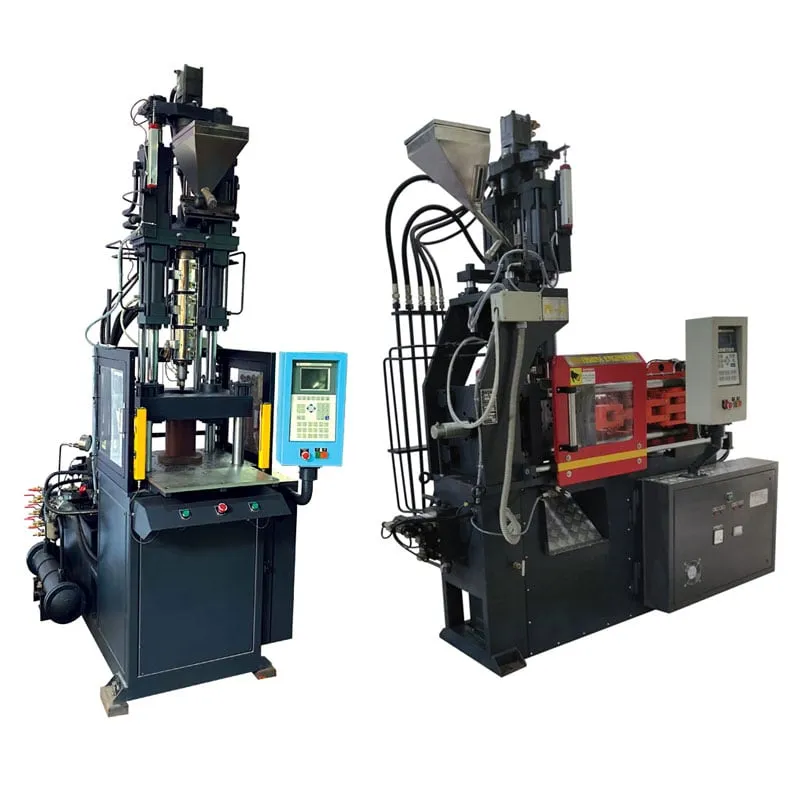

A plant head in Thane has a new two-cavity PP container mould and three offers on the desk: one for a 150 t machine, one for 200 t and one for 250 t. The biggest feels safest. It is not. Injection moulding machine price by tonnage climbs in steps, because each size up brings a heavier frame, larger platens, a bigger pump or drive and often a larger injection unit. Buying above what the mould needs means you pay more on the day of purchase and again on every power bill. This page explains how clamp and injection unit sizes move a quote, without quoting prices, and how to work out the size your mould needs. Pratishna Engineers' series data runs from 75 t to 350 t, so the examples stay inside that span.
Key Takeaways
- A quote rises with clamp tonnage because frame, platens, tie bars, pump or drive and connected load all step up together with each size.
- The injection unit is a separate step: a larger screw adds swept volume but lowers the injection pressure available on the same unit.
- Size the clamp from projected area and a tonnage factor, then add a modest reserve, rather than picking the next size up for comfort.
- An oversized machine costs you twice: a higher purchase figure on day one, then a higher base load and connected demand for years.
Why does injection moulding machine price by tonnage rise in steps?
Because a machine is built as a set of matched parts. Moving up one clamp size changes the frame, platens, tie bars, clamp cylinder or toggle, hydraulic pump or drive, motor and electrical panel together. The quote follows the heaviest of those changes, not the tonnage figure alone.
Look at what scales with clamp size. Platens must spread more force without bending, so they get thicker and heavier. Tie bars carry the clamp load, so their diameter grows. The pump and motor must move a heavier platen through the same stroke in a similar time, and the panel, cables and protection grow with the motor.
Connected load is the clearest outside sign of this step. Series specification sheets list total connected load in kW against clamp force, and the figure rises with each size. That number matters to you twice: it shows how much machine you are buying, and it sets how much electrical capacity your plant must supply.
Tie-bar spacing and platen size also step with tonnage. Sometimes a mould needs a larger platen than its clamp force alone would justify, and that, not the force, pushes you to the next size. Check both before you accept a larger machine.
What changes in a quote when you move up one machine size
| Part of the machine | What changes | Effect after purchase |
|---|---|---|
| Frame and platens | Thicker, heavier steel to carry more force | More floor load; no gain if the mould does not need the force |
| Tie bars | Larger diameter, often wider spacing | Fits larger moulds |
| Pump, motor or drive | Higher flow and power | Higher base load when the machine is under-used |
| Electrical panel | Larger rating and cables | Higher connected load and contract demand |
| Injection unit | Larger screw and barrel | Longer residence and degraded melt if your shot is small |
How does the injection unit change the quote?
The injection unit is chosen separately from the clamp, and one unit can carry more than one screw size. A larger screw gives more swept volume per stroke but less injection pressure, so the right choice depends on your shot size and how hard your part is to fill.
On the same unit, pressure scales with one over the screw diameter squared, and swept volume with the diameter squared. Moving from a 32 mm to a 35 mm screw raises the swept area by about 20% and cuts the available pressure to about 84% of the smaller screw's figure. That trade is the reason not to buy the biggest screw by default.
Shot ratings are usually given in grams of polystyrene. Convert to your own material by volume: PS melt density is 0.945 g/cm³ and PP about 0.74 g/cm³, so a PP shot weighs about 22% less than a PS shot of the same volume. Add 10% for check-valve leakage and melt uniformity before you size the barrel.
Then keep the shot between about 20% and 65% of barrel capacity. Below that window, long residence time degrades the melt; above it, melt quality suffers. A unit sized for a future mould with twice your current shot can leave today's part below the window.
Why does an oversized machine cost you twice?
You pay more when you buy it, and you keep paying while it runs. A larger machine carries a bigger pump or drive and a larger heated barrel than the part needs, so its base load stays high on every cycle you run.
The energy guide from ExxonMobil, AMI and Tangram Technology puts standard hydraulic machine base load at 75% or more of total energy, and notes that a high base load can mean the machine is too large for the job. Measurements reported in PlasticsToday add that large machines making small products are energy-inefficient.
There is a second cost in the electrical supply. MSEDCL levies demand charges on kVA, so a larger connected load can raise the contract demand your plant must hold and pay for each month, even on days the machine stands idle.
Over-clamping is the third trap. Running a mould at the full force of a much larger machine can crush vents, roll the parting line and crack inserts. Plastics Technology describes a mould needing about 100 tons that was clamped at a 400-ton machine's maximum; the cavity block split in two places.
Buy the clamp your mould needs plus a modest reserve, and put the difference into the right screw, a picker or robot, or a set of spares. Those choices earn back their cost on every shift; extra tonnage does not.
How do you work out the tonnage your mould needs?
Multiply the projected area of all cavities, plus any cold runner, by a tonnage factor for your material, then add a small reserve. For PP the factor is typically 2 to 3 US tons per square inch. The result is the clamp force your mould needs.
Take the projected area of one part as seen from the clamp direction, subtract through holes, multiply by the number of cavities and add the full cold-runner area. Plastics Technology recommends 3 tons per square inch as a starting point without better data, and lists flow length, wall thickness, gate size and melt flow as factors that move it.
Convert carefully. One US ton per square inch equals 0.1406 t per cm², so factors of 2, 3 and 4 become 0.281, 0.422 and 0.562 t/cm². Add a reserve of 10%, which is a starting margin, not a rule, and widen it for long flow or thin walls.
Then pick the smallest standard size that covers the result, and check that the mould fits between the tie bars and inside the shut-height range. If it does, you have found the size that should set your quote.
How Pratishna Engineers steps its machines by tonnage
Pratishna Engineers publishes total connected load against clamp force for each series, which lets you see the size steps described above in real figures. In the E series, E - 75 lists 75 tons and 17.5 kW, E - 100 lists 100 tons and 18.5 kW, and E - 150 lists 140 tons and 23.7 kW. In the C series, C - 180 lists 180 tons and 34.5 kW, and C - 320 lists 320 tons and 58.0 kW.
The PHM two-platen series runs from PHM - 160 at 160 tons and 38.6 kW to PHM - 350 at 350 tons and 81 kW. Design, manufacturing, assembly, testing and service are done in-house in Mumbai, and machines are selected in a set order: Component, Material, Mould, Production Requirement, Machine Configuration.
- Ask for the specification sheet row for the size your calculation points to, not only the range brochure.
- Range: horizontal (E, C and H series), vertical, PET, two-platen (PHM series) and hybrid machines.
What should you send to get a correctly sized quote?
Send the part drawing, material grade, number of cavities, runner type, shot weight and target cycle. Ask each supplier to show the tonnage calculation behind its offer, so you compare the same size on every quote. Then review the machine range against your result.
Frequently Asked Questions About Injection Moulding Machine Price by Tonnage
Does a higher tonnage machine always give better parts?
No. Clamp force only has to hold the mould shut against injection pressure. Extra force beyond that brings no gain in part quality and can harm it: over-clamping can crush vents, cause burns and short shots, roll the parting line and crack inserts or cavity blocks. Size to the mould, then add a modest reserve.
Can I run a small mould on a large machine?
You can, within limits. The mould should cover a fair share of the tie-bar gap; a rule of thumb is at least 70%, because smaller moulds let platens bow and can flash in the centre. Run below full clamp force and expect higher energy per part than on a machine sized for the mould.
Should I buy extra tonnage for future moulds?
Only if those moulds are planned and their size is known. A machine bought for a mould that may never arrive will run today's work at a high base load. If future moulds are uncertain, consider a second barrel now or a second machine later rather than a larger clamp today.
Why do two quotes for the same tonnage differ?
Because tonnage is only one line. Screw size and barrel, drive type, tie-bar spacing, platen size, opening stroke, controller, robot interface and auxiliaries all change the offer. Ask each supplier for a full specification against the same part brief, so you compare like with like before looking at the figure.
What tonnage factor should I use for my material?
Start with the resin supplier's datasheet. Published guidance puts PP at 2 to 3 US tons per square inch and polycarbonate toward the high end of a 2 to 8 range, while ABS datasheets often show 2 to 4. Thin walls and long flow lengths push the factor up, so confirm it on a trial.
Where can I see Pratishna Engineers' tonnage steps?
Each Pratishna Engineers series specification sheet lists mould clamping force and total connected load for every model, from E - 75 at 75 tons in the E series to PHM - 350 at 350 tons in the PHM series. Ask for the sheet that matches the clamp size your own calculation gives.
Related Articles
- Injection Moulding Machine Manufacturers Near Me (Mumbai)
- Injection Moulding Machine Suppliers Comparison Mumbai
- Plastic Injection Moulding Machine Price in Mumbai
- Cost of Injection Moulding Machines in Mumbai
Sources & References
- Plastics Technology, J. Williams (RJG): Clamp Tonnage: More Is Better...Right? (May 2017)
- Plastics Technology, J. Bozzelli: A Simpler Way to Calculate Shot Size vs. Barrel Capacity (2017, updated 2022)
- ExxonMobil, AMI and Tangram Technology: An Energy Saving Guide for Injection Moulders
- MSEDCL: kVAh Billing: Frequently Asked Questions
Technical Disclaimer
Disclaimer: The information provided in this document is for general informational and educational purposes only. It is based on technical references and industry information available at the time of preparation and may be subject to change. It does not constitute engineering, technical, commercial or professional advice, nor does it constitute a quotation, specification, warranty or contractual commitment by Pratishna Engineers.
Actual injection moulding machine and process requirements vary according to the component design, material, mould, production volume, machine configuration and operating conditions. The information, examples, calculations and recommendations provided should be independently evaluated and verified for the specific application before making any equipment, process or production decision. Information obtained from third-party sources remains subject to the accuracy and limitations of those sources.
Limitation of Liability: Pratishna Engineers makes no representation or warranty, express or implied, regarding the completeness, accuracy or suitability of the information for any particular application. To the extent permitted by applicable law, Pratishna Engineers shall not be liable for any loss, damage, cost or consequence arising from reliance on or use of the information contained in this document. Final machine selection, configuration and application suitability should be confirmed with Pratishna Engineers based on complete and accurate project requirements.

