






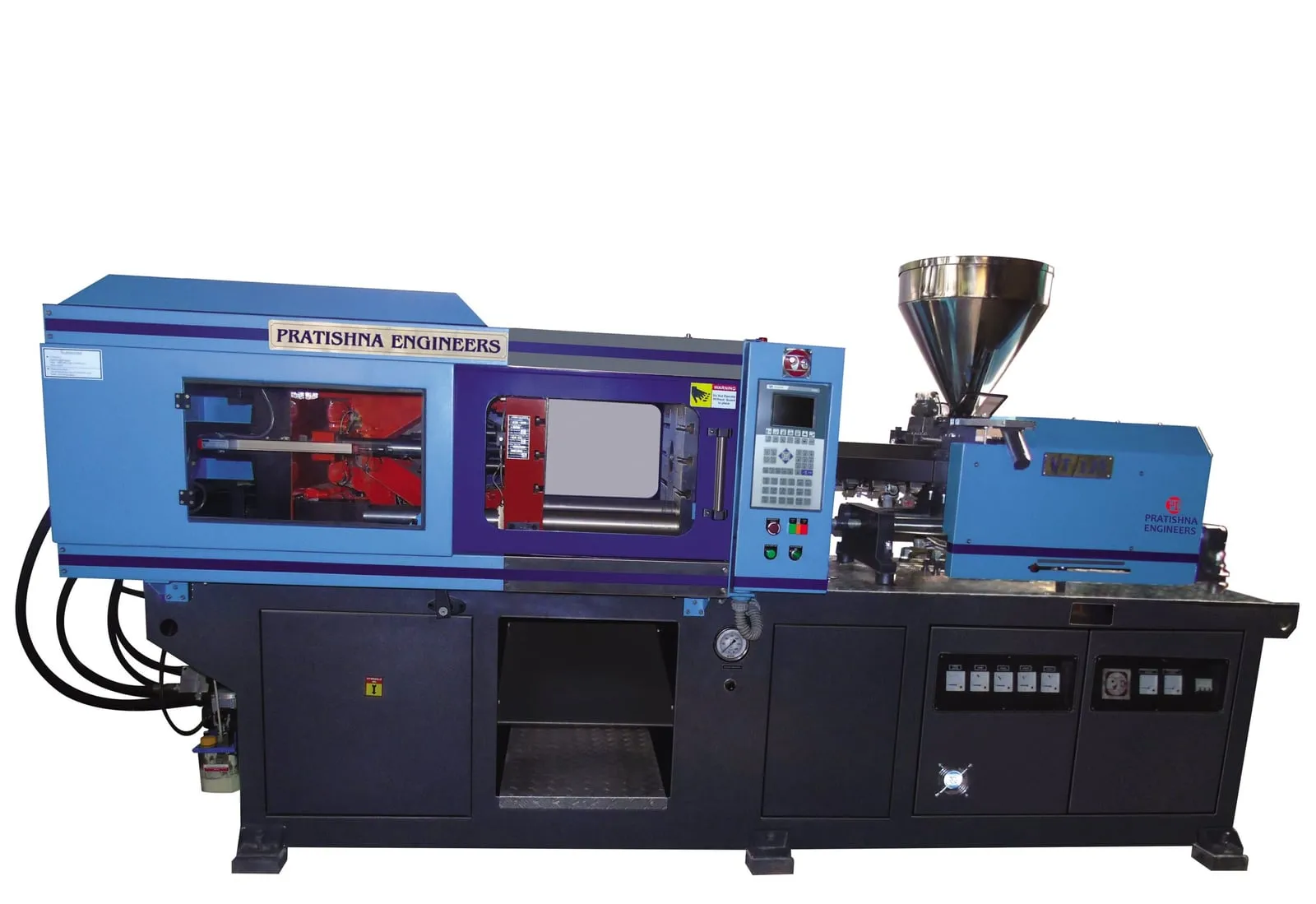

Add a moulding machine for business expansion when your present machines are booked for most of their available hours and the new work cannot be absorbed by an extra shift, a better mould or a shorter cycle. Size it for the jobs it will run on most days, not for the largest order you hope to win. Before you order, check two things that are easy to leave late: the extra electrical demand on your connection and the floor area the machine needs once the dryer, chiller, mould handling and part storage are counted.
Key Takeaways
- Measure booked hours per machine against the hours you can really run before deciding, because a gap that an extra shift covers does not justify a purchase.
- Size the next machine to the clamp and shot window of the jobs it will run daily, since an oversized machine wastes energy on small parts.
- Add the new connected load to your maximum demand and check power factor, because MSEDCL kVAh billing charges you for power that does no useful work.
- Plan floor space for the whole cell, including dryer, chiller, mould change access and finished part storage, not only the footprint of the machine.
When should you add a moulding machine for business expansion?
Add a machine when booked hours stay above what your current machines can deliver for several months, and when cheaper fixes such as an extra shift, a shorter cycle or more cavities cannot close the gap. A single large order is a weak reason on its own.
Start with machine hours, not orders. For each job, divide the monthly quantity by the good parts per hour on the machine that runs it. Add the hours by machine and compare them with the hours you can run after mould changes, maintenance and breaks. A machine booked on paper for every available hour will still miss deliveries.
Then test the cheaper options in order. An extra shift costs labour but no capital. A cycle trimmed through better mould cooling adds capacity on every job that mould runs. A mould with more cavities can raise output from the same machine if clamp and shot allow it.
Look at the trend as well as the total. If the shortfall comes from one customer whose volumes swing, overtime or subcontracting may serve you better than a fixed asset that sits idle when the order ends. If the gap has grown across several customers, it is structural, and that is the case for a new machine.
Capacity signals and the first response to try
| Signal on the shop floor | What it usually means | First response |
|---|---|---|
| Booked hours above available hours for one month | Temporary peak | Extra shift or overtime |
| Booked hours above available hours for several months | Structural shortfall | Plan a new machine |
| One machine overloaded while others sit idle | Job mix does not fit the idle machines | Check clamp, shot and mould fit before buying |
| One mould with a long cycle | Cooling or mould limit | Correct the mould first |
| Mould changes eat a large share of each shift | Too many short runs on one machine | Group jobs or add a small machine for short runs |
Which size should the next machine be?
Choose the clamp force and shot capacity that cover the jobs the machine will run on most days, with a modest reserve. Buying the largest machine you can afford feels safe, but it costs more to run on small parts and often moulds them less consistently.
List the moulds the new machine will carry for most of its hours. For each, note projected area, shot weight, mould height and tie-bar fit. The right machine is the smallest one that clears all of them with a reserve. A 10% clamp reserve is a sensible start; treat it as a starting margin, not a rule.
Oversizing has two costs. The first is energy. A standard hydraulic machine can spend 75% or more of its energy as base load, and a high base load can mean the machine is too large for the job. The second is melt quality, because a small shot in a large barrel stays longer at temperature and can degrade.
Undersizing fails faster and more visibly: flash, short shots and moulds that do not fit between the tie bars. If your job mix spans a wide range, two machines of different sizes often serve it better than one large machine. Put plainly, a machine bought for a hoped-for order but run on small jobs is the costliest machine in the shop.
How will a new machine affect your power and floor space?
A new machine raises your connected load, your maximum demand and, under kVAh billing, the cost of a poor power factor. It also needs more floor than its own footprint, because the dryer, chiller, mould handling and part removal all sit around it.
Start with the electricity connection. Add the connected load of the machine and its auxiliaries to your present maximum demand and compare the total with your sanctioned contract demand. If the margin is thin, raise it with MSEDCL early, so the approval is in place before commissioning.
Check power factor next. Under MSEDCL kVAh billing, energy is charged on apparent power, so at a power factor of 0.85, 15% of the power drawn does no useful work. Capacitor banks or an automatic power factor correction panel help, and they need resizing when a large motor load is added.
Idle time matters too. Idling machines can draw between 52% and 97.5% of their full moulding energy, so plan the schedule so the new machine runs full shifts. For floor space, draw the cell: mould opening length, a clear path for the crane or trolley, the dryer and loader, and room for boxes of parts.
What should you prepare before adding the next machine?
Prepare a list of the moulds the machine will run, with part drawings, material grades, target cycles and monthly quantities, plus your current contract demand and a floor sketch. With these in hand, a supplier can size clamp, shot and auxiliaries from facts. Browse the injection moulding machine range with them at hand.
Frequently Asked Questions About Adding Moulding Capacity
How many hours a month can one moulding machine really run?
It depends on shifts, working days, mould changes, planned maintenance and breaks. Work it out from your own records: scheduled hours minus logged stoppages over the last few months. That figure, not the calendar hours, is the capacity to compare with booked hours when you plan an expansion.
Should I buy one large machine or two smaller ones?
Two smaller machines suit a job mix with many medium parts, because each can run its own mould and one breakdown does not stop all output. One large machine suits a few big parts that need its clamp and shot. Compare both options by machine hours, energy at the expected load and floor area.
Does adding a machine always need a higher contract demand?
Not always. If your present maximum demand sits well below the sanctioned contract demand, the new load may fit. Add the connected load of the machine and its auxiliaries, allow for times when several heaters and motors start together, and compare the total with the sanctioned figure before you order.
Can a shorter cycle replace a new machine?
Sometimes. A shorter cycle adds capacity on every job that mould runs, and cooling time rises with the square of wall thickness, so mould cooling is the first place to look. If trials show the part warps or sinks at a shorter cycle, the gain is not available and a new machine may be needed.
What auxiliaries does a new moulding machine need?
A typical cell needs a dryer or hopper loader for hygroscopic resins, a chiller or cooling tower supply, a mould temperature controller where the part needs a warm mould, and part removal ranging from a chute to a robot. Budget floor space and electrical load for each of them, not only for the machine.
Related Articles
- The Essential Role of Injection Molding Machines in Manufacturing
- The PHM Series Two Platen Injection Molding Machine: Revolutionizing Large Part Production
- Hybrid Injection Moulding Machines: Bridging Efficiency and Precision
- Why Automatic Injection Moulding Machines Are Perfect for Mass Production
Sources & References
- ExxonMobil, AMI and Tangram Technology: An Energy Saving Guide for Injection Moulders
- PlasticsToday, R. Kent: Getting to know your real energy use and cost (Jan 2010)
- MSEDCL: kVAh Billing: Frequently Asked Questions
- Plastics Technology, J. Bozzelli: A Simpler Way to Calculate Shot Size vs. Barrel Capacity
Technical Disclaimer
Disclaimer: The information provided in this document is for general informational and educational purposes only. It is based on technical references and industry information available at the time of preparation and may be subject to change. It does not constitute engineering, technical, commercial or professional advice, nor does it constitute a quotation, specification, warranty or contractual commitment by Pratishna Engineers.
Actual injection moulding machine and process requirements vary according to the component design, material, mould, production volume, machine configuration and operating conditions. The information, examples, calculations and recommendations provided should be independently evaluated and verified for the specific application before making any equipment, process or production decision. Information obtained from third-party sources remains subject to the accuracy and limitations of those sources.
Limitation of Liability: Pratishna Engineers makes no representation or warranty, express or implied, regarding the completeness, accuracy or suitability of the information for any particular application. To the extent permitted by applicable law, Pratishna Engineers shall not be liable for any loss, damage, cost or consequence arising from reliance on or use of the information contained in this document. Final machine selection, configuration and application suitability should be confirmed with Pratishna Engineers based on complete and accurate project requirements.

