






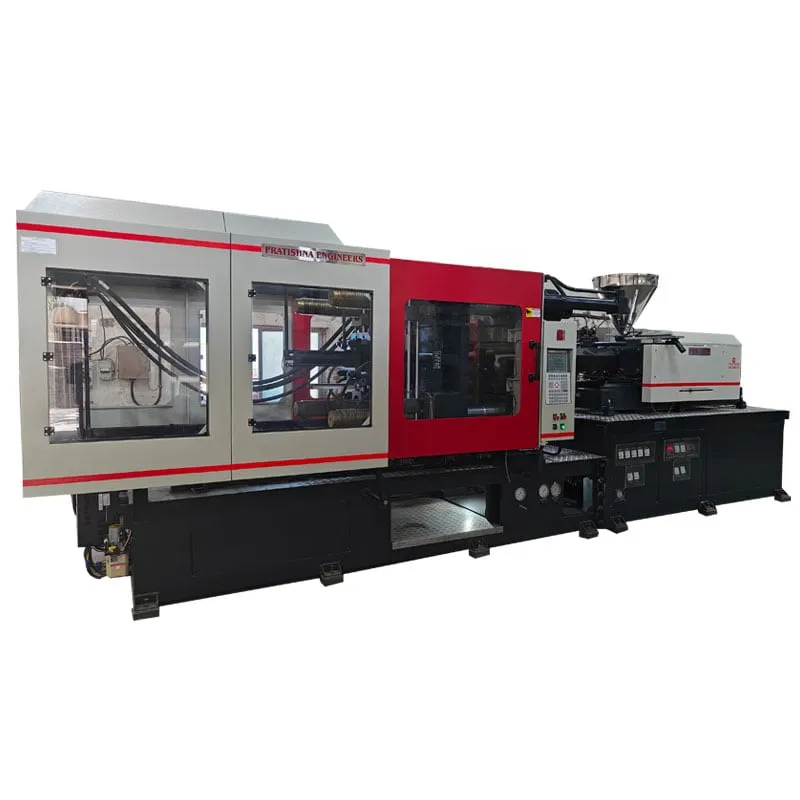

A plant head has a new order for large PP crates. The part fits a 250 t clamp on paper, yet the trial mould will not open far enough to drop the crate, and the toggle machine on the floor runs out of stroke before the part clears the core. This is where a PHM series two platen machine for large parts earns its place. Sizing it comes down to three checks done in order: clamp force per cavity, opening for the tallest part, and the size and weight of the mould the platens must carry. Pratishna Engineers builds the PHM series in Mumbai in 160, 200, 250 and 350 t sizes, and this guide uses its published data for each check.
Key Takeaways
- Work out clamp force from projected area per cavity, a tonnage factor for the resin and a reserve, then compare it with the rated clamp of the machine.
- On a two-platen machine the usable stroke falls as mould height rises, so check opening at your actual mould height, not the catalogue stroke.
- Allow an opening of at least 2.5 times the part height, and confirm the mould fits inside the tie bars and above the minimum mould thickness.
- Ask for the maximum mould weight for each platen and level the machine at installation, because heavy large moulds load the moving platen through every cycle.
How much clamp force does a large part need per cavity?
Multiply the projected area of each cavity, less any through openings, by a tonnage factor for the resin, add any cold-runner area, then add a reserve. For PP crates and bins the factor usually sits between 2 and 3 US tons per square inch.
Converted to metric, 2 and 3 US tons per square inch are 0.281 and 0.422 t/cm². Crates help you here: the open grid in a crate base is not projected area, so a 450 × 300 mm crate with 40% open area projects about 810 cm², not 1,350 cm². A 10% reserve on top is a starting margin, not a rule.
Thin walls and long flow paths push the factor up, and the table shows how wide the range is. A 500 × 350 mm crate with 40% open area needs 325 to 487 t, which spans more than one machine size. If the low figure fits and the high one does not, a mould trial on the actual grade decides.
Do not solve the problem with extra tonnage. Clamping a mould far above its need can crush vents, roll the parting line and crack cavity blocks; one published case split a cavity block in two places.
Clamp force per cavity for PP parts (factor 2 to 3 US t/in², with a 10% reserve)
| Part (one cavity) | Projected area | Clamp needed |
|---|---|---|
| Round rim, 300 mm | 706.9 cm² | 219 to 328 t |
| Crate 450 × 300 mm, 40% open | 810 cm² | 250 to 376 t |
| Crate 500 × 350 mm, 40% open | 1,050 cm² | 325 to 487 t |
| Box 500 × 220 mm | 1,100 cm² | 340 to 511 t |
| Crate 600 × 400 mm, 50% open | 1,200 cm² | 371 to 557 t |
How much opening does a tall part need on a two-platen machine?
Allow an opening of at least 2.5 times the part height between the mould faces once the mould is open. On a two-platen machine, check that opening at your actual mould height, because the stroke you can use falls as the mould gets taller.
The reason lies in the clamp design. On a toggle machine the full stroke is available at every shut height, and maximum daylight equals maximum shut height plus stroke. On a piston or two-platen clamp, maximum daylight equals minimum shut height plus maximum stroke, so a tall mould eats into the opening.
The PHM data follow this rule. For the PHM - 250, a minimum mould thickness of 250 mm plus a 1,150 mm stroke gives the 1,400 mm maximum daylight listed. Usable opening is that daylight minus your mould height, so a 600 mm mould leaves 800 mm.
Work backwards from the part. If the mould is the part height plus an allowance for plates and core, the daylight needed is 3.5 times the part height plus that allowance. With 1,400 mm of daylight and an assumed 260 mm allowance, the tallest part is about 326 mm. Check daylight before tonnage, because on tall parts it is the figure that rules a machine out.
What mould size and weight can the platens carry?
The mould should fit between the tie bars, or at least keep the projected area of the parts inside them, and it should cover about 70% of the tie-bar gap. Its height must fall within the minimum and maximum mould thickness, and its weight within the limit for both platens.
A mould that is too small lets the platens bow under clamp, which shows up as flash in the centre of the mould, and very small moulds can damage the platens. On the PHM - 250, with 640 × 640 mm between tie bars, 70% coverage means a mould at least 448 mm across.
A mould whose cavities sit too close to the tie bars has the opposite problem: platens pull in near the bars and wear the parting line. Check the mounting hole pattern and the ejector pattern too, because a mismatch may need an ejector box, which adds height and takes away opening.
Mould weight is the figure buyers forget. Crate and bin moulds are heavy, and the moving platen carries its half on guides through every cycle. Ask for the maximum mould weight for each platen in writing, and level the machine at installation; parallelism of 0.025 to 0.05 mm is generally acceptable below 500 t.
How do you choose a PHM series two platen machine for large parts?
Choose the smallest PHM size whose clamp, usable opening, tie-bar space and shot all clear your mould with a reserve. Clamp and opening usually decide the size for tall PP parts, while shot capacity decides it for heavy parts with thick walls.
Shot ratings are given in grams of PS, and PP melt is lighter, so convert by volume. Once the 20% to 65% barrel window and a 10% allowance are applied, a good PP shot sits between about 14% and 46% of the PS rating. The PHM - 350 B barrel, rated 1,492 g PS, gives a good PP shot of about 212 to 691 g.
Material grade also shapes cycle time on large parts. One Indian high-crystalline PP impact copolymer, with an MFR of 30 g/10 min, is described by its maker as suited to large articles with lower cycle times, because of its high flow and fast crystallisation.
Two-platen clamps also tend to shorten the machine compared with a toggle of the same force, which helps in a crowded hall. The table lists the PHM figures that matter for large parts, quoted as given in the series sheet.
PHM series figures for large-part sizing (as given in the series sheet)
| Model | Clamp (Tons) | Stroke (mm) | Mould thickness (mm) | Max. daylight (mm) | Tie bars H × V (mm) |
|---|---|---|---|---|---|
| PHM - 160 | 160 | 1000 | 225 to 645 | 1225 | 460 × 440 |
| PHM - 200 | 200 | 1100 | 240 to 655 | 1340 | 560 × 540 |
| PHM - 250 | 250 | 1150 | 250 to 700 | 1400 | 640 × 640 |
| PHM - 350 | 350 | 1350 | 300 to 800 | 1650 | 720 × 720 |
How Pratishna Engineers builds the PHM series for large moulds
Pratishna Engineers was founded in Mumbai in 1991 by Nandkumar R. Kushe and has supplied more than 9,000 machines to over 1,000 customers in India and international markets. Design, manufacturing, assembly, testing and service are done in-house, at facilities of about 25,000 sq ft with CNC turning centres, machining centres and jig boring machines.
The PHM series is its two-platen, hydro-mechanical range, built from 160 to 350 t with a servo driven pump on every size. Sizing starts from your part, not the catalogue, in a fixed order: component, material, mould, production requirement and machine configuration.
- Clamp from 160 to 350 t, maximum daylight from 1,225 to 1,650 mm, and tie-bar space from 460 × 440 to 720 × 720 mm.
- Two screw options per size, so the shot can be matched to a heavy part or a lighter one on the same clamp.
What should you send for a large-part sizing check?
Send the part drawing with its height and projected area, the resin grade, the mould drawing with height, footprint and weight, the cavity count, and the cycle and monthly volume you need. With these, clamp, opening, tie-bar fit and shot can be checked before a trial. See the two platen injection moulding machine range.
Frequently Asked Questions About Two-Platen Machines for Large Parts
Why choose a two-platen machine over a toggle for large parts?
A two-platen clamp locks the moving platen and applies tonnage through short-stroke cylinders, so it usually makes a shorter machine with a long stroke. Toggles keep full stroke at every shut height and are simple and rigid. For tall parts in a crowded hall, length and stroke often favour the two-platen design.
What is daylight on an injection moulding machine?
Daylight is the largest distance between the fixed and moving platens with the clamp fully open. Usable opening is daylight minus mould height. On a two-platen machine, maximum daylight equals minimum mould thickness plus maximum stroke, so a taller mould leaves less opening for taking the part out.
How do I find the projected area of a crate?
Take the outline area of the crate seen in the clamping direction, then subtract the through openings in the base that the clamp does not have to hold shut. Side-wall openings do not count, because they run parallel to the clamp direction. Add the cold-runner area if the mould has one.
How heavy a part can a large two-platen machine mould?
Shot capacity sets that limit, not clamp. Using the 20% to 65% barrel window with a 10% allowance, a good PP shot is about 14% to 46% of the PS rating of the barrel. Check that window for the screw option you choose, and confirm the injection rate fills the part in time.
Does a two-platen machine need less floor space?
It usually needs less length than a toggle machine of the same clamp force, because there is no long linkage behind the moving platen. Width and height are similar. Plan the floor for the whole cell, including crane access for mould changes, since large moulds are lifted in from above.
Can Pratishna build a machine beyond the standard PHM range?
Pratishna Engineers lists special-purpose machines alongside its horizontal, vertical, PET, two-platen and hybrid ranges, and designs and builds them in-house. If a large part needs stroke, platen size or clamp beyond the standard PHM table, send the part and mould details so a custom build can be assessed.
Related Articles
- Plastic Injection Moulding Machines: Empowering Your Business for Growth
- The Essential Role of Injection Molding Machines in Manufacturing
- PHM series Two Platen Injection Molding Machine: An Overview
- Applications of Two-Platen Injection Moulding Machines in Large-Scale Projects
Sources & References
- MoldMaking Technology, B. Catoen: Machine Sizing and Specification for Optimal Mold Performance, Part 1 (Aug 2025)
- SPE Plastics Engineering, A. Urbina: Mastering Clamping Force Calculation (Mar 2024)
- Plastics Technology, J. Williams (RJG): Clamp Tonnage: More Is Better...Right? (May 2017)
- Reliance Industries: Repol B300MN Technical Data Sheet (July 2024)
Technical Disclaimer
Disclaimer: The information provided in this document is for general informational and educational purposes only. It is based on technical references and industry information available at the time of preparation and may be subject to change. It does not constitute engineering, technical, commercial or professional advice, nor does it constitute a quotation, specification, warranty or contractual commitment by Pratishna Engineers.
Actual injection moulding machine and process requirements vary according to the component design, material, mould, production volume, machine configuration and operating conditions. The information, examples, calculations and recommendations provided should be independently evaluated and verified for the specific application before making any equipment, process or production decision. Information obtained from third-party sources remains subject to the accuracy and limitations of those sources.
Limitation of Liability: Pratishna Engineers makes no representation or warranty, express or implied, regarding the completeness, accuracy or suitability of the information for any particular application. To the extent permitted by applicable law, Pratishna Engineers shall not be liable for any loss, damage, cost or consequence arising from reliance on or use of the information contained in this document. Final machine selection, configuration and application suitability should be confirmed with Pratishna Engineers based on complete and accurate project requirements.

