






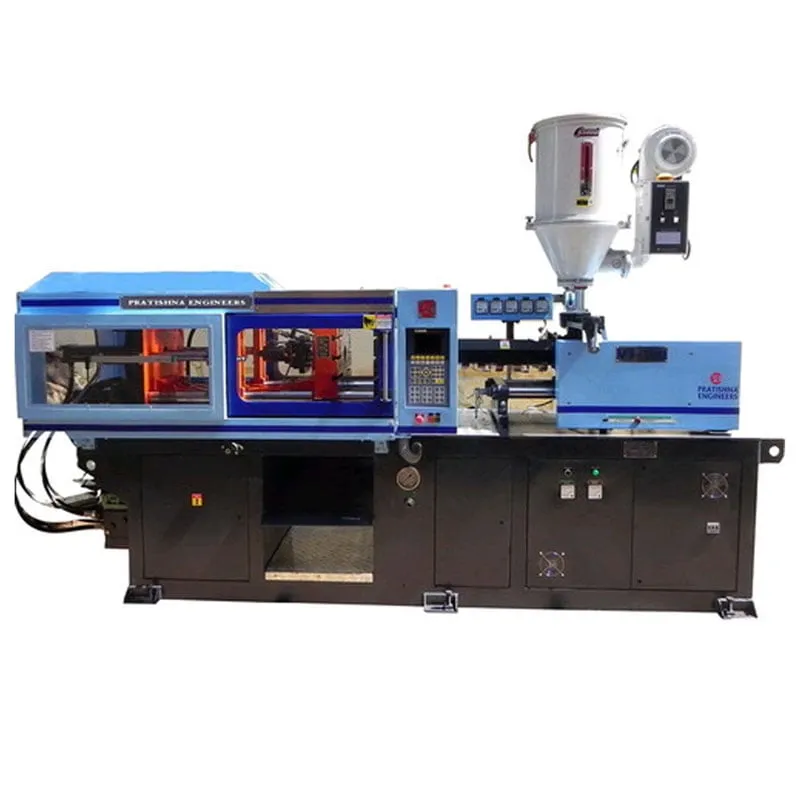

Before you match a part to a PV series plastic injection molding machine, run these five checks against the spec sheet. The PV is a horizontal clamp with a vertical injection unit, built by Pratishna Engineers in 40 t and 55 t sizes.
1. Clamp: does your projected area, times a tonnage factor, stay inside 40 t or 55 t with a reserve?
2. Shot: is your shot between 20% and 65% of the barrel, after converting the PS rating to your resin?
3. Fit: does every cavity sit inside the tie-bar space, with the mould between 125 mm and 300 mm thick?
4. Opening: is the clamp stroke at least two and a half times the part height?
5. Ejection: are 40 mm or 50 mm of ejector stroke enough to clear the part from the cavity?
Key Takeaways
- The PV series pairs a horizontal clamp with vertical injection, so the nozzle feeds the parting line from above, which suits cords, pins and inserts across the joint.
- Shot ratings are in grams of PS; a PP or PVC shot weighs differently, so convert by melt density before you judge the barrel size.
- On both models, maximum daylight is the 300 mm maximum mould thickness plus the clamp stroke, so the full stroke remains usable across the range.
- Size clamp from projected area and a tonnage factor, then keep a reserve; a 10% reserve is a starting margin, not a rule.
What does each PV series plastic injection molding machine figure mean?
Each figure answers one question about your part. Clamping force limits projected area. Shot weight limits part plus runner volume. Mould thickness and daylight decide which moulds fit and how far they open. Tie-bar space and platen size limit mould footprint, and ejector stroke limits part depth.
The table below lists the figures as printed on the series sheet. Read them as limits, not targets. A machine run close to every limit at once leaves you no room for a second mould, a new resin grade or a tool modification later.
Injection pressure falls from 1,300 kg/cm² on the 27 mm screw to 1,065 kg/cm² on the 35 mm screw. That pattern is normal: a larger screw delivers more volume at lower plastic pressure, so thin or long-flow parts may need the smaller unit even when the shot fits.
Motor and heater ratings are given in HP on this sheet: 5 HP and 3.5 HP for the 40 t model, 7.5 HP and 5 HP for the 55 t model. Use them for a first check of your supply, then confirm the connected load before you plan cabling and the panel.
PV series figures as printed on the series sheet
| Figure | PV 40 | PV 55 |
|---|---|---|
| Screw diameter | 27 mm | 35 mm |
| Max. shot weight (PS) | 64 g | 130 g |
| Max. injection pressure | 1,300 kg/cm² | 1,065 kg/cm² |
| Mould clamping force | 40 t | 55 t |
| Mould clamping stroke | 200 mm | 225 mm |
| Mould thickness (min to max) | 125 to 300 mm | 125 to 300 mm |
| Max. daylight opening | 500 mm | 525 mm |
| Space between tie bars (H x V) | 265 x 195 mm | 350 x 298 mm |
| Platen size | 415 x 370 mm | 480 x 415 mm |
| Ejector stroke and force | 40 mm, 1.7 t | 50 mm, 2.0 t |
| Machine weight | 1.25 t | 1.65 t |
| Floor space (L x W x H) | 1.85 x 0.75 x 2.5 m | 2.3 x 0.9 x 2.5 m |
How much shot can the PV 40 or PV 55 deliver in your material?
Less than the label suggests for most resins. The rating is in grams of polystyrene, and a good shot sits between about 20% and 65% of barrel capacity. In PP, the 64 g barrel gives roughly 9 to 30 g and the 130 g barrel roughly 18 to 60 g.
The conversion works in volume. Polystyrene melt is about 0.945 g/cm³ and PP melt about 0.74 g/cm³, so the same swept volume holds about 22% less PP by weight. Add about 10% for check-valve leakage and melt uniformity before you compare your shot with the barrel.
Rigid PVC runs the other way. Its specific gravity is about 1.3 to 1.4 against 1.0 for PS, so a PS-rated barrel holds about 30% more PVC by weight. PVC guidance also prefers shots of 50% to 80% of barrel capacity, because low shot percentages on long cycles degrade the melt.
Below about 20% of the barrel, residence time grows and heat-sensitive resins degrade. Above about 65%, unmelts and long recovery appear. If your part sits at either edge on both models, say so in your enquiry rather than forcing the fit. A second screw and barrel size is far easier to arrange at order stage than after the mould is built.
Will your mould fit between the tie bars and open far enough?
Check footprint, thickness and opening. Every cavity should sit inside the tie-bar space, the mould should be 125 mm to 300 mm thick, and it should open at least two and a half times the part height. The PV 40 stroke limits parts to about 80 mm tall.
Ideally the whole mould sits between the tie bars. At minimum, the projected area of every cavity must, because platens can pull in near the tie bars under clamp and wear the parting line. On the PV 40 the gap is 265 x 195 mm; on the PV 55 it is 350 x 298 mm.
Daylight works out neatly on both models: 300 mm plus 200 mm gives 500 mm, and 300 mm plus 225 mm gives 525 mm. Even the thickest mould the machine accepts therefore still gets the full clamp stroke for opening, which is not true of every clamp design.
Opening of 2.5 times part height is a guide for clean part removal. With 200 mm of stroke the tallest part is about 80 mm; with 225 mm it is 90 mm. Deeper parts need a longer-stroke machine or a mould that releases the part in a different direction.
Which parts suit vertical injection into a horizontal clamp?
Parts where something must lie across the parting line suit it best. With the nozzle feeding from above into the joint, cords, pins, terminals and metal inserts can sit in locating slots in one half while the clamp closes. Small plug tops, cable grommets and strain reliefs are typical.
Plugs and socket-outlets in India are made to IS 1293, which covers earthing, shock protection, resistance to abnormal heat and a normal-operation test in which the plug is inserted and withdrawn 10,000 times. Moulding around the pins only helps if the pins stay located while the melt flows past them.
Because the clamp is horizontal, there is no sliding or rotary table on this design, and inserts are placed by hand or by a loader into a vertical mould face. If your process needs gravity to hold loose inserts, or two lower halves to load while one moulds, look at a vertical-clamp machine.
A flat rule from the shop floor: if the insert can fall out of a vertical mould face, do not fight it with magnets and tape. Choose the clamp orientation that lets gravity do the locating.
How Pratishna Engineers supports PV series buyers
Pratishna Engineers was founded in Mumbai in 1991 by Nandkumar R. Kushe, a first-generation engineer. Its vertical range covers the PV series with horizontal clamp and vertical injection and the PVDL series with vertical clamp, alongside horizontal, two-platen, PET, hybrid and special-purpose machines.
Design, manufacturing, assembly, testing and service are done in-house. The design team works in SolidWorks, Creo and AutoCAD, so a PV machine can be checked against your mould drawing before an order rather than after delivery, and changes to ejection or nozzle position can be discussed early. The group also builds SPMs, hydraulic systems and automation, which helps when a PV cell needs an insert feeder or a custom fixture.
- Machine selection follows a fixed order: component, material, mould, production requirement, then machine configuration.
- Sending your part drawing, resin grade and insert details lets clamp, shot and mould fit be checked against the PV 40 and PV 55 figures.
What should you send before choosing a PV model?
Send a part drawing with the parting line marked, the resin grade, the insert or cord details, the cavity count and your monthly volume. With those, clamp, shot, mould fit and opening can be checked in one pass rather than by trial. See the PV series vertical injection machine page.
Frequently Asked Questions About the PV Series
Is the PV series a vertical machine or a horizontal machine?
It is both, in a way. The clamp opens and closes horizontally, like a conventional machine, while the injection unit stands vertically and feeds the mould from above at the parting line. That layout keeps the floor footprint small and suits parts with cords or pins crossing the joint.
Can a PV machine run PP and ABS as well as PVC?
Yes, provided the shot and pressure fit. Convert the PS shot rating by melt density, keep the shot inside roughly 20% to 65% of the barrel, and check that injection pressure suits your flow length. Heat-sensitive PVC needs a streamlined melt path, so mention it before you order.
What does maximum daylight opening mean on the spec sheet?
It is the largest distance the platens can open apart. Subtract your mould thickness and you get the usable opening for removing the part. On both PV models, daylight equals the 300 mm maximum mould thickness plus the clamp stroke, so the full stroke is available across the range.
How do I check whether my mould fits the machine?
Ideally the whole mould fits between the tie bars; at minimum, every cavity's projected area must sit inside them, because platens can pull in near the tie bars and wear the parting line. Then confirm the mould is 125 mm to 300 mm thick and the stroke clears the part.
Why is injection pressure lower on the PV 55 than on the PV 40?
The PV 55 carries a larger 35 mm screw. A larger screw sweeps more volume per stroke but develops lower plastic pressure for a given hydraulic force. That is why a thin or long-flow part sometimes needs the smaller screw, even when the shot weight would fit the larger one.
Can Pratishna Engineers check my part against the PV figures?
Yes. Send the part drawing, resin grade, insert or cord details, cavity count and monthly volume through the contact page or WhatsApp. The application team works through component, material, mould, production requirement and machine configuration, in that order, before recommending a configuration for your job.
Related Articles
- PHM Series Two Platen Injection Molding Machine: An Overview
- Vertical Locking Vertical Injection Sliding Double Station Explained
- Applications of PV Series Plastic Injection Moulding Machines in Consumer Electronics
- Vertical Injection Moulding Machines: Innovating Manufacturing
Sources & References
- MoldMaking Technology, B. Catoen: Machine Sizing and Specification for Optimal Mold Performance, Part 1 (Aug 2025)
- Plastics Technology, J. Bozzelli: A Simpler Way to Calculate Shot Size vs. Barrel Capacity
- GEON Performance Solutions: Injection Molding Guide: GEON PVC Molding Formulations (PG0019BC, 2021)
- BIS Blog, N. Agarwal: Standards for Plugs-Socket-Outlets and Switches (Feb 2023)
Technical Disclaimer
Disclaimer: The information provided in this document is for general informational and educational purposes only. It is based on technical references and industry information available at the time of preparation and may be subject to change. It does not constitute engineering, technical, commercial or professional advice, nor does it constitute a quotation, specification, warranty or contractual commitment by Pratishna Engineers.
Actual injection moulding machine and process requirements vary according to the component design, material, mould, production volume, machine configuration and operating conditions. The information, examples, calculations and recommendations provided should be independently evaluated and verified for the specific application before making any equipment, process or production decision. Information obtained from third-party sources remains subject to the accuracy and limitations of those sources.
Limitation of Liability: Pratishna Engineers makes no representation or warranty, express or implied, regarding the completeness, accuracy or suitability of the information for any particular application. To the extent permitted by applicable law, Pratishna Engineers shall not be liable for any loss, damage, cost or consequence arising from reliance on or use of the information contained in this document. Final machine selection, configuration and application suitability should be confirmed with Pratishna Engineers based on complete and accurate project requirements.

