






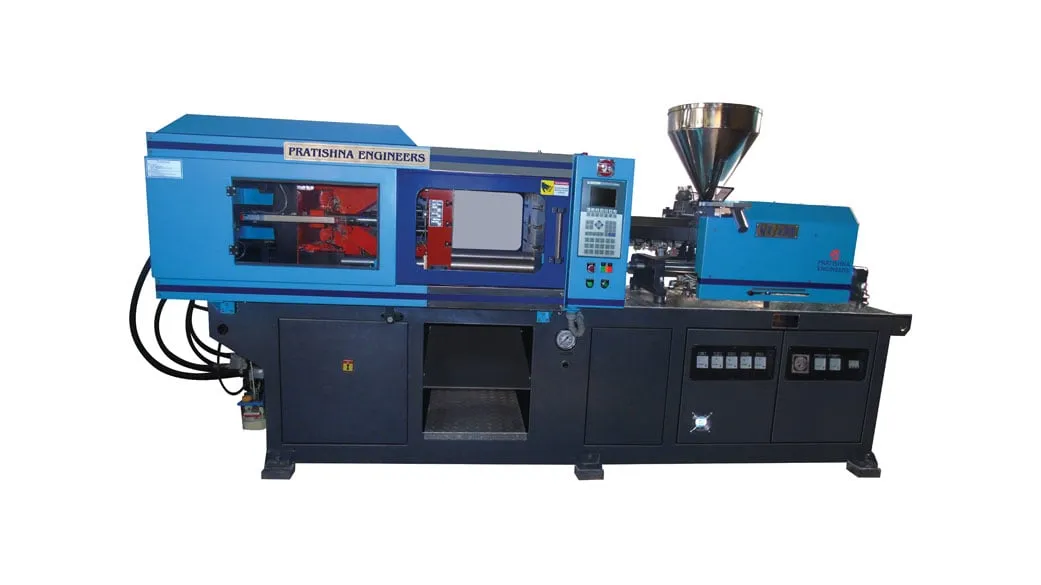

A frame maker runs a two-cavity temple mould in polycarbonate on a press bought for bucket lids. The shot uses a sliver of the barrel, the melt sits too long, and parts come out with yellow streaks and splay near the gate. That is the usual way an injection moulding machine for eyewear frames gets chosen badly: tonnage gets the attention, while shot size, drying and control resolution decide the reject rate. Temples, fronts, nose pads and hinge covers are small, cosmetic parts in engineering resins. The machine has to suit them, not the biggest mould you might buy one day.
Key Takeaways
- Frame parts are small, so the shot should sit between about 20% and 65% of barrel capacity; a big barrel on a small shot degrades the melt.
- Polycarbonate needs drying to 0.020% moisture or less before moulding, so the dryer matters as much as the press for clear, splay-free parts.
- Clamp force for frames is modest because lens openings are cored out of the projected area; most of the decision is about the injection unit.
- Ask for control resolution, a barrel matched to your shot and a trial on your own mould before you compare any machine offer side by side.
What should an injection moulding machine for eyewear frames deliver?
It should deliver a small, repeatable shot with a barrel sized to that shot, fine control of speed and pressure, steady mould temperature and enough clamp for the frame's real projected area. Cosmetic quality on visible faces matters more here than raw tonnage or the fastest dry cycle.
A front frame, a temple and a nose pad have little in common except size. Each is light, each has a face the wearer sees, and each must fit a hinge or lens groove within tight limits. A small drift in shot volume shows up as a short temple tip or flash in a lens groove.
Cosmetic faces add their own demands. Splay, flow lines and gate blush are often traced to moisture, melt temperature or venting rather than to the machine. Even so, a press that holds melt temperature and injection speed steady from shot to shot gives you a window you can actually work in.
Our flat view: for frames, buy the injection unit first and the clamp second. A press with a well-matched barrel and fine control will mould better frames than a larger press with more tonnage and a barrel far too big for the part. If your unit is billed in kVAh by MSEDCL, poor power factor shows up directly in the energy charge, and a lightly loaded oversized press does not help it.
How do you match the shot and barrel to small frame parts?
Work in volume, not grams. Add the cavity and runner volumes, add about 10% for check-valve leakage, then choose a barrel where that shot uses roughly 20% to 65% of capacity. Below that range the melt sits too long; above it, melt uniformity suffers.
Machine shot ratings are usually given in grams of polystyrene, which is why volume is the safer unit. A frame resin with a different density will not fill the same number of grams, so convert the rating to swept volume before you compare offers from different machines.
The lower limit is the one frame makers break most often. Bozzelli, writing in Plastics Technology, notes that shots under about 20% of barrel capacity mean long residence time and degradation. Polycarbonate held too long at melt temperature can yellow and lose toughness, and a hinge boss is often the first place that shows it.
If you run frames and larger accessories on one machine, a second barrel and screw is worth asking about. Bozzelli also notes that a second barrel ordered with a new machine can be low cost, and a skilled operator can swap one in under 30 minutes.
Shot control matters as much as shot size. A small screw travels further per gram of resin, which makes the transfer position easier to set and repeat on a light part.
Which frame resins are moulded, and what do they ask of the machine?
Polycarbonate and nylon are common choices for moulded frames and accessories. Both need careful drying, melt temperatures near or above 280 °C and heated moulds, so the machine must hold barrel and mould temperatures steady and keep dried resin dry on its way to the throat.
Frame resins and what they ask of the machine (figures from resin datasheets)
| Resin | Drying before moulding | Melt / mould temperature | What it means for the machine |
|---|---|---|---|
| PC, general grade | 121 °C for 4 h, 0.020% moisture max | 282 to 302 °C / 66 to 104 °C | Dryer sized to hourly use; mould temperature unit; datasheet clamp 3 to 5 US tons/in² |
| PA66, impact-modified | Exposed resin dried at 66 °C to 0.04 to 0.20% moisture | 288 to 305 °C / 60 to 100 °C | Hold packing until the gate area freezes; closed transfer from dryer to hopper |
Polycarbonate gives clear or tinted parts with good impact strength, and it punishes moisture. Wet PC shows splay on the face and can lose toughness, so the dryer and the hopper loading route need as much attention as the press.
Nylon is hygroscopic as well, and the datasheet for one impact-modified PA66 asks you to hold packing until the gate area has frozen. That favours a machine whose hold pressure and time you can set finely and repeat, shot after shot.
Nylon generally shrinks more than polycarbonate, so a lens groove or hinge seat cut for one resin will not suit the other without mould changes. Settle the resin before the mould is cut, and before you fix the machine.
Mould temperature also drives gloss. Both resins run in heated moulds, so plan a temperature control unit with enough capacity for the mould and confirm the machine can interlock with it.
What should you send before choosing a machine for frames?
Send part drawings or samples, the resin grade, the cavity count you plan, the yearly volume and the cosmetic standard for visible faces. Ask each supplier to state your shot as a share of barrel capacity and to run a trial on your mould. See the optical industry page for related applications.
Frequently Asked Questions About Moulding Eyewear Frames
Can a general-purpose machine mould eyewear frames?
Yes, if its barrel suits the shot and its controls are fine enough. Problems start when a large barrel feeds a small frame shot, because the melt sits too long. Check shot volume as a share of barrel capacity, drying arrangements and mould temperature control before you reuse a machine bought for bigger parts.
Why do polycarbonate frames show silver streaks near the gate?
Silver streaks, or splay, usually point to moisture in the resin. One general-purpose PC datasheet asks for drying at 121 °C for 4 hours to 0.020% moisture or less. Check dryer dew point, drying time and how resin travels to the hopper before you change machine settings.
How much clamp force do frame moulds need?
Usually less than buyers expect, because lens openings are cored out and do not count toward projected area. Multiply the remaining area of all cavities and the cold runner by the resin tonnage factor, then add a reserve. Moulding with far too much clamp can crush vents and damage mould inserts.
Is a vertical machine better for nose pads with metal inserts?
A vertical machine helps when you place metal inserts by hand, because gravity holds them in the lower mould half. For plain plastic temples and fronts, a horizontal machine with a gravity drop or picker usually suits better. Decide by the part and the loading method, not by habit.
How do I check shot consistency during a machine trial?
Weigh a run of consecutive shots on a scale that reads to 0.01 g and look at the spread, not only the average. Watch the cushion position too. A steady cushion and a tight weight spread show the injection unit is holding volume, which is what frame dimensions depend on.
Related Articles
- The Role of Vertical Injection Moulding Machines in Footwear Manufacturing
- Industrial Injection Moulding Machines in Mumbai
- The Role of Toggle Moulding Machines in High-Precision Manufacturing
- Plastic Injection Molding Machine: Enhancing Efficiency and Precision in Manufacturing
Sources & References
- Plastics Technology, J. Bozzelli: A Simpler Way to Calculate Shot Size vs. Barrel Capacity
- Bayer MaterialScience (now Covestro) via IDES: Makrolon 2558 datasheet
- BASF via Material Data Center (M-Base): Ultramid A3L HP datasheet
- MSEDCL: kVAh Billing: Frequently Asked Questions
Technical Disclaimer
Disclaimer: The information provided in this document is for general informational and educational purposes only. It is based on technical references and industry information available at the time of preparation and may be subject to change. It does not constitute engineering, technical, commercial or professional advice, nor does it constitute a quotation, specification, warranty or contractual commitment by Pratishna Engineers.
Actual injection moulding machine and process requirements vary according to the component design, material, mould, production volume, machine configuration and operating conditions. The information, examples, calculations and recommendations provided should be independently evaluated and verified for the specific application before making any equipment, process or production decision. Information obtained from third-party sources remains subject to the accuracy and limitations of those sources.
Limitation of Liability: Pratishna Engineers makes no representation or warranty, express or implied, regarding the completeness, accuracy or suitability of the information for any particular application. To the extent permitted by applicable law, Pratishna Engineers shall not be liable for any loss, damage, cost or consequence arising from reliance on or use of the information contained in this document. Final machine selection, configuration and application suitability should be confirmed with Pratishna Engineers based on complete and accurate project requirements.

