






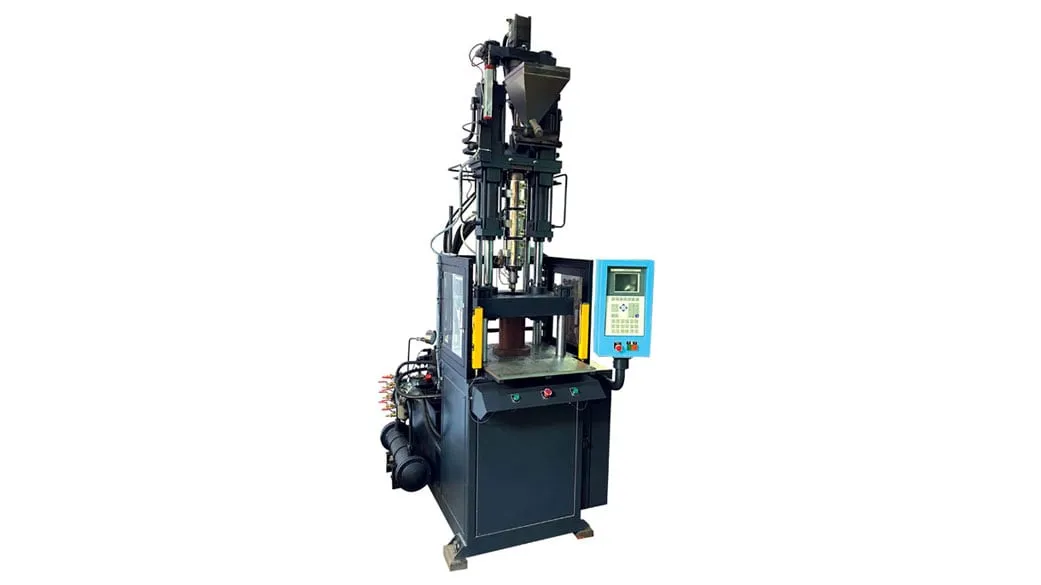

A moulding machine for medical components needs three things beyond a normal press: repeatable shots on small parts, clean handling from mould to bag, and records that trace every lot back to its settings and resin. In India, the device class under the Medical Devices Rules, 2017 tells you how deep your customer's audits will go. Hubs, connectors and housings for disposables are small, so a modest clamp often does the job; the effort goes into process control, drying, part handling and documentation. Start from the device, its class and its material, then size the machine around them.
Key Takeaways
- Small medical parts rarely test the clamp; shot repeatability, resin drying and part handling decide whether a lot passes your customer's incoming inspection.
- The Medical Devices Rules, 2017 have been in force since 1 January 2018, and the device class shapes the quality records your customer will ask for.
- Published hub materials include ABS, acrylic, PC, PE, PP, polysulfone and PU; each has its own drying, melt and mould temperature window to hold.
- Traceability means linking each lot to resin batch, machine, mould, cavity and settings, so choose controls that record and export those values.
Which device classes apply to moulded medical parts in India?
Device class depends on the finished device, not the part alone. Under the CDSCO draft risk list annexed to its June 2017 notice, single lumen hypodermic needles, disposable syringes and IV cannulae were placed in Class B and scalp vein sets in Class C.
The same notice records that disposable hypodermic syringes and needles, perfusion sets, catheters, IV cannulae and scalp vein sets were already notified devices under the Drugs and Cosmetics Act. If you mould a hub or a connector for one of these, you work inside your customer's regulated quality system.
That changes what the buyer audits. Expect questions on how you control resin lots, mould changes, process changes, cleaning and rejected parts, and on whether your machine settings can be shown for any given lot. A draft list is not the final word, so confirm the current class with your customer.
Product standards add their own tests. ISO 7864:2016 for sterile single-use hypodermic needles has clauses on the needle hub, hub colour and the bond between hub and needle tube, with an informative bonding strength test method in its annex.
Draft device class and what it means on the moulding floor
| Moulded part for | Draft class (CDSCO 2017 list) | Moulding focus |
|---|---|---|
| Single lumen hypodermic needle | B | Hub dimensions, hub colour, bond to the cannula |
| Disposable hypodermic syringe | B | Dimensional repeatability, clean handling |
| IV cannula | B | Small shots, flash-free parting lines |
| Scalp vein set | C | Lot records and change control agreed with the customer |
What should a moulding machine for medical components control?
It should hold shot weight, melt temperature, injection speed and hold pressure from shot to shot on small parts, and record them. Look for fine control resolution, a barrel sized so the shot is not too small a share of capacity, and alarms that reject shots outside set limits.
Barrel size is the trap on small medical shots. Shots below about 20% of barrel capacity sit in the barrel for a long time, which risks degradation, and heat-sensitive resins show it first as discolouration or brittle parts. If your shot is tiny, ask for a smaller screw rather than a bigger machine.
Drying comes next. Polycarbonate, a common hub material, is dried at about 121 °C for 4 hours to a maximum moisture of 0.020% in one published data sheet. Wet PC can look acceptable and still lose toughness, so a dryer with dew point monitoring belongs with the machine from day one. Size the hopper from resin use per hour and the drying time, not from the machine size.
Clean handling closes the loop. Parts should drop or be picked into covered bins or onto a conveyor, away from oil mist and floor dust, and guarding and drip trays should keep hydraulic oil off the mould area. Our view: on a medical line, spend on dryer control and part handling before extra tonnage.
How do you build traceability into medical moulding?
Give every lot an identity that links the resin batch, dryer settings, machine, mould, cavity number and process settings used. Mark the cavity number on the part where the drawing allows, and keep the process data for each lot so a complaint can be traced back to a shift.
Cavity marking matters because the cavities of one mould do not always fill alike. When one cavity drifts, you can quarantine its parts instead of the whole lot, and the record shows your customer exactly what was held back and why.
Change control is the other half. Record every change to mould, material grade, process window and machine after validation, and agree with your customer which changes need their approval before parts ship. A controller that stores recipes and logs setting changes with time and user makes this far easier to prove.
Assembly can drive part design too. Published tests on needle assembly found plasma-treated PE hubs bonded to 22-gauge cannulae far more strongly than untreated hubs, which is why PE and PP hubs often need surface treatment before adhesive bonding. Moulding the cannula into the hub is possible, but it is slow, costly and must be accurate to avoid leak paths.
What should you share before choosing a machine for medical parts?
Share the part drawing, device type and class, resin grade, cavity count, annual volume and your customer's documentation needs. With those, a supplier can size clamp, screw, dryer, handling and data recording as one cell. See the medical sector solutions page for related applications.
Frequently Asked Questions About Medical Component Moulding
Do medical parts need a cleanroom?
It depends on the device and on your customer's requirements, not on the moulding process itself. Some parts are moulded in controlled areas and others in clean general production with covered handling. Agree the environment, gowning and cleaning rules with your customer at the enquiry stage, because changing them later means revalidation.
Which plastics are common for needle hubs?
Published guidance on needle assembly lists ABS, acrylic, PC, PE, PP, polysulfone and PU as common hub materials. PE and PP need corona or plasma treatment before adhesive bonding. Your final choice also depends on the sterilisation method, the bonding process and the device standard your customer builds to.
Can one machine make both medical and general parts?
It can, but mixing work raises contamination and documentation risk. If you share a machine, clean and purge to a written procedure, keep separate resin and regrind storage, and record each changeover. A dedicated machine for validated medical parts keeps that validation from being reopened by unrelated jobs.
Is regrind allowed in medical parts?
That is your customer's decision, and it should be written into the part specification. If regrind is not allowed, plan the runner around it: a hot runner or a small cold runner cuts waste, and a sprue picker keeps runners out of the part bin so they cannot mix with good parts.
What process records should a medical moulder keep?
Keep resin lot numbers, dryer temperature and time, machine and mould numbers, cavity identity, the validated process settings, alarm history and inspection results for each lot. Store them so any lot can be traced within hours. Your customer's quality agreement sets how long records are kept and in what form.
Related Articles
- Injection Moulding Machine for Caps & Closers
- Injection Moulding Machine for Agriculture & Water Management
- Why PVDL Series Vertical Locking Machines Are Ideal for Medical Equipment Parts
- Vertical Injection Moulding Machines: Innovating Manufacturing
Sources & References
- CDSCO: Notice dated 29 June 2017 with draft risk-class list for medical devices
- UNMS SR: Preview of STN EN ISO 7864:2017, Sterile hypodermic needles for single use
- MD+DI, C. M. Salerni and J. A. Serenson: Light-Cure Adhesives for Needle Assembly (2003)
- Plastics Technology, J. Bozzelli: A Simpler Way to Calculate Shot Size vs. Barrel Capacity
Technical Disclaimer
Disclaimer: The information provided in this document is for general informational and educational purposes only. It is based on technical references and industry information available at the time of preparation and may be subject to change. It does not constitute engineering, technical, commercial or professional advice, nor does it constitute a quotation, specification, warranty or contractual commitment by Pratishna Engineers.
Actual injection moulding machine and process requirements vary according to the component design, material, mould, production volume, machine configuration and operating conditions. The information, examples, calculations and recommendations provided should be independently evaluated and verified for the specific application before making any equipment, process or production decision. Information obtained from third-party sources remains subject to the accuracy and limitations of those sources.
Limitation of Liability: Pratishna Engineers makes no representation or warranty, express or implied, regarding the completeness, accuracy or suitability of the information for any particular application. To the extent permitted by applicable law, Pratishna Engineers shall not be liable for any loss, damage, cost or consequence arising from reliance on or use of the information contained in this document. Final machine selection, configuration and application suitability should be confirmed with Pratishna Engineers based on complete and accurate project requirements.

